

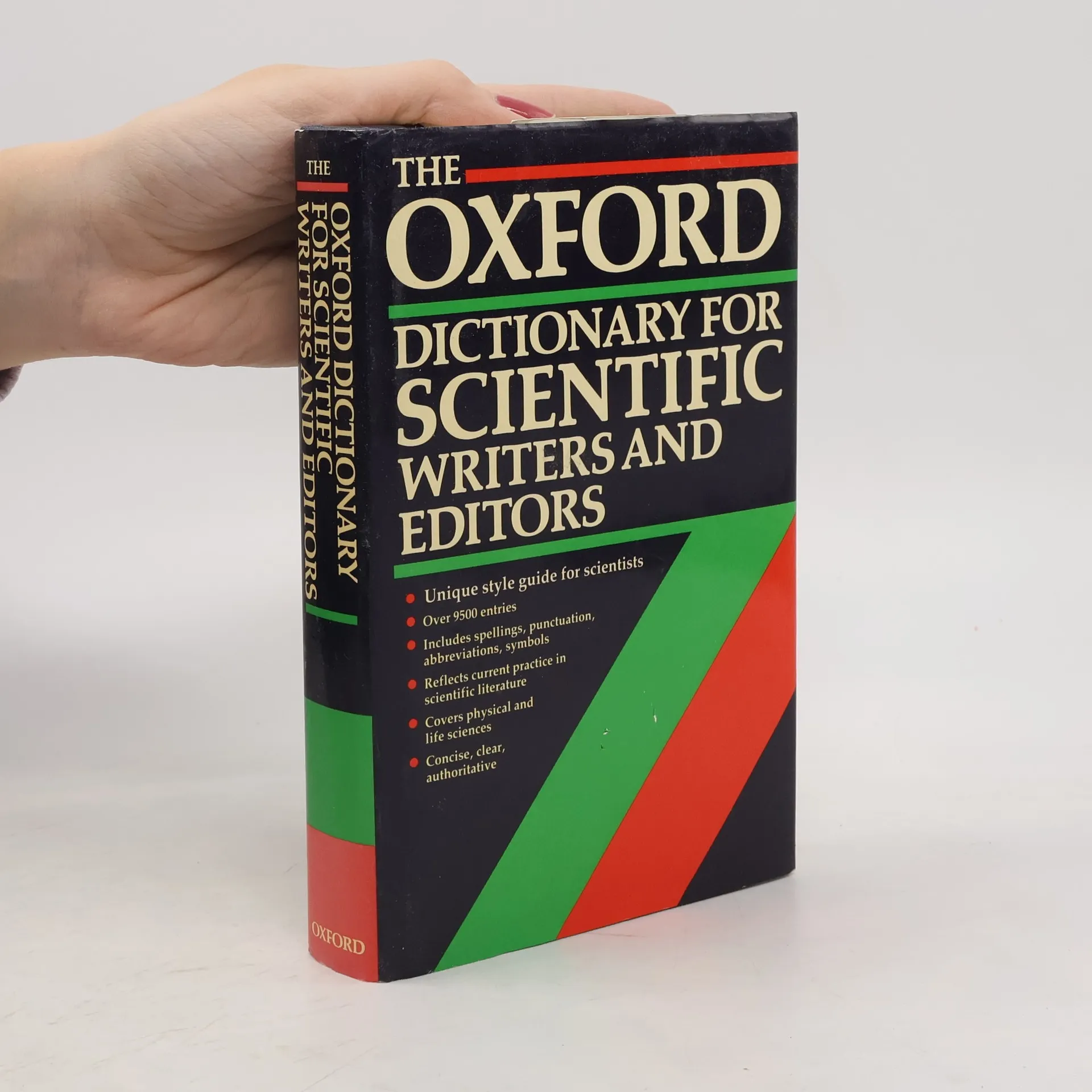


The Oxford Dictionary for Scientific Writers and Editors
Authors
Book rating
More about the book
This dictionary provides scientists, science writers, and all who work in scientific publishing with a clear and concise style guide for the presentation of scientific information. Reflecting widely accepted usage and following the recommendations of such international scientific bodies asIUPAC and IUPAP, the dictionary offers guidance on spelling (UK and US), punctuation, abbreviations, prefixes and suffixes, units and quantities, symbols, biological nomenclature, and the spelling of scientists' names. There are over 9,500 entries covering a wide range of scientific subjectsincluding physics, chemistry, botany, zoology, genetics, biochemistry, immunology, microbiology, astronomy, mathematics, and computer science. The extensive tables at the end of the dictionary cover the electromagnetic spectrum, graphic and letter symbols in electronics, geological timescales,mathematical symbols, the periodic table of the elements, SI units, and the Greek alphabet. It will ensure up-to-date and consistent style for all scientific material intended for publication.
Book purchase
The Oxford Dictionary for Scientific Writers and Editors, Market House Books
- Language

- Released
- 1991
- Binding
- (Hardcover)
Payment methods
We’re missing your review here.
- Title
- The Oxford Dictionary for Scientific Writers and Editors
- Language
- English
- Authors
- Market House Books
- Publisher
- Oxford University Press
- Released
- 1991
- Format
- Hardcover
- Pages
- 389
- ISBN10
- 0198539207
- ISBN13
- 9780198539209
- Series
- Categories
- Rating
- 3 out of 5
- Description
- This dictionary provides scientists, science writers, and all who work in scientific publishing with a clear and concise style guide for the presentation of scientific information. Reflecting widely accepted usage and following the recommendations of such international scientific bodies asIUPAC and IUPAP, the dictionary offers guidance on spelling (UK and US), punctuation, abbreviations, prefixes and suffixes, units and quantities, symbols, biological nomenclature, and the spelling of scientists' names. There are over 9,500 entries covering a wide range of scientific subjectsincluding physics, chemistry, botany, zoology, genetics, biochemistry, immunology, microbiology, astronomy, mathematics, and computer science. The extensive tables at the end of the dictionary cover the electromagnetic spectrum, graphic and letter symbols in electronics, geological timescales,mathematical symbols, the periodic table of the elements, SI units, and the Greek alphabet. It will ensure up-to-date and consistent style for all scientific material intended for publication.