

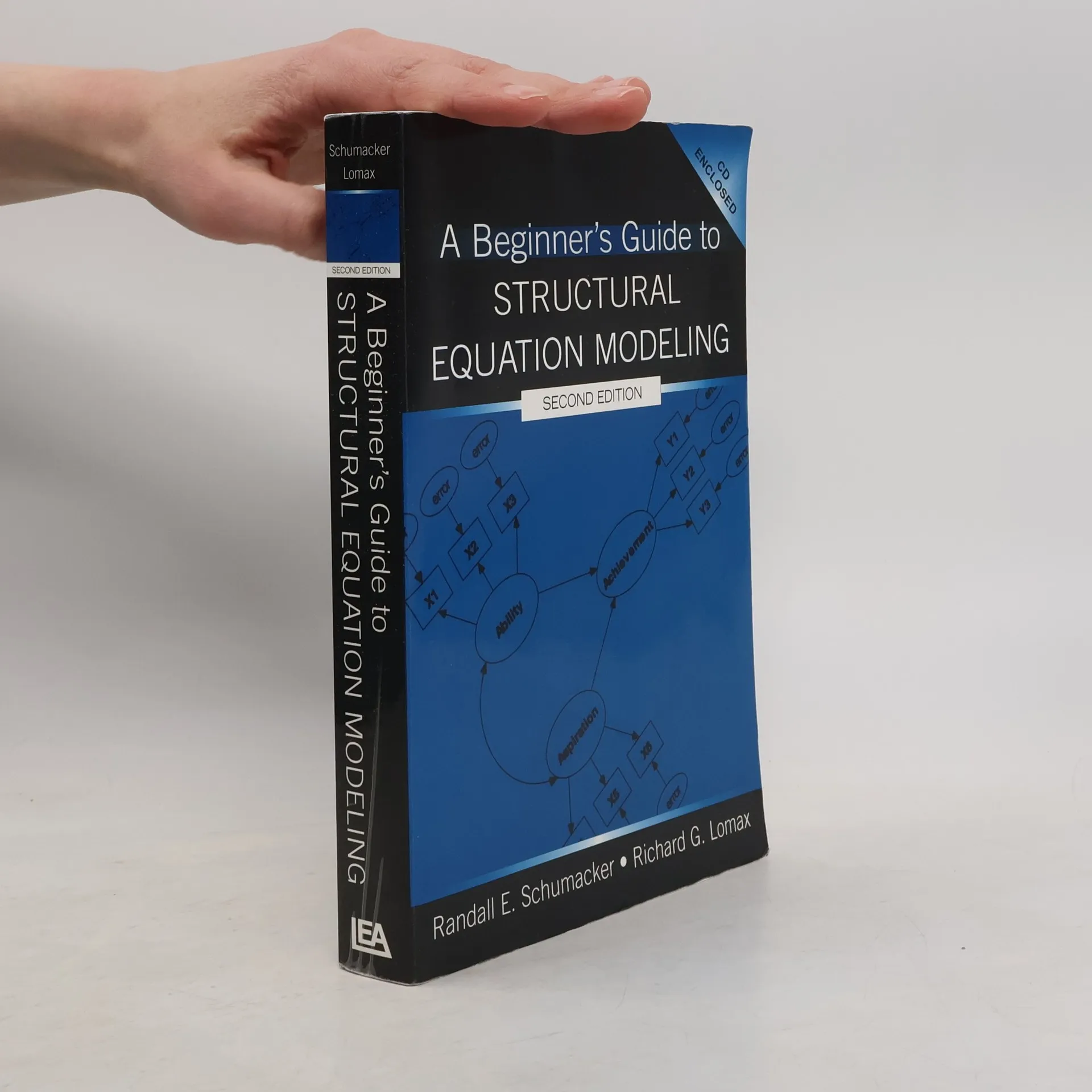
A Beginner's Guide to Structural Equation Modeling
Second Edition
Book rating
More about the book
The second edition features:a CD with all of the book's Amos, EQS, and LISREL programs and data sets; new chapters on importing data issues related to data editing and on how to report research; an updated introduction to matrix notation and programs that illustrate how to compute these calculations; many more computer program examples and chapter exercises; and increased coverage of factors that affect correlation, the 4-step approach to SEM and hypothesis testing, significance, power, and sample size issues.The new edition's expanded use of applications make this book ideal for advanced students and researchers in psychology, education, business, health care, political science, sociology, and biology. A basic understanding of correlation is assumed and an understanding of the matrices used in SEM models is encouraged.
Book purchase
A Beginner's Guide to Structural Equation Modeling, Randall E. Schumacker, Richard G. Lomax
- Language

- Released
- 2004
- Binding
- (Paperback)
Payment methods
We’re missing your review here.
- Title
- A Beginner's Guide to Structural Equation Modeling
- Subtitle
- Second Edition
- Language
- English
- Publisher
- Psychology Press
- Released
- 2004
- Format
- Paperback
- Pages
- 498
- ISBN10
- 0805840184
- ISBN13
- 9780805840186
- Series
- Rating
- 3.4 out of 5
- Description
- The second edition features:a CD with all of the book's Amos, EQS, and LISREL programs and data sets; new chapters on importing data issues related to data editing and on how to report research; an updated introduction to matrix notation and programs that illustrate how to compute these calculations; many more computer program examples and chapter exercises; and increased coverage of factors that affect correlation, the 4-step approach to SEM and hypothesis testing, significance, power, and sample size issues.The new edition's expanded use of applications make this book ideal for advanced students and researchers in psychology, education, business, health care, political science, sociology, and biology. A basic understanding of correlation is assumed and an understanding of the matrices used in SEM models is encouraged.