

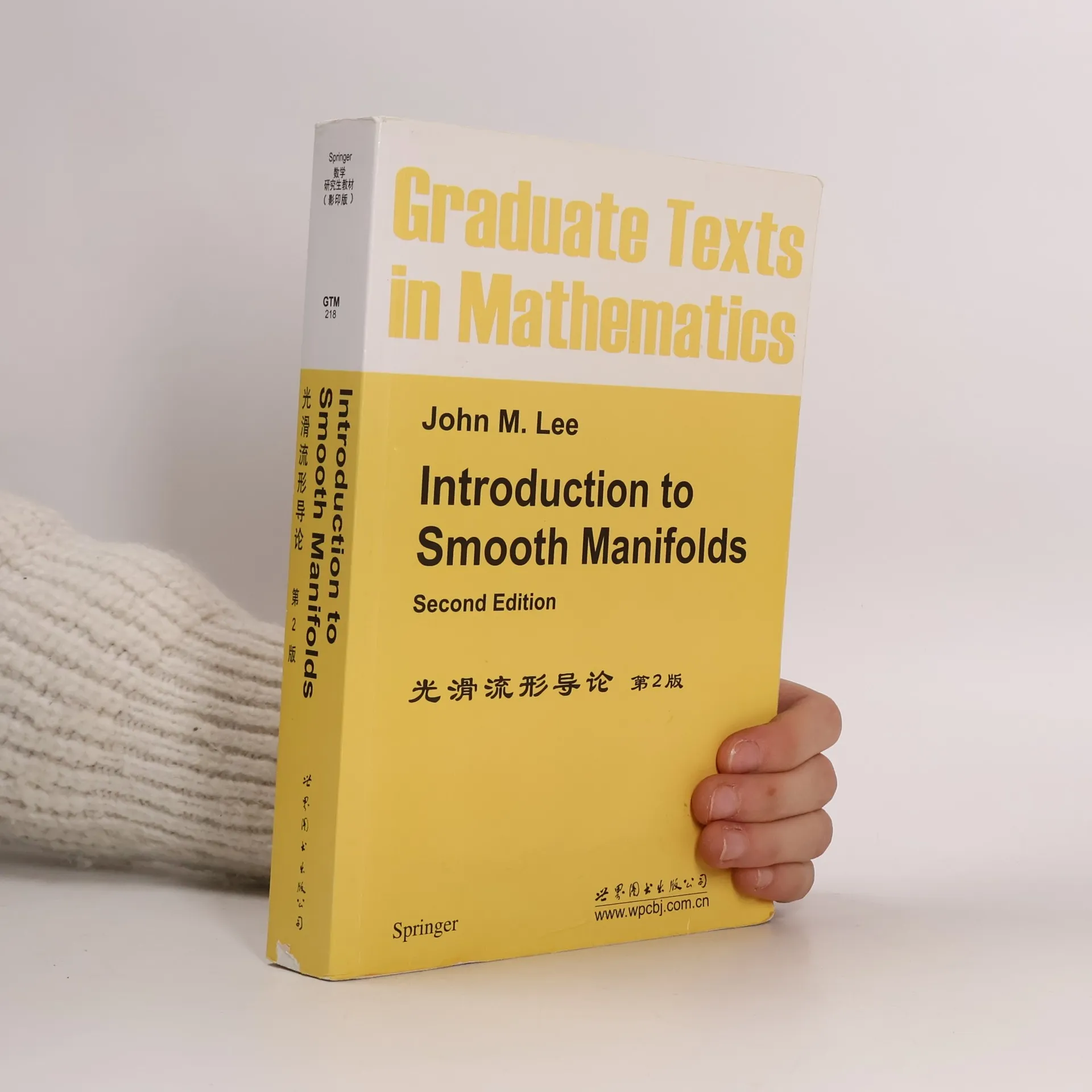
Smooth Manifold Introduction - 2nd Edition
Authors
More about the book
Pub 2016-05-01 World Book Publishing Company The book is an introductory textbook for graduate students on smooth manifold theory. designed to allow students need to be familiar with the manifold in mathematics and research work tools. such as smooth structure. tangent vectors and residual vector. vector bundles. caught and embedded submanifold on tensor differential forms. de Rham cohomology. vector field. flow. foliation. Lie derivative. Li Qun. Lee algebra. Take full advantage of the powerful tools of modern mathematics provided at the same time. the book uses as specific research methods to select a variety of images and geometric abstractions were intuitive thinking to consider discussions.
Book purchase
Smooth Manifold Introduction - 2nd Edition, John Lee
- Language

- Released
- 2015
- Binding
- (Paperback)
Payment methods
No one has rated yet.
- Title
- Smooth Manifold Introduction - 2nd Edition
- Language
- English
- Authors
- John Lee
- Publisher
- World Book Publishing Company
- Released
- 2015
- Format
- Paperback
- Pages
- 708
- ISBN10
- 7510098831
- ISBN13
- 9787510098833
- Series
- Tags
- Math Textbooks, Research
- Description
- Pub 2016-05-01 World Book Publishing Company The book is an introductory textbook for graduate students on smooth manifold theory. designed to allow students need to be familiar with the manifold in mathematics and research work tools. such as smooth structure. tangent vectors and residual vector. vector bundles. caught and embedded submanifold on tensor differential forms. de Rham cohomology. vector field. flow. foliation. Lie derivative. Li Qun. Lee algebra. Take full advantage of the powerful tools of modern mathematics provided at the same time. the book uses as specific research methods to select a variety of images and geometric abstractions were intuitive thinking to consider discussions.