

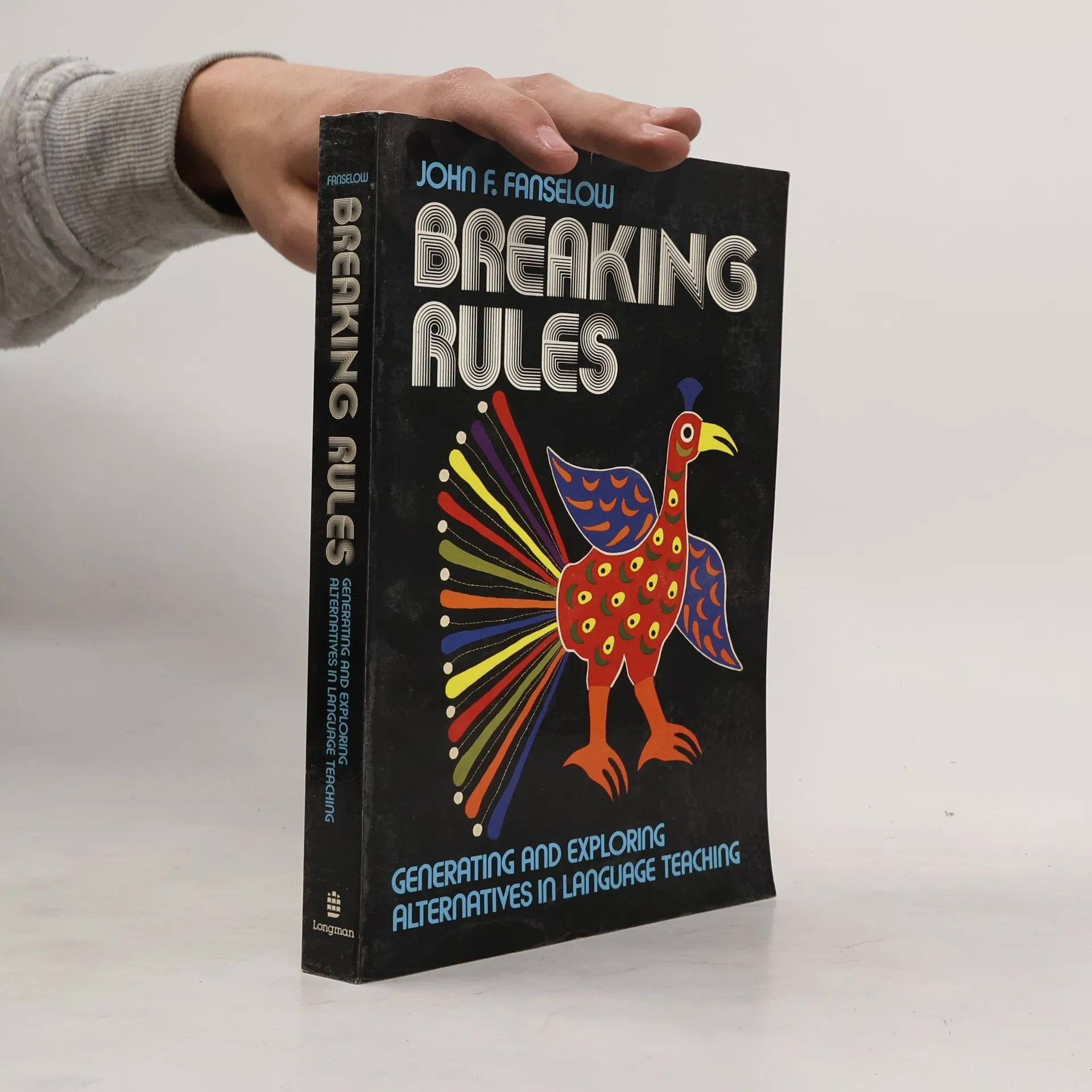
Breaking Rules
Generating and Exploring Alternatives in Language Teaching
Authors
Book rating
More about the book
"In a groundbreaking work, Breaking Rules (1987), John F. Fanselow suggested that one way of developing is to break our own rules and see what happens. If we normally teach one way, in other words, we should try teaching in the opposite way and see what effect it has. If we normally move around the class all the time, perhaps we should see what happens if we spend the whole lesson sitting in the same place. The results may be surprising but will never be less than interesting. . . . We need to have confidence and enthusiasm for investigation and discovery." (Jeremy Harmer, The Practice of English Language Teaching, 4th Edition, 2007, Longman) "As John Fanselow observes in his undeservedly little-known book, Breaking Rules, we tend to operate within a rather narrow range most of the time. The rules of the classroom game are remarkably stable. (9) In this paper, I shall argue that our teaching can benefit from a greater measure of diversity. . . . Yet, despite this rich array of human di
Book purchase
Breaking Rules, John F. Fanselow
- Language

- Released
- 1987
- Binding
- (Paperback)
Payment methods
We’re missing your review here.
- Title
- Breaking Rules
- Subtitle
- Generating and Exploring Alternatives in Language Teaching
- Language
- English
- Authors
- John F. Fanselow
- Publisher
- Pearson P T R
- Released
- 1987
- Format
- Paperback
- Pages
- 487
- ISBN10
- 0582797330
- ISBN13
- 9780582797338
- Series
- Rating
- 4.8 out of 5
- Description
- "In a groundbreaking work, Breaking Rules (1987), John F. Fanselow suggested that one way of developing is to break our own rules and see what happens. If we normally teach one way, in other words, we should try teaching in the opposite way and see what effect it has. If we normally move around the class all the time, perhaps we should see what happens if we spend the whole lesson sitting in the same place. The results may be surprising but will never be less than interesting. . . . We need to have confidence and enthusiasm for investigation and discovery." (Jeremy Harmer, The Practice of English Language Teaching, 4th Edition, 2007, Longman) "As John Fanselow observes in his undeservedly little-known book, Breaking Rules, we tend to operate within a rather narrow range most of the time. The rules of the classroom game are remarkably stable. (9) In this paper, I shall argue that our teaching can benefit from a greater measure of diversity. . . . Yet, despite this rich array of human di