

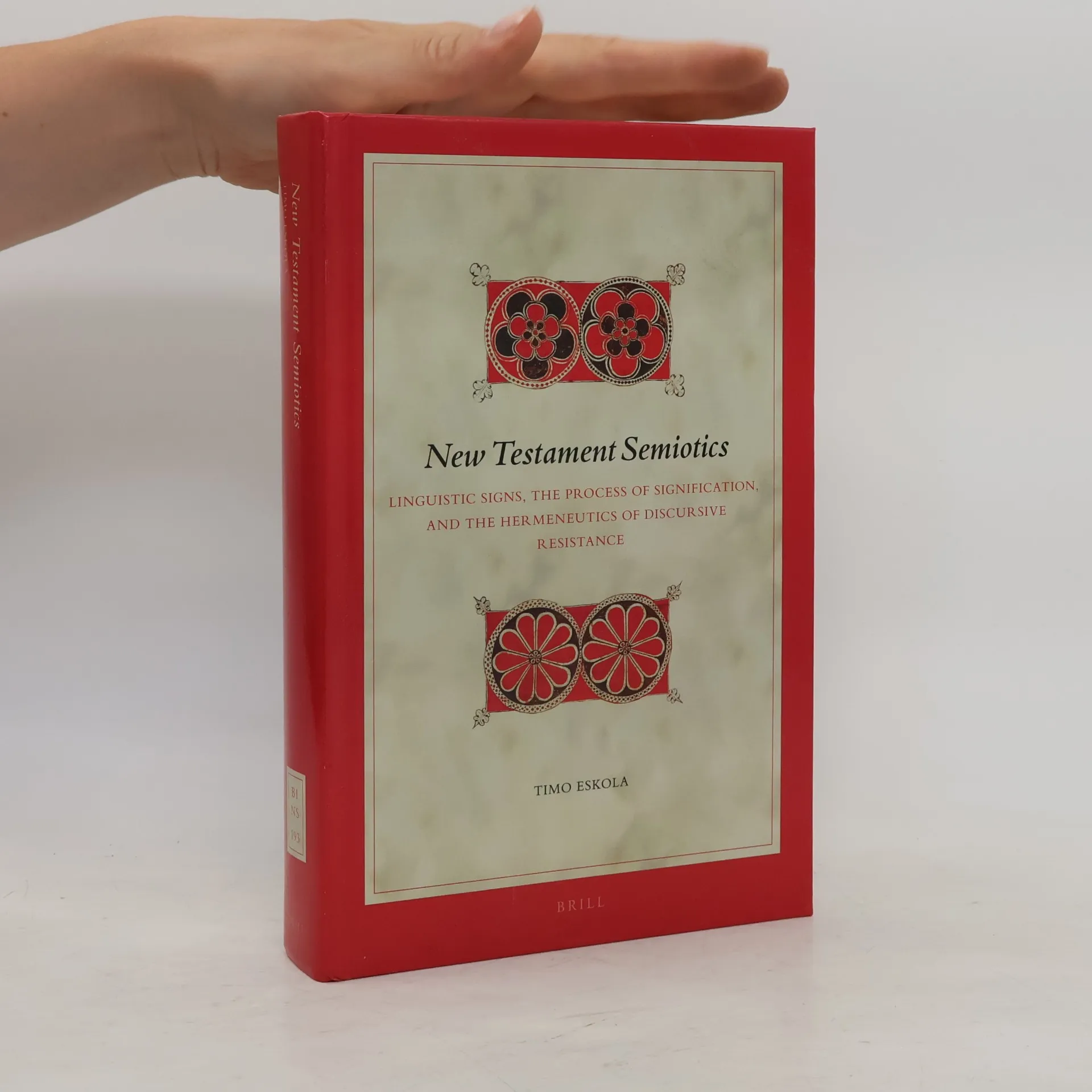


New Testament Semiotics
Linguistic Signs, the Process of Signification, and the Hermeneutics of Discursive Resistance
More about the book
"Focusing on linguistic signs, New Testament Semiotics navigates through different realist and nominalist traditions. From this perspective, Saussure's and Peirce's traditions exhibit similarities. Questioning Derrida's and Eco's semiotics based on their misuse of Peirce's innovations, Dr. Privatdozent Timo Eskola rehabilitates Benveniste and Ricoeur. A sign is about conditions and functions. Sign as a role is a manifestation of participation. Serving as a sign entails participation in a web of relations, participation in a network of meanings, and adoption of a set of rules. We should focus on sentences and networks, not primitive reference or binary oppositions. Enunciations are postulations producing evanescent meanings. Finally, the study suggests a linguistic approach to metatheology that is based on hermeneutics of discursive resistance"--
Book purchase
New Testament Semiotics, University of Helsinki, Timo Eskola
- Language

- Released
- 2021
- Binding
- (Hardcover)
Payment methods
No one has rated yet.
- Title
- New Testament Semiotics
- Subtitle
- Linguistic Signs, the Process of Signification, and the Hermeneutics of Discursive Resistance
- Language
- English
- Authors
- University of Helsinki, Timo Eskola
- Publisher
- Brill
- Released
- 2021
- Format
- Hardcover
- Pages
- 472
- ISBN10
- 9004465758
- ISBN13
- 9789004465756
- Series
- Categories
- Description
- "Focusing on linguistic signs, New Testament Semiotics navigates through different realist and nominalist traditions. From this perspective, Saussure's and Peirce's traditions exhibit similarities. Questioning Derrida's and Eco's semiotics based on their misuse of Peirce's innovations, Dr. Privatdozent Timo Eskola rehabilitates Benveniste and Ricoeur. A sign is about conditions and functions. Sign as a role is a manifestation of participation. Serving as a sign entails participation in a web of relations, participation in a network of meanings, and adoption of a set of rules. We should focus on sentences and networks, not primitive reference or binary oppositions. Enunciations are postulations producing evanescent meanings. Finally, the study suggests a linguistic approach to metatheology that is based on hermeneutics of discursive resistance"--