

More about the book
The Cambridge History of China is one of the most far-reaching works of international scholarship ever undertaken, exploring the main developments in political, social, economic and intellectual life from the Ch'in empire to the present day. The contributors are specialists from the international community of sinological scholars. Many of the accounts break new ground; all are based on fresh research. The works are written not only with students and scholars but also with the general reader in mind. No knowledge of Chinese is assumed, though for readers of Chinese, proper and other names are identified with their characters in the index. Numerous maps and tables illustrate the text. Volume 3, covers the second great period of unified imperial power, 589–906, when China established herself as the centre of a wider cultural sphere, embracing Japan, Korea and Vietnam. It was an era in which there was a great deal of rapid social and economic change, and in which literature and the arts reached new heights of attainment.
Book purchase
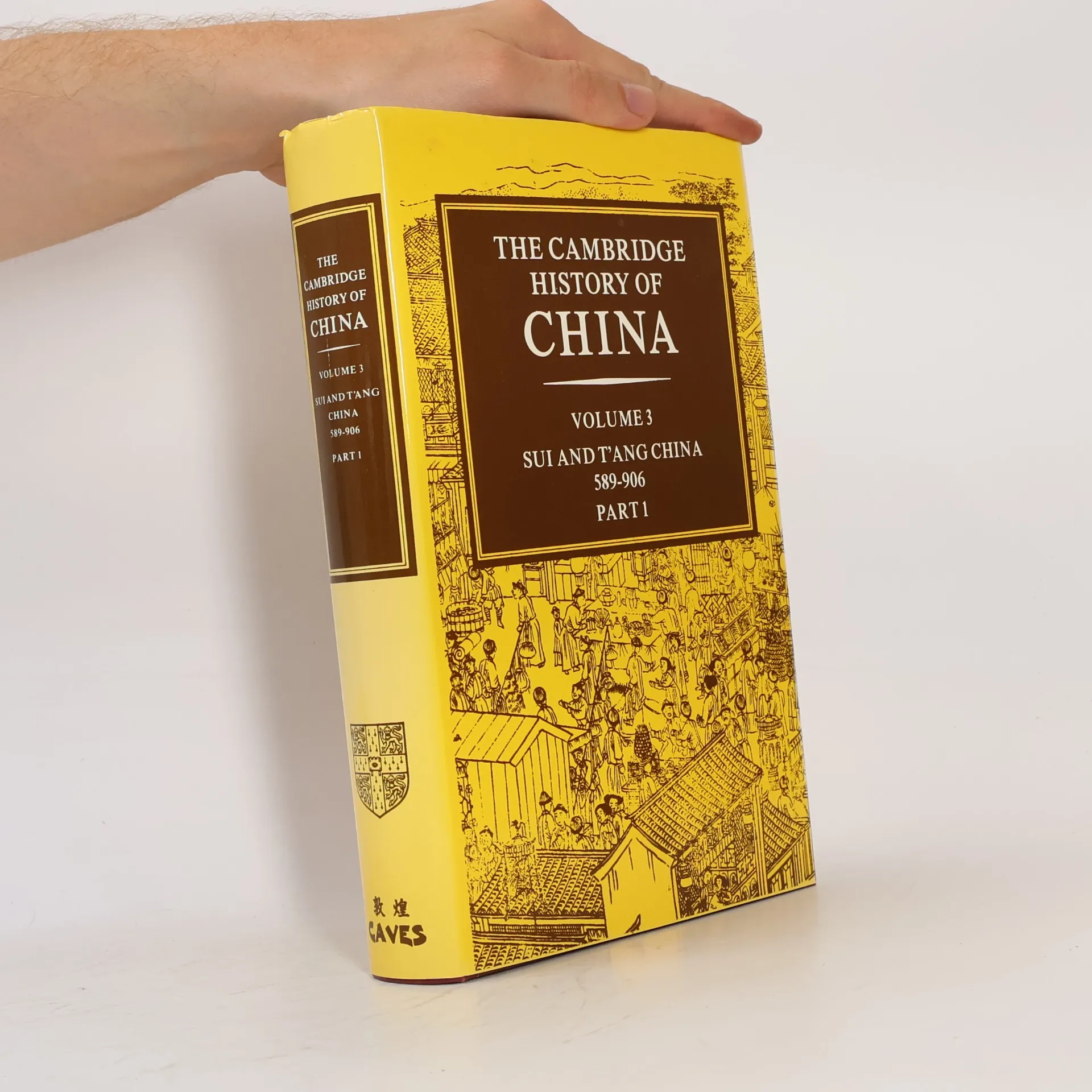
The Cambridge History Of China - 3, Part 1: Sui And T'ang China, Denis Crispin Twitchett, John K. Fairbank
- Language

- Released
- 1989
- Binding
- (Hardcover)
Payment methods
No one has rated yet.
- Title
- The Cambridge History Of China - 3, Part 1: Sui And T'ang China
- Subtitle
- 589-906 AD, Part 1
- Language
- English
- Publisher
- Cambridge University Press
- Released
- 1989
- Format
- Hardcover
- Pages
- 872
- ISBN10
- 0521214467
- ISBN13
- 9780521214469
- Series
- Categories
- Tags
- Historical Themes, Europe, Middle Ages, Asia, China
- Description
- The Cambridge History of China is one of the most far-reaching works of international scholarship ever undertaken, exploring the main developments in political, social, economic and intellectual life from the Ch'in empire to the present day. The contributors are specialists from the international community of sinological scholars. Many of the accounts break new ground; all are based on fresh research. The works are written not only with students and scholars but also with the general reader in mind. No knowledge of Chinese is assumed, though for readers of Chinese, proper and other names are identified with their characters in the index. Numerous maps and tables illustrate the text. Volume 3, covers the second great period of unified imperial power, 589–906, when China established herself as the centre of a wider cultural sphere, embracing Japan, Korea and Vietnam. It was an era in which there was a great deal of rapid social and economic change, and in which literature and the arts reached new heights of attainment.