

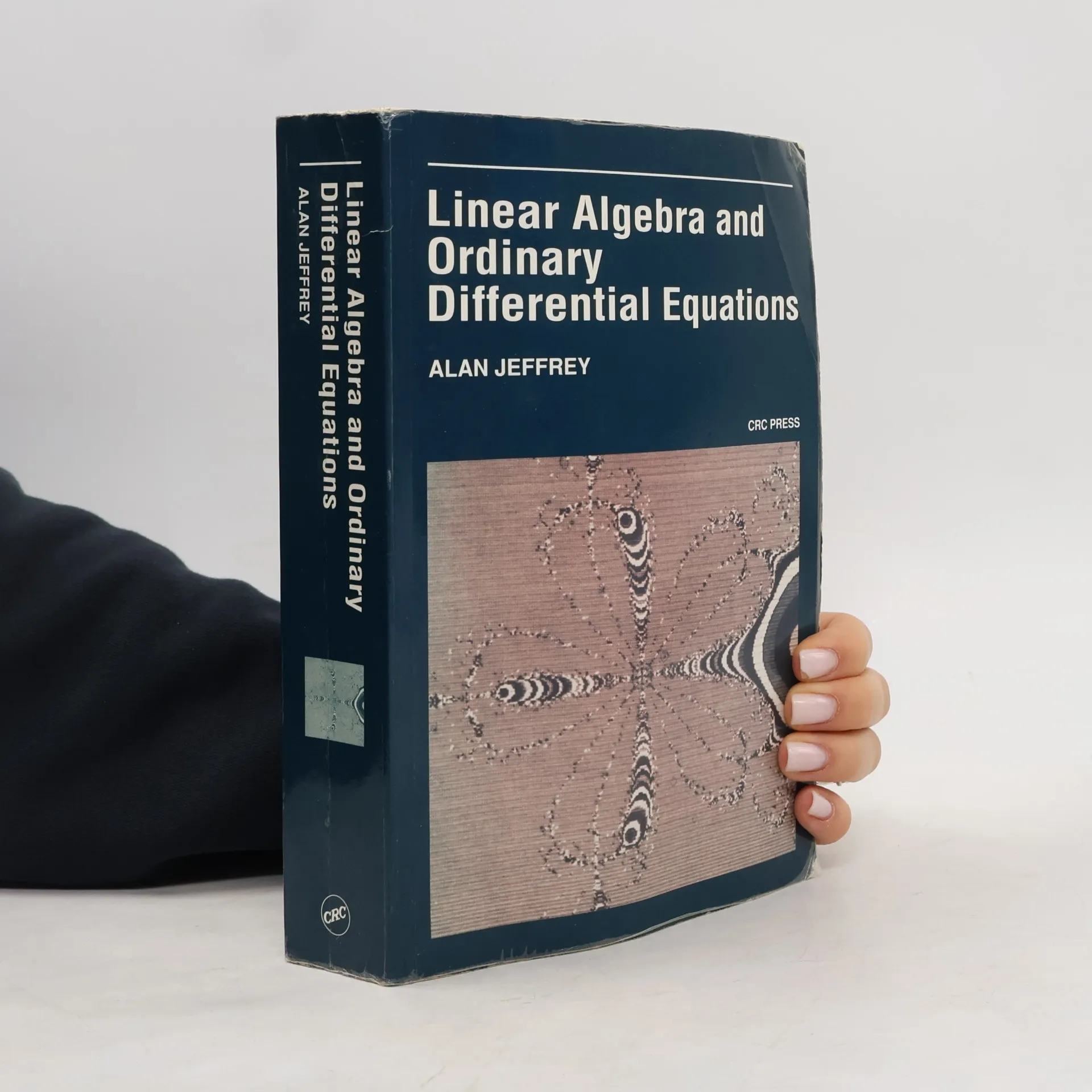
More about the book
This book, written for undergraduate engineering and applied mathematics students, incorporates a broad coverage of essential standard topics in differential equations with material important to the engineering and applied mathematics fields. Because linear differential equations and systems play an essential role in many applications, the book presents linear algebra using a detailed development of matrix algebra, preceded by a short discussion of the algebra of vectors. New ideas are introduced with carefully chosen illustrative examples, which in turn are reinforced by the problem sets at the end of each section. The problem sets are divided into two parts. The first part contains straightforward problems similar to those in the text that are designed to emphasize key concepts and develop manipulative skills. The second part provides a more difficult group of problems that both extend the text and provide a deeper insight into the subject.
Book purchase
Linear Algebra and Ordinary Differential Equations, Alan Jeffrey
- Language

- Released
- 1991
- Binding
- (Paperback)
Payment methods
No one has rated yet.
- Title
- Linear Algebra and Ordinary Differential Equations
- Language
- English
- Authors
- Alan Jeffrey
- Publisher
- CRC Press
- Released
- 1991
- Format
- Paperback
- Pages
- 1136
- ISBN10
- 0865421145
- ISBN13
- 9780865421141
- Series
- Description
- This book, written for undergraduate engineering and applied mathematics students, incorporates a broad coverage of essential standard topics in differential equations with material important to the engineering and applied mathematics fields. Because linear differential equations and systems play an essential role in many applications, the book presents linear algebra using a detailed development of matrix algebra, preceded by a short discussion of the algebra of vectors. New ideas are introduced with carefully chosen illustrative examples, which in turn are reinforced by the problem sets at the end of each section. The problem sets are divided into two parts. The first part contains straightforward problems similar to those in the text that are designed to emphasize key concepts and develop manipulative skills. The second part provides a more difficult group of problems that both extend the text and provide a deeper insight into the subject.