

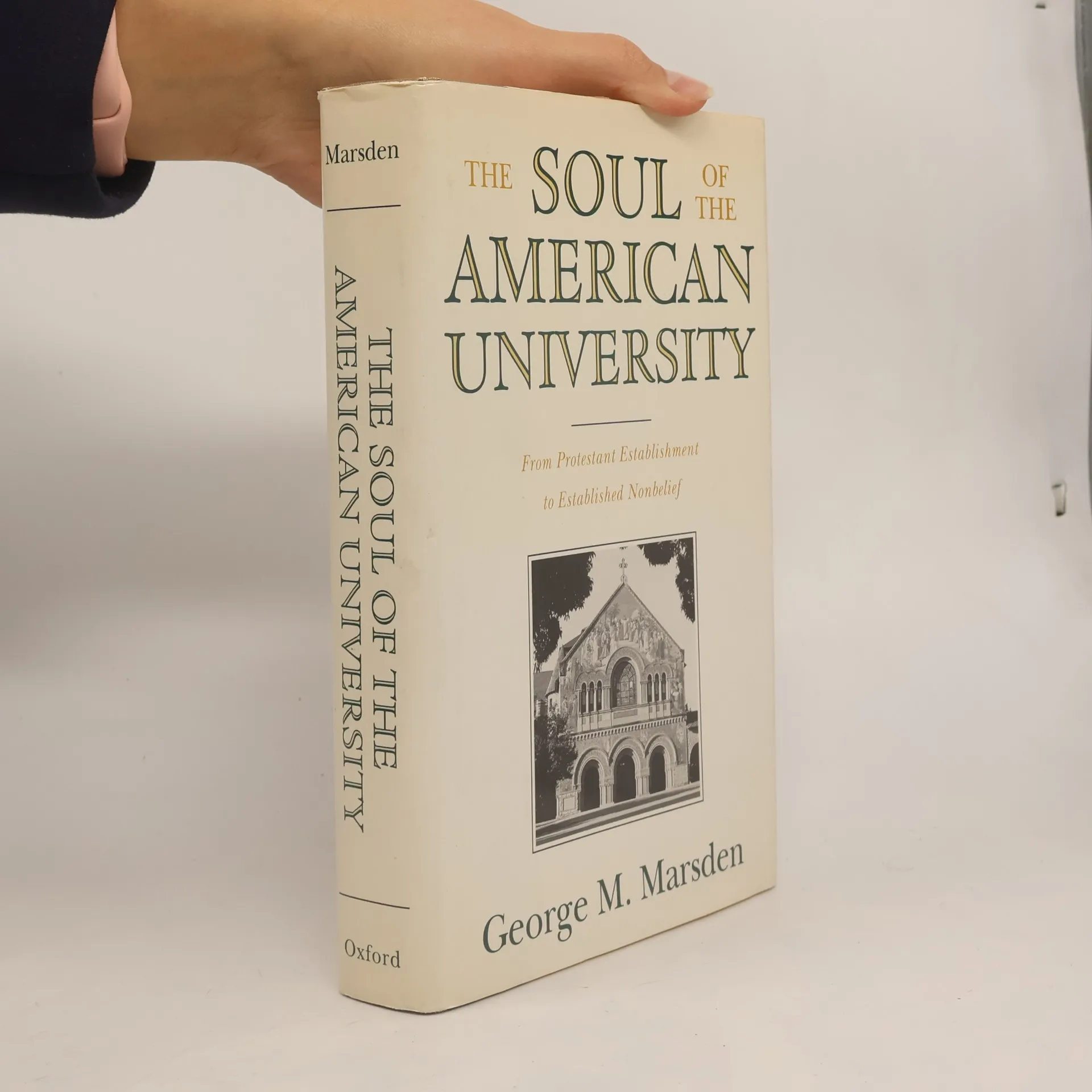


The Soul of the American University
From Protestant Establishment to Established Nonbelief
Authors
Parameters
- 480 pages
- 17 hours of reading
More about the book
Only a century ago, compulsory chapel services and Sunday church attendance were common at state universities, with many institutions identifying as "Christian" until the 1950s. Today, the influence of religion in America's leading colleges has nearly vanished. George Marsden examines the reasons behind these significant changes, offering a critique of the era when mainline Protestants dominated American education. He traces the role of Protestantism from Harvard's founding in the 1630s to the decline of the WASP establishment in the 1960s, highlighting pivotal moments in the histories of universities like Harvard, Yale, and Princeton. Marsden recounts the religious conflicts during Yale's evolution into a university and the debates over religion's place in education, including the clash between Harvard's President Charles Eliot and Princeton's President James McCosh. His analysis covers issues such as Darwinism, government influence, changing student attitudes, and even college football's religious aspects. He argues that the values of "liberalism" and "tolerance" used to marginalize Christian fundamentalism ultimately led to religion's exclusion from academia, establishing nonbelief as the dominant perspective. In a compelling conclusion, Marsden advocates for the inclusion of traditional religious viewpoints alongside feminist and multicultural perspectives, asserting that religious insights can enrich scholarly discourse.
Book purchase
The Soul of the American University, George M. Marsden
- Language

- Released
- 1994
- Binding
- (Hardcover),
- Book condition
- Good
- Price
- €6.09
Payment methods
No one has rated yet.
- Title
- The Soul of the American University
- Subtitle
- From Protestant Establishment to Established Nonbelief
- Language
- English
- Authors
- George M. Marsden
- Publisher
- Oxford University Press
- Released
- 1994
- Format
- Hardcover
- Pages
- 480
- ISBN10
- 0195070461
- ISBN13
- 9780195070460
- Series
- Description
- Only a century ago, compulsory chapel services and Sunday church attendance were common at state universities, with many institutions identifying as "Christian" until the 1950s. Today, the influence of religion in America's leading colleges has nearly vanished. George Marsden examines the reasons behind these significant changes, offering a critique of the era when mainline Protestants dominated American education. He traces the role of Protestantism from Harvard's founding in the 1630s to the decline of the WASP establishment in the 1960s, highlighting pivotal moments in the histories of universities like Harvard, Yale, and Princeton. Marsden recounts the religious conflicts during Yale's evolution into a university and the debates over religion's place in education, including the clash between Harvard's President Charles Eliot and Princeton's President James McCosh. His analysis covers issues such as Darwinism, government influence, changing student attitudes, and even college football's religious aspects. He argues that the values of "liberalism" and "tolerance" used to marginalize Christian fundamentalism ultimately led to religion's exclusion from academia, establishing nonbelief as the dominant perspective. In a compelling conclusion, Marsden advocates for the inclusion of traditional religious viewpoints alongside feminist and multicultural perspectives, asserting that religious insights can enrich scholarly discourse.