




More about the book
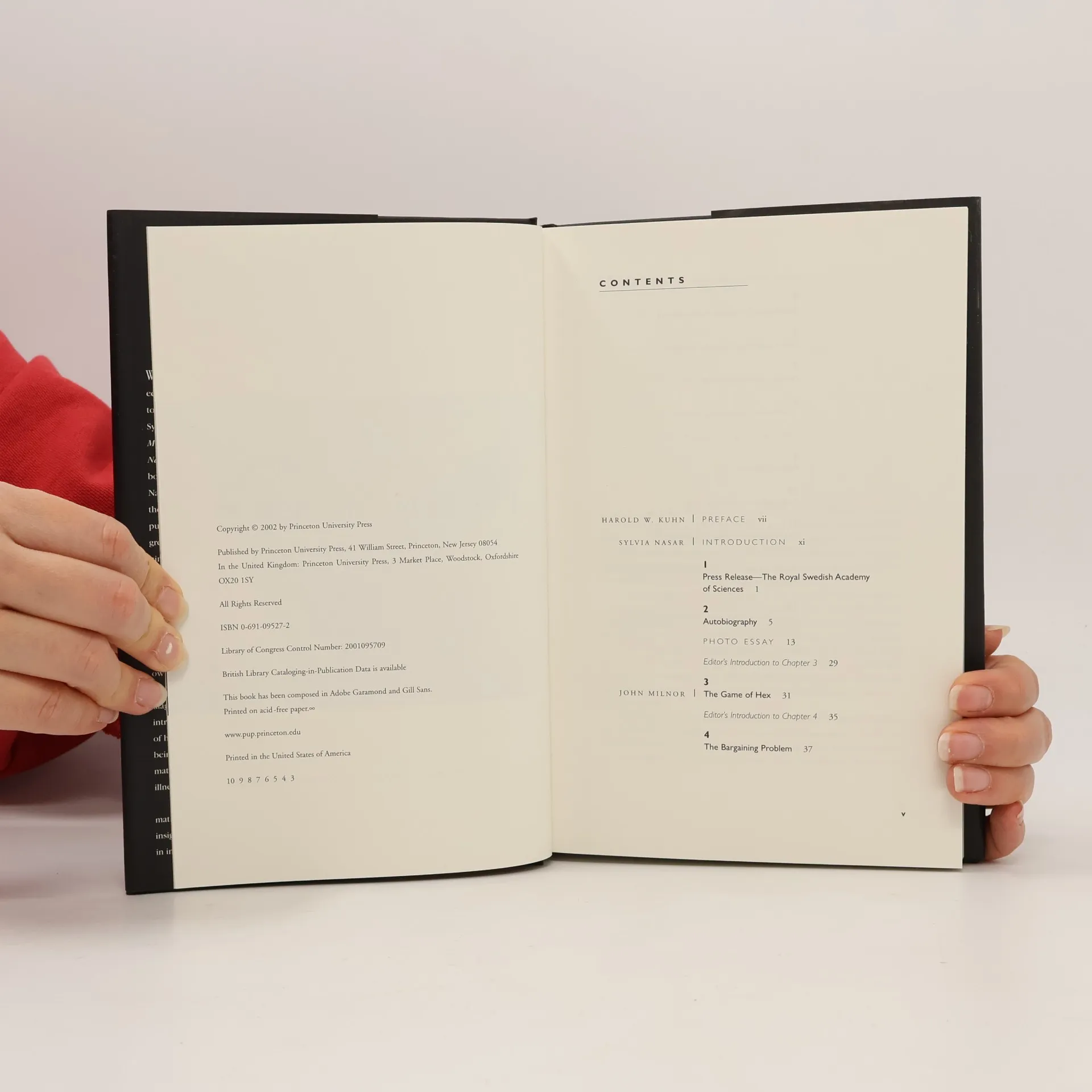
When John Nash won the Nobel prize in economics in 1994, many people were surprised to learn that he was alive and well. Since then, Sylvia Nasar's celebrated biography <i>A Beautiful Mind</i>, the basis of a new major motion picture, has revealed the man. <i>The Essential John Nash</i> reveals his work--in his own words. This book presents, for the first time, the full range of Nash's diverse contributions not only to game theory, for which he received the Nobel, but to pure mathematics--from Riemannian geometry and partial differential equations--in which he commands even greater acclaim among academics. Included are nine of Nash's most influential papers, most of them written over the decade beginning in 1949. From 1959 until his astonishing remission three decades later, the man behind the concepts Nash equilibrium and Nash bargaining--concepts that today pervade not only economics but nuclear strategy and contract talks in major league sports--had lived in the shadow of a condition diagnosed as paranoid schizophrenia. In the introduction to this book, Nasar recounts how Nash had, by the age of thirty, gone from being a wunderkind at Princeton and a rising mathematical star at MIT to the depths of mental illness. In his preface, Harold Kuhn offers personal insights on his longtime friend and colleague; and in introductions to several of Nash's papers, he provides scholarly context. In an afterword, Nash describes his current work, and he discusses an error in one of his papers. A photo essay chronicles Nash's career from his student days in Princeton to the present. Also included are Nash's Nobel citation and autobiography. <i>The Essential John Nash</i> makes it plain why one of Nash's colleagues termed his style of intellectual inquiry as like lightning striking. All those inspired by Nash's dazzling ideas will welcome this unprecedented opportunity to trace these ideas back to the exceptional mind they came from. -- "SIAM News"
Book purchase
The Essential John Nash, Harold William Kuhn, Sylvia Nasar, John F. Nash
- Language

- Released
- 2002
- Binding
- (Hardcover),
- Book condition
- Good
- Price
- €10.49
Payment methods
No one has rated yet.
- Title
- The Essential John Nash
- Language
- English
- Authors
- Harold William Kuhn, Sylvia Nasar, John F. Nash
- Publisher
- Princeton University Press
- Released
- 2002
- Format
- Hardcover
- Pages
- 224
- ISBN10
- 0691095272
- ISBN13
- 9780691095271
- Series
- Categories
- Tags
- Business, Science, USA, Game Theory
- Description
- When John Nash won the Nobel prize in economics in 1994, many people were surprised to learn that he was alive and well. Since then, Sylvia Nasar's celebrated biography <i>A Beautiful Mind</i>, the basis of a new major motion picture, has revealed the man. <i>The Essential John Nash</i> reveals his work--in his own words. This book presents, for the first time, the full range of Nash's diverse contributions not only to game theory, for which he received the Nobel, but to pure mathematics--from Riemannian geometry and partial differential equations--in which he commands even greater acclaim among academics. Included are nine of Nash's most influential papers, most of them written over the decade beginning in 1949. From 1959 until his astonishing remission three decades later, the man behind the concepts Nash equilibrium and Nash bargaining--concepts that today pervade not only economics but nuclear strategy and contract talks in major league sports--had lived in the shadow of a condition diagnosed as paranoid schizophrenia. In the introduction to this book, Nasar recounts how Nash had, by the age of thirty, gone from being a wunderkind at Princeton and a rising mathematical star at MIT to the depths of mental illness. In his preface, Harold Kuhn offers personal insights on his longtime friend and colleague; and in introductions to several of Nash's papers, he provides scholarly context. In an afterword, Nash describes his current work, and he discusses an error in one of his papers. A photo essay chronicles Nash's career from his student days in Princeton to the present. Also included are Nash's Nobel citation and autobiography. <i>The Essential John Nash</i> makes it plain why one of Nash's colleagues termed his style of intellectual inquiry as like lightning striking. All those inspired by Nash's dazzling ideas will welcome this unprecedented opportunity to trace these ideas back to the exceptional mind they came from. -- "SIAM News"