

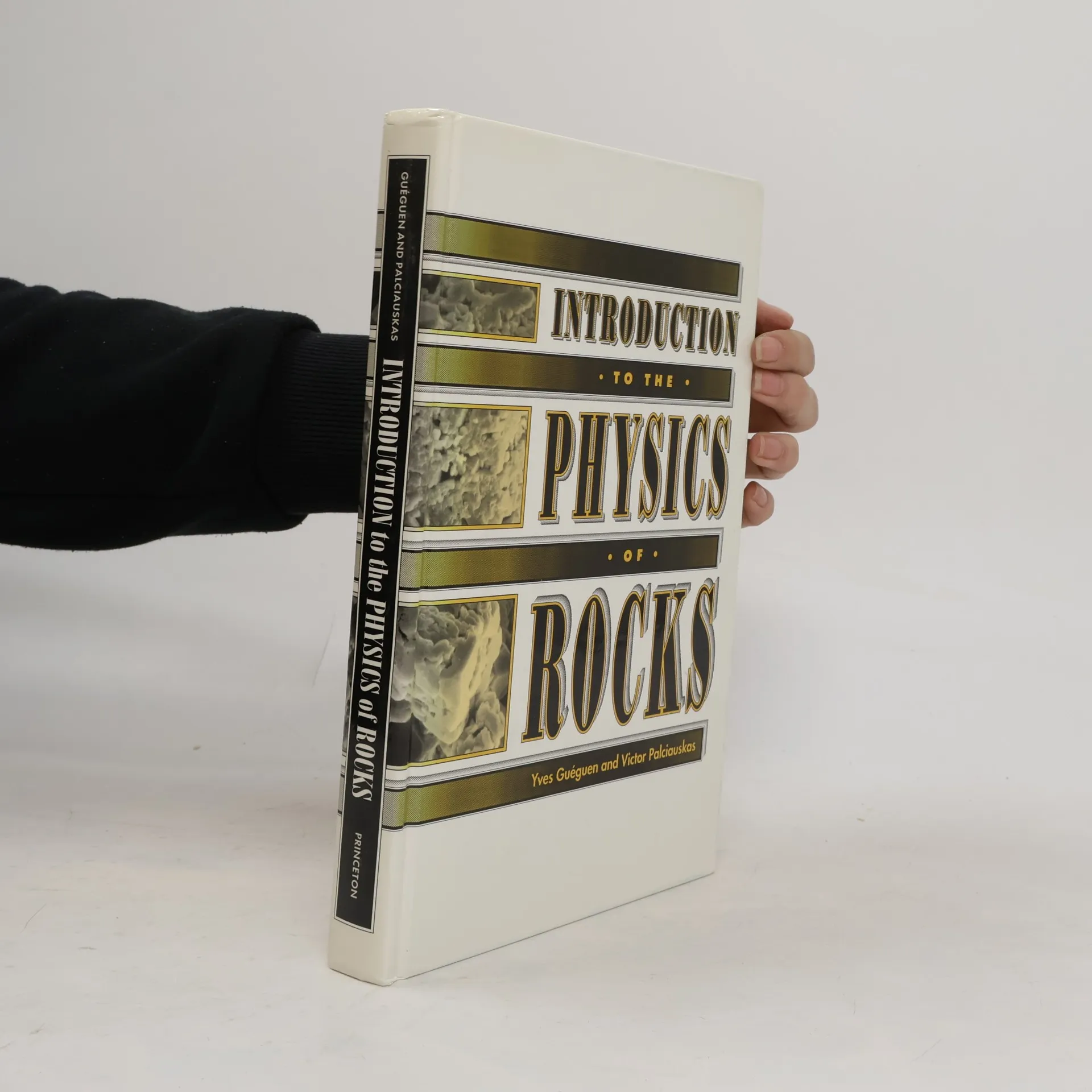


Introduction to the Physics of Rocks
More about the book
Understanding the rocks beneath the earth's surface is crucial for addressing various environmental challenges. This book serves as an essential resource for those assessing radioactive waste sites, exploring energy resources like oil and gas, studying natural hazards such as earthquakes and volcanoes, or analyzing groundwater flow. It uniquely combines comprehensive coverage of rock behavior with accessibility. The authors, Yves Guéguen and Victor Palciauskas, begin by discussing the physical properties of rocks, systematically covering mechanical, fluid flow, acoustical, electrical, dielectric, thermal, and magnetic aspects. They also establish a theoretical framework for obtaining reliable data and making informed inferences about the earth's aggregate system. Key theoretical approaches to the physics of inhomogeneous media are included, such as bounds on properties, effective medium theories, percolation, and fractals. This book is valuable for students and researchers in civil, petroleum, and environmental engineering, as well as geologists, geophysicists, hydrologists, and other earth scientists. Its clear presentation, complete with end-of-chapter problems and selective references, makes it suitable for advanced undergraduate or graduate-level courses.
Book purchase
Introduction to the Physics of Rocks, Jean-Yves Guéguen, Victor Palciauskas
- Language

- Released
- 1994
- Binding
- (Hardcover),
- Book condition
- Good
- Price
- €5.29
Payment methods
No one has rated yet.
- Title
- Introduction to the Physics of Rocks
- Language
- English
- Authors
- Jean-Yves Guéguen, Victor Palciauskas
- Publisher
- Princeton University Press
- Released
- 1994
- Format
- Hardcover
- Pages
- 392
- ISBN10
- 0691034524
- ISBN13
- 9780691034522
- Series
- Categories
- Tags
- Nature, Natural sciences, Science, Geology
- Description
- Understanding the rocks beneath the earth's surface is crucial for addressing various environmental challenges. This book serves as an essential resource for those assessing radioactive waste sites, exploring energy resources like oil and gas, studying natural hazards such as earthquakes and volcanoes, or analyzing groundwater flow. It uniquely combines comprehensive coverage of rock behavior with accessibility. The authors, Yves Guéguen and Victor Palciauskas, begin by discussing the physical properties of rocks, systematically covering mechanical, fluid flow, acoustical, electrical, dielectric, thermal, and magnetic aspects. They also establish a theoretical framework for obtaining reliable data and making informed inferences about the earth's aggregate system. Key theoretical approaches to the physics of inhomogeneous media are included, such as bounds on properties, effective medium theories, percolation, and fractals. This book is valuable for students and researchers in civil, petroleum, and environmental engineering, as well as geologists, geophysicists, hydrologists, and other earth scientists. Its clear presentation, complete with end-of-chapter problems and selective references, makes it suitable for advanced undergraduate or graduate-level courses.