

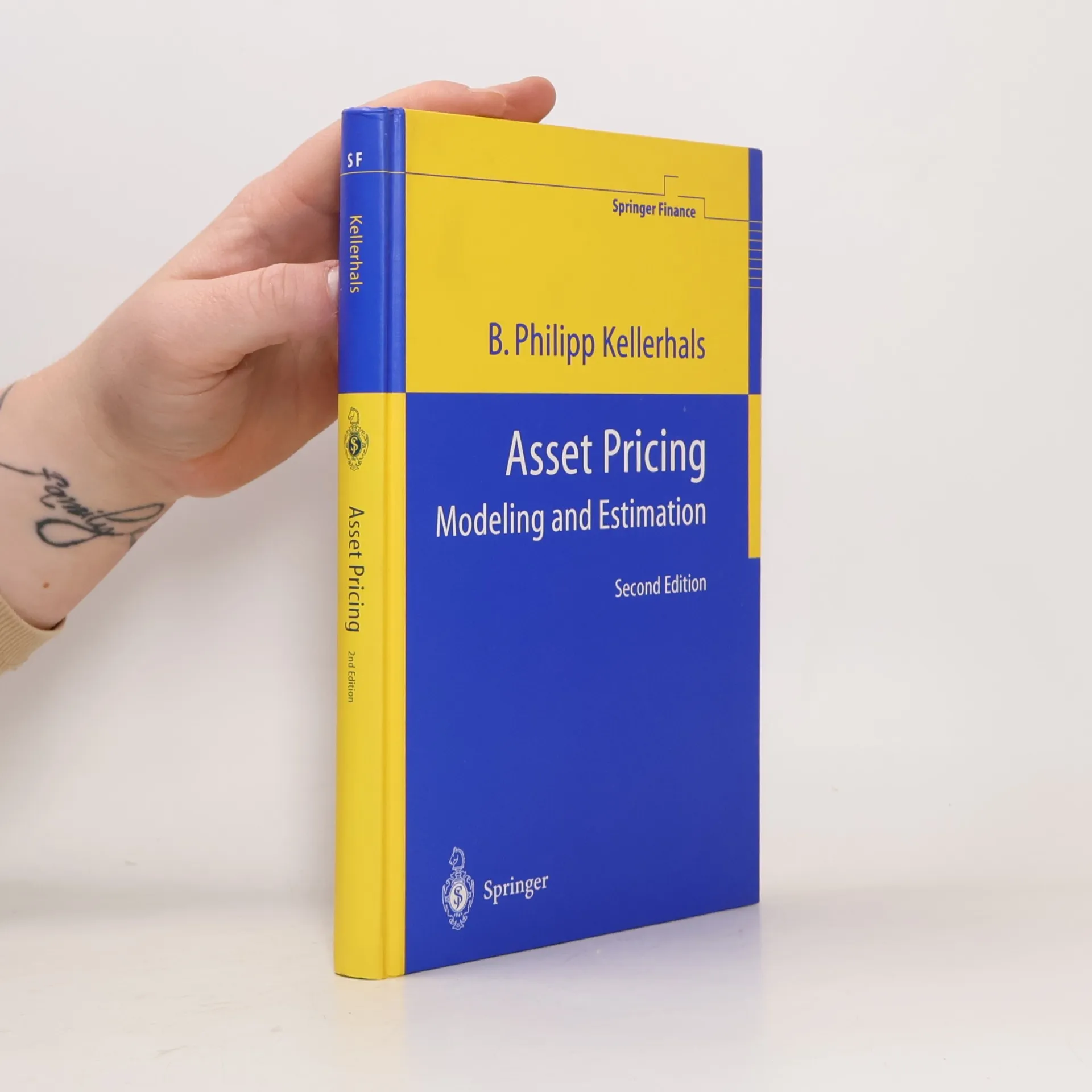


Asset pricing
Modeling and Estimation
Authors
Parameters
- 243 pages
- 9 hours of reading
More about the book
The modern field of asset pricing seeks robust models based on financial economic theory and accurate estimation techniques for empirical analysis. This work aims to provide a framework that connects continuous-time pricing practices in financial engineering with capital market data, which is typically available only at discrete intervals. The focus is on three major financial markets: equity, bond, and electricity. For each market, new valuation models are developed to price selected financial instruments in continuous time. The choice of a continuous-time modeling framework is influenced by the extensive stochastic theory available for continuous processes, particularly Merton's contributions to financial economics. This framework enables the derivation of analytical pricing formulas that are not possible in a discrete time setting. However, when applying these theoretical models to market data sampled at discrete intervals, we utilize exact discrete time equivalents. The work demonstrates how to effectively operate within a state space framework, derived in a general context and specifically tailored for each of the three markets.
Book purchase
Asset pricing, Boris Philipp Kellerhals
- Language

- Released
- 1997
- Binding
- (Hardcover),
- Book condition
- Very Good
- Price
- €40.89
Payment methods
No one has rated yet.
- Title
- Asset pricing
- Subtitle
- Modeling and Estimation
- Language
- English
- Authors
- Boris Philipp Kellerhals
- Publisher
- Springer
- Released
- 1997
- Format
- Hardcover
- Pages
- 243
- ISBN10
- 3540208534
- ISBN13
- 9783540208532
- Series
- Categories
- Tags
- Business, References & Manuals, Legal Topics, USA, Medicine, Professional Literature, Finance, Writing, Western Europe, Industry, Investing, Humanities, Developmental Psychology, Psychological Aspects, Modelling, Game Theory
- Description
- The modern field of asset pricing seeks robust models based on financial economic theory and accurate estimation techniques for empirical analysis. This work aims to provide a framework that connects continuous-time pricing practices in financial engineering with capital market data, which is typically available only at discrete intervals. The focus is on three major financial markets: equity, bond, and electricity. For each market, new valuation models are developed to price selected financial instruments in continuous time. The choice of a continuous-time modeling framework is influenced by the extensive stochastic theory available for continuous processes, particularly Merton's contributions to financial economics. This framework enables the derivation of analytical pricing formulas that are not possible in a discrete time setting. However, when applying these theoretical models to market data sampled at discrete intervals, we utilize exact discrete time equivalents. The work demonstrates how to effectively operate within a state space framework, derived in a general context and specifically tailored for each of the three markets.