

Applied Mathematical Sciences - 19: The Hopf Bifurcation and Its Applications
More about the book
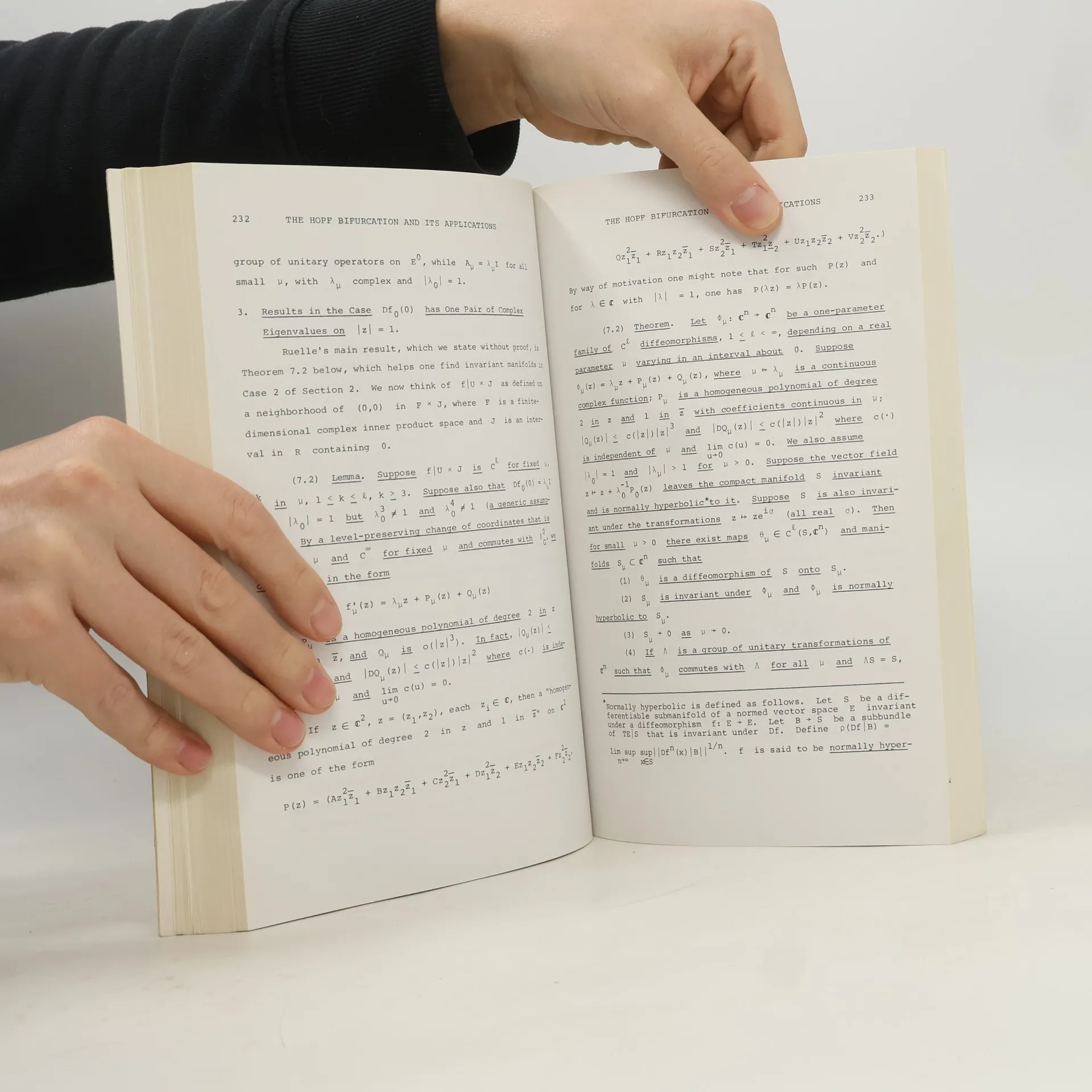
These notes aim to provide a reasonably complete discussion of the Hopf bifurcation, including its applications and stability calculations. The topic originated in Poincare's work around 1892 and was further developed by Andronov, Witt, and others starting in the 1930s. Hopf's significant contribution in 1942 extended the concept from two dimensions to higher dimensions. Although "Poincare-Andronov-Hopf bifurcation" is more precise, the term "Hopf Bifurcation" is more widely used. The primary technique discussed is that of invariant manifolds, following the Ruelle-Takens method, with added details, examples, and proofs. Contributions from P. Chernoff, J. Dorroh, O. Lanford, and F. Weissler are acknowledged for their influence on the exposition. The method of invariant manifolds is prevalent in dynamical systems and ordinary differential equations, as noted in works by Hale and Hartman. To provide a balanced perspective, alternative approaches are also included, such as a translation of Hopf's original paper by L. Howard and N. Kopell, which is typically hard to access.
Book purchase
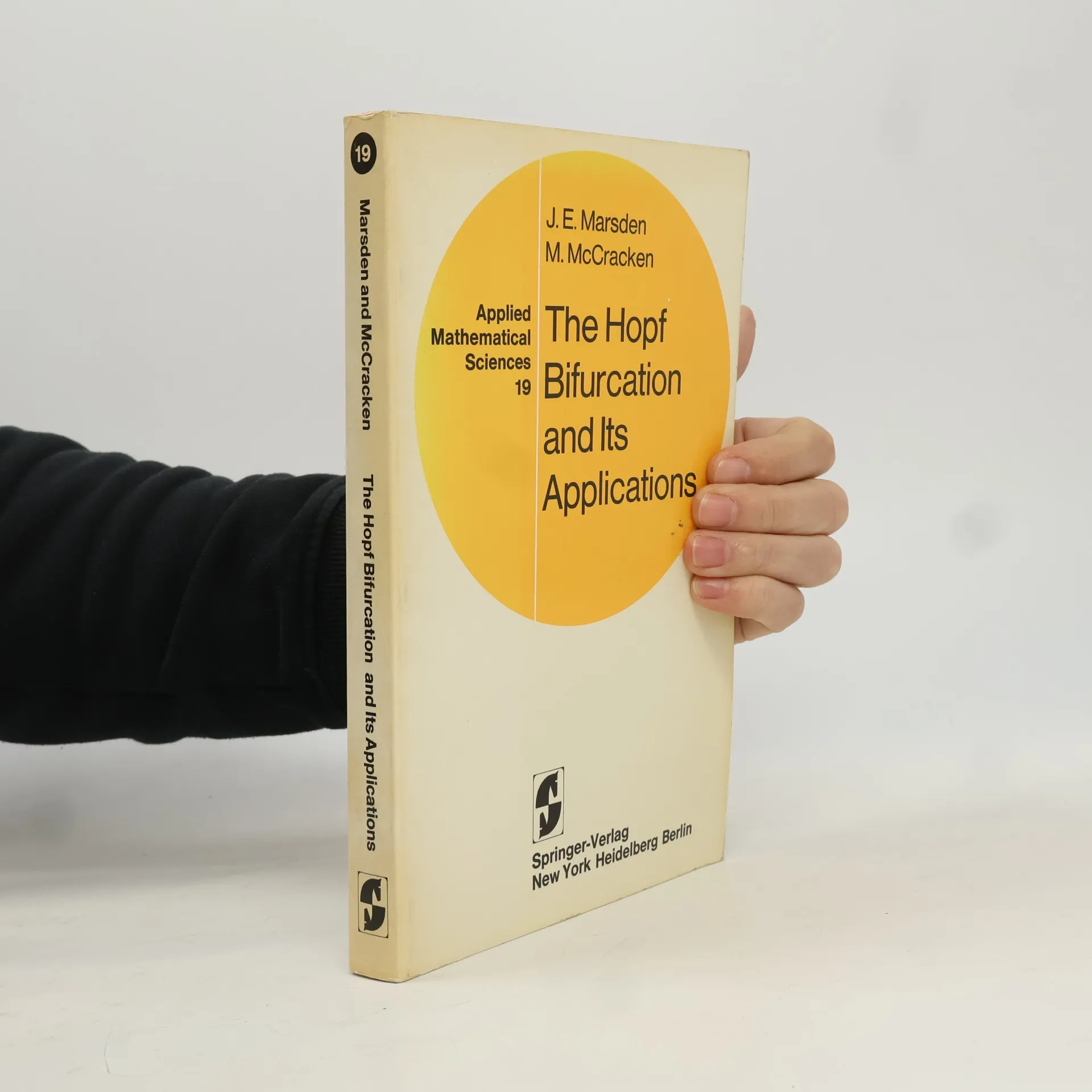
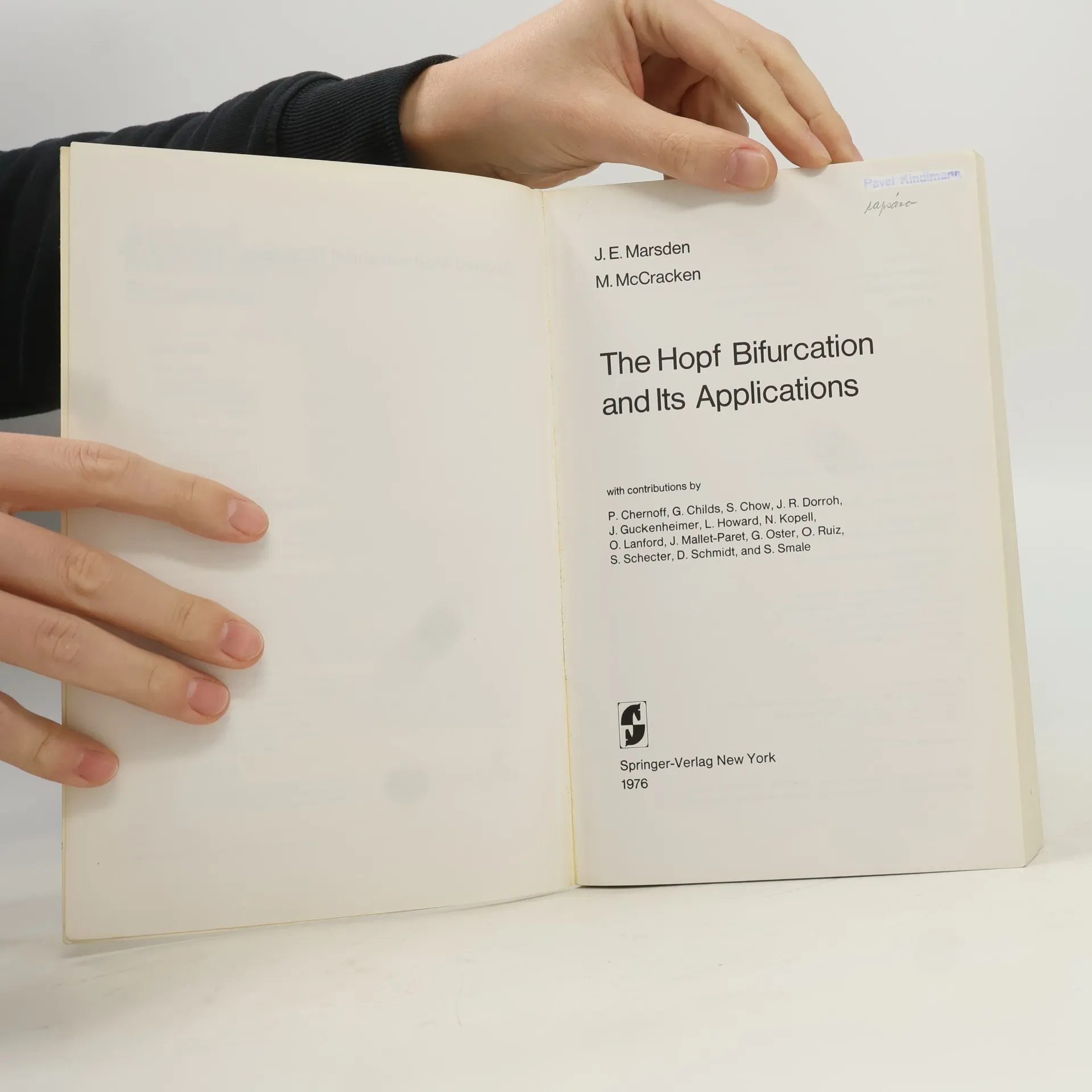
Applied Mathematical Sciences - 19: The Hopf Bifurcation and Its Applications, Jerrold Marsden, Marjorie McCracken
- Language

- Released
- 1976
- Binding
- (Paperback),
- Book condition
- Damaged
- Price
- €13.49
Payment methods
No one has rated yet.
- Title
- Applied Mathematical Sciences - 19: The Hopf Bifurcation and Its Applications
- Language
- English
- Authors
- Jerrold Marsden, Marjorie McCracken
- Publisher
- Springer
- Released
- 1976
- Format
- Paperback
- Pages
- 408
- ISBN10
- 0387902007
- ISBN13
- 9780387902005
- Series
- Categories
- Description
- These notes aim to provide a reasonably complete discussion of the Hopf bifurcation, including its applications and stability calculations. The topic originated in Poincare's work around 1892 and was further developed by Andronov, Witt, and others starting in the 1930s. Hopf's significant contribution in 1942 extended the concept from two dimensions to higher dimensions. Although "Poincare-Andronov-Hopf bifurcation" is more precise, the term "Hopf Bifurcation" is more widely used. The primary technique discussed is that of invariant manifolds, following the Ruelle-Takens method, with added details, examples, and proofs. Contributions from P. Chernoff, J. Dorroh, O. Lanford, and F. Weissler are acknowledged for their influence on the exposition. The method of invariant manifolds is prevalent in dynamical systems and ordinary differential equations, as noted in works by Hale and Hartman. To provide a balanced perspective, alternative approaches are also included, such as a translation of Hopf's original paper by L. Howard and N. Kopell, which is typically hard to access.