


Explore the latest books of this year!
Bookbot

Michio Morishima

    Michio Morishima was an influential Japanese economist, mathematician, and econometrician whose work focused on the mathematical modeling of economic systems. He served as a professor at the London School of Economics, and his research deepened the understanding of economic theory and its connection to mathematics. His contributions lay in developing sophisticated analytical tools for economics. Morishima's works are valued for their depth and rigor.

    Warum Japan so erfolgreich ist
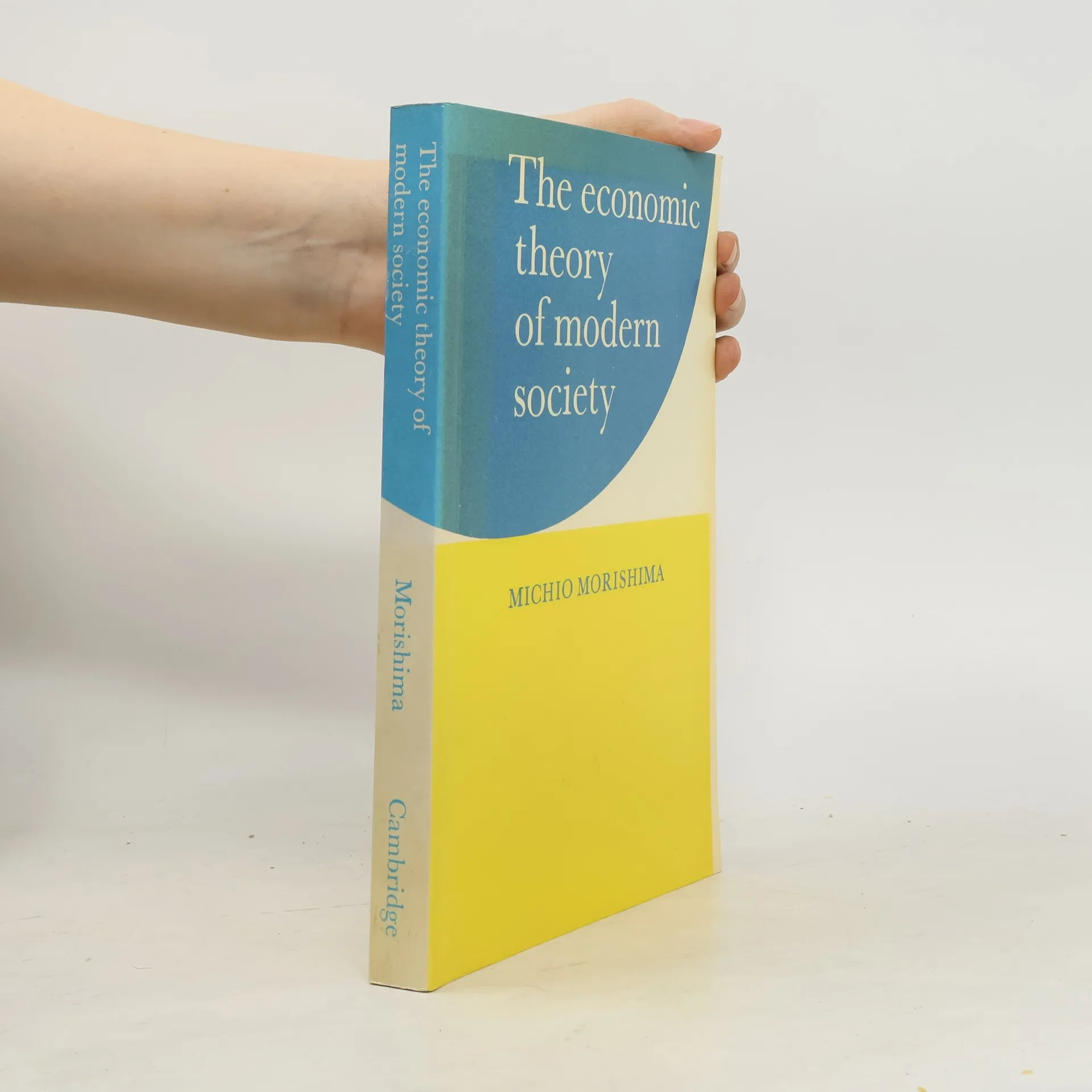
    The Economic Theory of Modern Society
    • The Economic Theory of Modern Society

      • 360 pages
      • 13 hours of reading

      This volume was originally published in 1976. The difference types of society in the world - capitalist, socialist, mixed, etc. - have many features in common, despite their dissimilarities. The object of this book is to make clear the economic logic of society in general, which applies to socialist as well as capitalist economies. Taking the Japanese economy as an example, part of the book tries to explain how an actual economy can deviate from the 'ideal' laws of motion, and shows that such aberrations themselves obey certain rules. In a broad sense, it belongs in the domain of the theory of comparative systems. The book is based on lectures which Professor Morishima gave to students at Osaka University in 1967-1968. It is translated from the Japanese by D. W. Anthony.

      The Economic Theory of Modern Society
    • Warum Japan so erfolgreich ist

      • 228 pages
      • 8 hours of reading

      Als <i>Warum Japan so erfolgreich ist</i> (1982) veröffentlicht wurde, war Japan noch ein Land des "Kapitalismus von oben". In den letzten zehn Jahren hat die Wirtschaft des Landes nachgelassen und ist zurückgegangen. Es wendet sich trotz der schwachen Demokratie Japans dem "Kapitalismus von unten" zu. Dieser Richtungswechsel wird aus verschiedenen Perspektiven untersucht, wobei ein tiefes Wissen über den japanischen Ethos, die nationale Geschichte, den Bildungshintergrund sowie die Soziologie der japanischen Wirtschaft und Geschäftswelt einfließt. Der Autor bietet eine langfristige Prognose für die Zukunft Japans.

      Warum Japan so erfolgreich ist
      5.0