

Explore the latest books of this year!
Bookbot

Yong Shi

    Towards Efficient Fuzzy Information Processing
    Intelligent knowledge
    Advances in Big Data Analytics
    Data mining and knowledge management
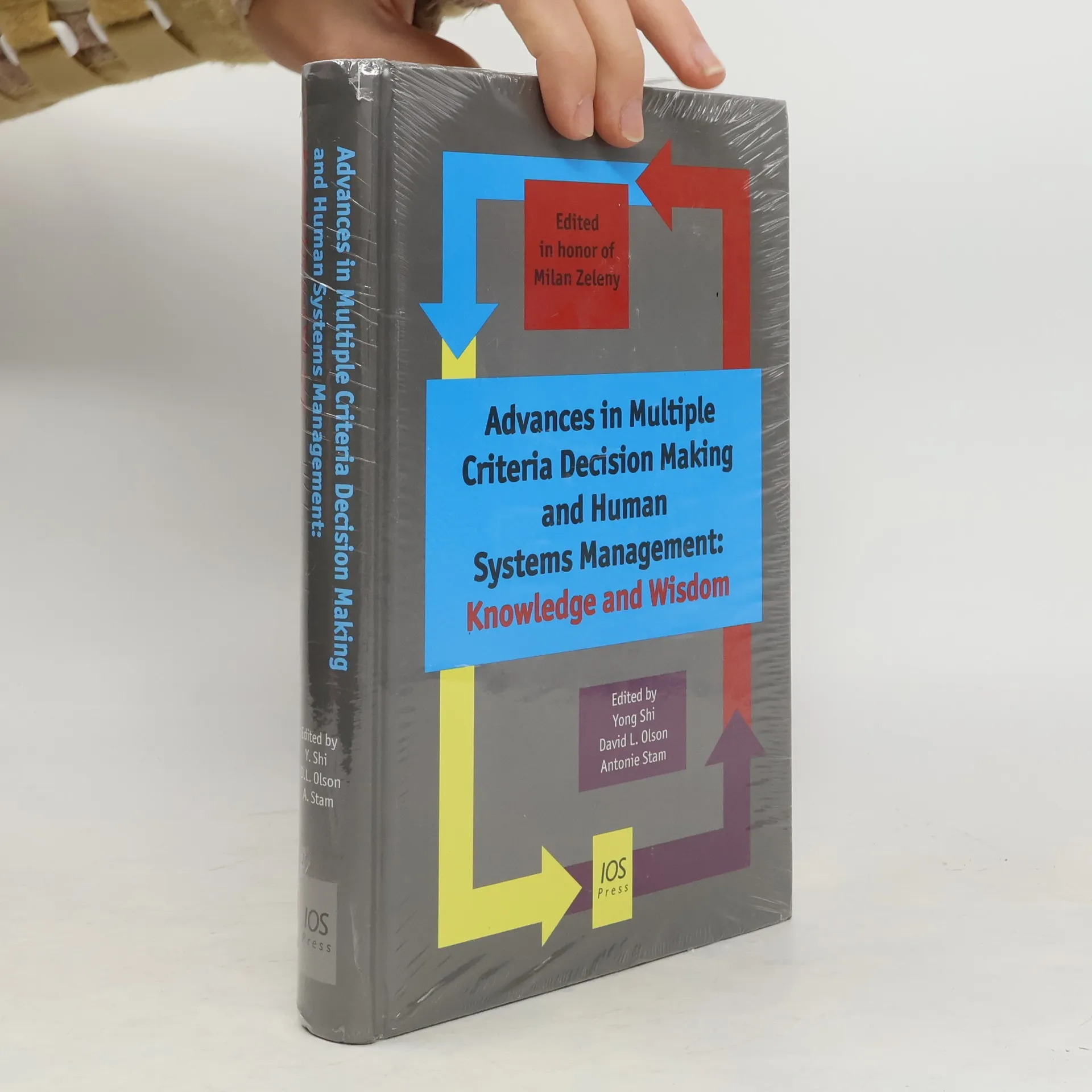
    Advances in Multiple Criteria Decision Making and Human Systems Management
    New state of MCDM in the 21st century
    • New state of MCDM in the 21st century

      • 213 pages
      • 8 hours of reading

      This book provides cutting-edge research results and application experiences from researchers and practitioners in multiple criteria decision making areas. It consists of three parts: MCDM Foundation and Theory, MCDM Methodology, and MCDM Applications. In Part I, it covers the historical MCDM development, the influence of MCDM on technology, society and policy, Pareto optimization, and analytical hierarchy process. In Part II, the book presents different MCDM algorithms based on techniques of robust estimating, evolutionary multiobjective optimization, Choquet integrals, and genetic search. In Part III, this book demonstrates a variety of MCDM applications, including project management, financial investment, credit risk analysis, railway transportation, online advertising, transport infrastructure, environmental pollution, chemical industry, and regional economy. The 17 papers of the book have been selected out of the 121 accepted papers at the 20th International Conference on Multiple Criteria Decision Making „New State of MCDM in 21st Century“, held at Chengdu, China, in 2009. The 35 contributors of these papers stem from 10 countries.

      New state of MCDM in the 21st century
    • Edited as a Festschrift in honor of Prof Milan Zeleny, this volume reflects and emulates his unmistakable legacy: the essential multidimensionality of human and social affairs. It contains papers dealing with: Multiple Criteria Decision Making; Social and Human System Management; and Information, Knowledge and Wisdom Management.

      Advances in Multiple Criteria Decision Making and Human Systems Management
    • Data mining and knowledge management

      • 263 pages
      • 10 hours of reading

      This book constitutes the thoroughly refereed post-proceedings of the Chinese Academy of Sciences Symosium on Data Mining and Knowledge Discovery CASDMKD 2004, held in Beijing, China in July 2004. The 25 revised full papers presented together with 3 invited keynote papers were carefully reviewed and selected from 60 submissions. The papers are organized in topical sections on data mining methodology, practical issues, data mining for bioinformatics, data mining applications, enterprise knowledge management, risk management and integration of data mining and knowledge management

      Data mining and knowledge management
    • Advances in Big Data Analytics

      Theory, Algorithms and Practices

      • 744 pages
      • 27 hours of reading

      Focusing on the transformative impact of big data, this book offers a thorough exploration of big data analytics, detailing concepts such as multi-criteria optimization, support vector machines, and various analysis techniques. It highlights practical applications in business, engineering, and healthcare, sharing valuable lessons learned from real-world implementations. Additionally, the text delves into advanced topics, including the development of intelligence-quotient tests for artificial intelligence, making it a vital resource for understanding the future of data science.

      Advances in Big Data Analytics
    • Intelligent knowledge

      • 168 pages
      • 6 hours of reading

      This book is mainly about an innovative and fundamental method called “intelligent knowledge” to bridge the gap between data mining and knowledge management, two important fields recognized by the information technology (IT) community and business analytics (BA) community respectively. The book includes definitions of the “first-order” analytic process, “second-order” analytic process and intelligent knowledge, which have not formally been addressed by either data mining or knowledge management. Based on these concepts, which are especially important in connection with the current Big Data movement, the book describes a framework of domain-driven intelligent knowledge discovery. To illustrate its technical advantages for large-scale data, the book employs established approaches, such as Multiple Criteria Programming, Support Vector Machine and Decision Tree to identify intelligent knowledge incorporated with human knowledge. The book further shows its applicability by means of real-life data analyses in the contexts of internet business and traditional Chinese medicines.

      Intelligent knowledge
    • Towards Efficient Fuzzy Information Processing

      Using the Principle of Information Diffusion

      • 396 pages
      • 14 hours of reading

      The book explores the challenges of understanding behavior from limited information, emphasizing the principle of information diffusion developed in China over the past 15 years. This principle allows for the transformation of precise observations into fuzzy sets, enhancing the recognition of relationships between inputs and outputs. It has proven effective in estimating probability density functions and demonstrates the applicability of fuzzy set theory in both soft and hard sciences, highlighting its versatility and practical benefits in various fields.

      Towards Efficient Fuzzy Information Processing