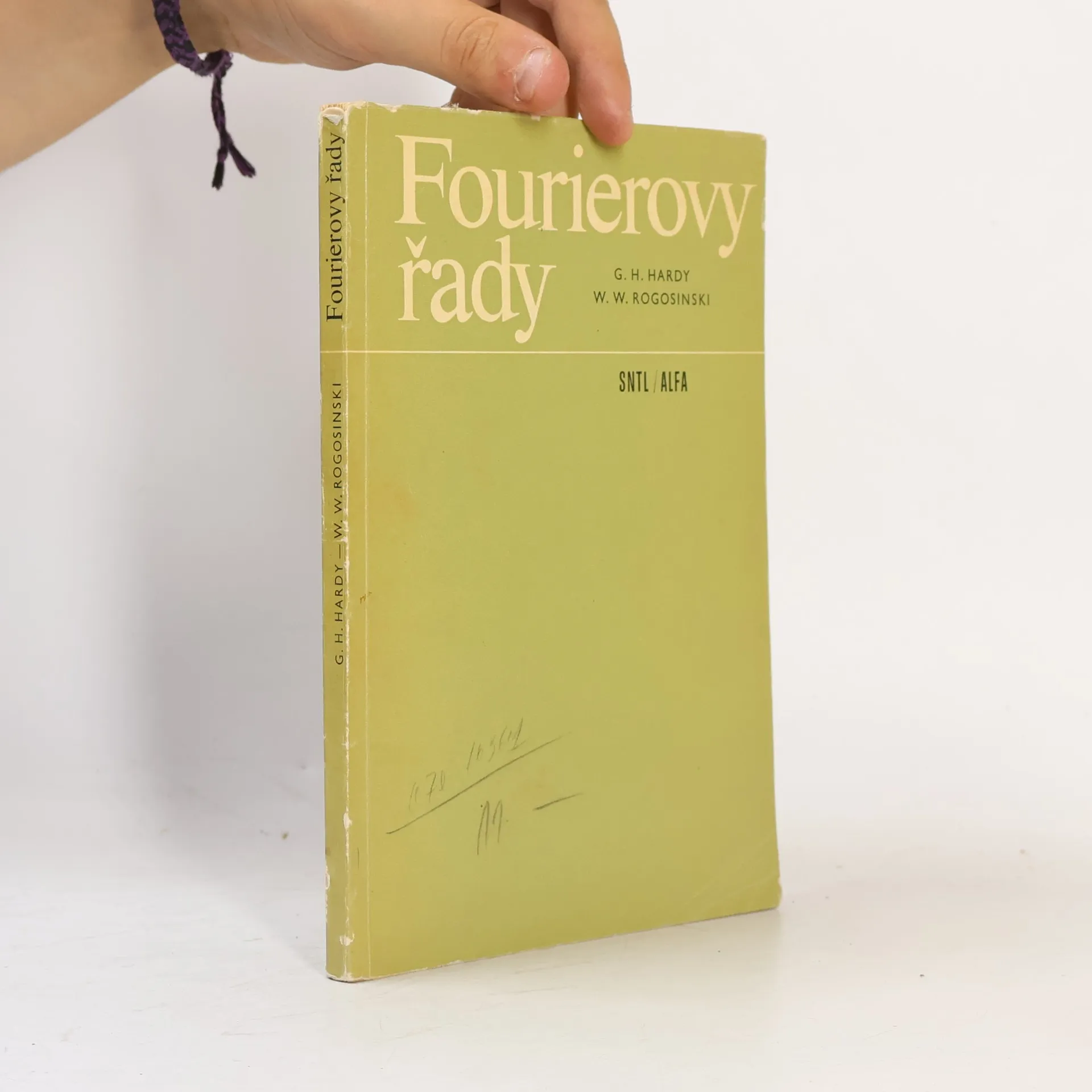
Godfrey Harold Hardy was a distinguished English mathematician renowned for his significant contributions to number theory and mathematical analysis. He is widely recognized by non-mathematicians for his 1940 essay, 'A Mathematician's Apology,' which delves into the aesthetics of mathematics and is celebrated as a rare insight into the mind of a mathematician for the general reader. Hardy's mentorship and close collaboration with the Indian mathematician Srinivasa Ramanujan, whose extraordinary and untutored brilliance he immediately perceived, became a celebrated partnership. Hardy himself considered the discovery of Ramanujan to be his greatest contribution and described their collaboration as 'the one romantic incident in my life.'
This classic calculus text remains a must-read for all students of introductory mathematical analysis. Clear, rigorous explanations of the mathematics of analytical number theory and calculus cover single-variable calculus, sequences, number series, more. 1921 edition.
From the Preface by J. E. "All [Hardy's] books gave him some degree of pleasure, but this one, his last, was his favourite. When embarking on it he told me that he believed in its value (as well he might), and also that he looked forward to the task with enthusiasm. He had actually given lectures on the subject at intervals ever since his return to Cambridge in 1931, and he had at one time or another lectured on everything in the book except Chapter XIII [The Euler-MacLaurin sum formula] ... [I]n the early years of the century the subject [Divergent Series], while in no way mystical or unrigorous, was regarded as sensational, and about the present title, now colourless, there hung an aroma of paradox and audacity."
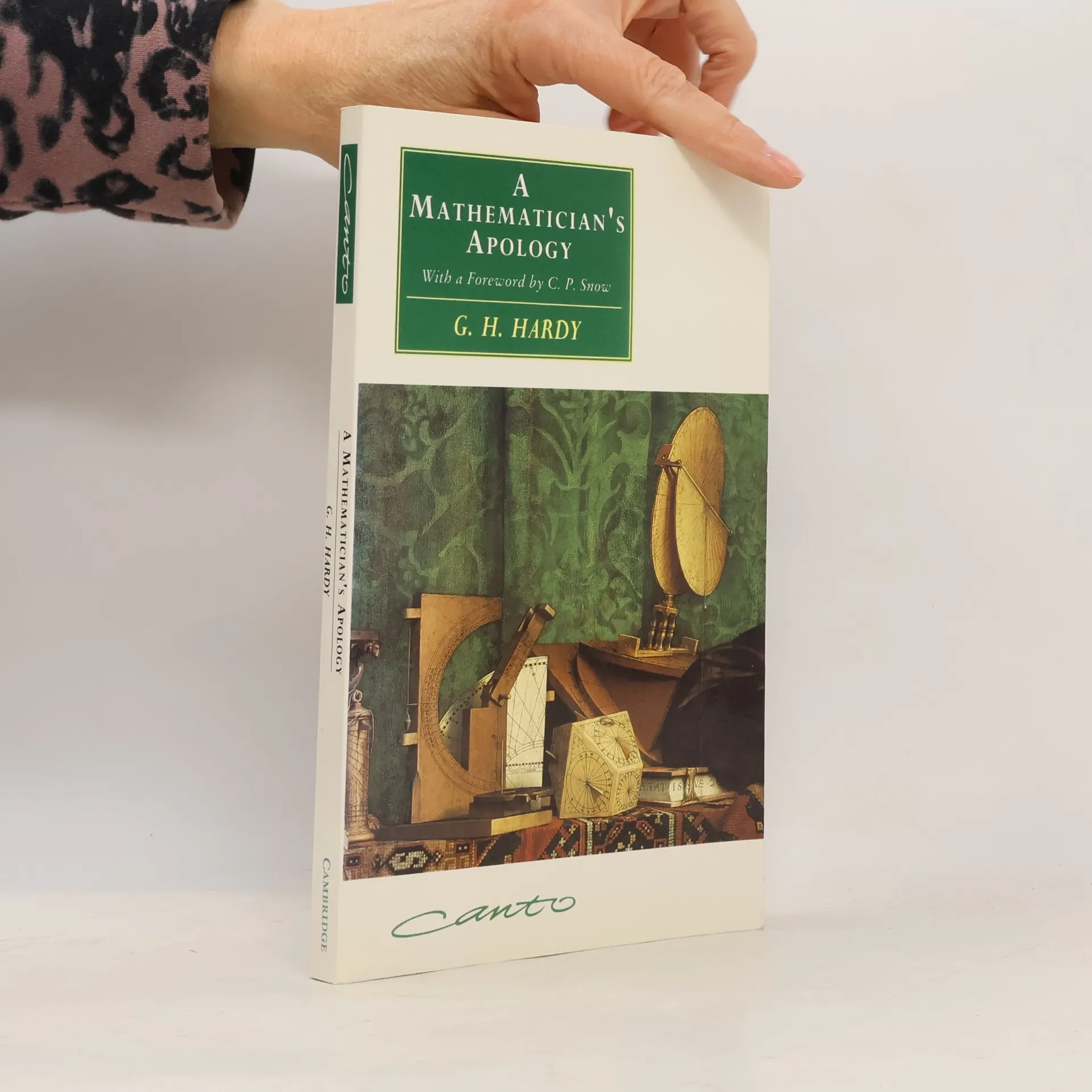
G. H. Hardy was one of this century's finest mathematical thinkers, renowned among his contemporaries as a 'real mathematician ... the purest of the pure'. He was also, as C. P. Snow recounts in his Foreword, 'unorthodox, eccentric, radical, ready to talk about anything'. This 'apology', written in 1940 as his mathematical powers were declining, offers a brilliant and engaging account of mathematics as very much more than a science; when it was first published, Graham Greene hailed it alongside Henry James's notebooks as 'the best account of what it was like to be a creative artist'. C. P. Snow's Foreword gives sympathetic and witty insights into Hardy's life, with its rich store of anecdotes concerning his collaboration with the brilliant Indian mathematician Ramanujan, his aphorisms and idiosyncrasies, and his passion for cricket. This is a unique account of the fascination of mathematics and of one of its most compelling exponents in modern times.
Originally published in 1910 as number twelve in the Cambridge Tracts in Mathematics and Mathematical Physics series, this book provides an up-to-date version of Du Bois-Reymond's Infinitarcalcul by the celebrated English mathematician G. H. Hardy. This tract will be of value to anyone with an interest in the history of mathematics or the theory of functions."