

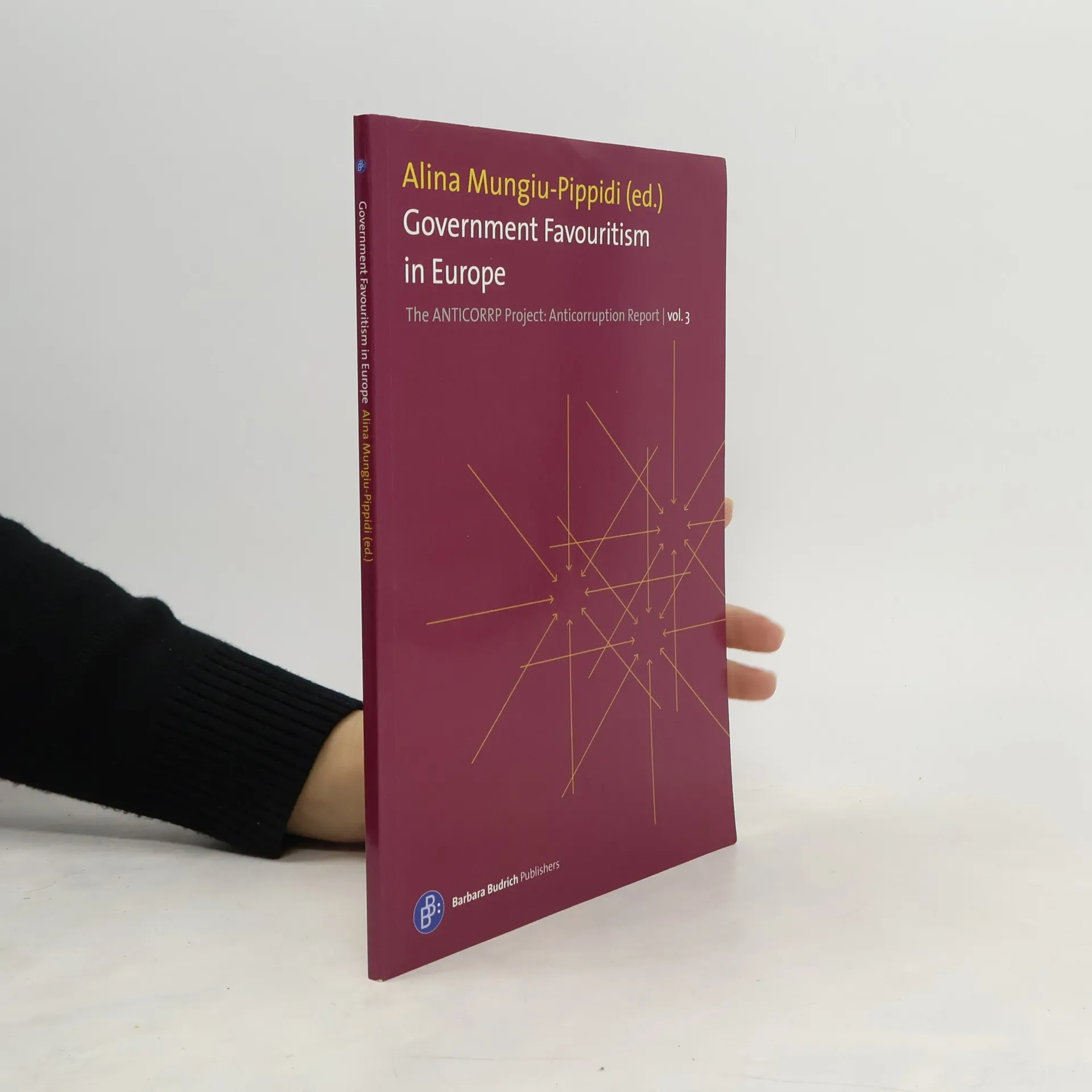
This volume on Government Favouritism in Europe reunites the fieldwork of 2014-2015 in the ANTICORRP project. It is entirely based on objective indicators and offers both quantitative and qualitative assessments of the linkage between political corruption and organised crime using statistics on spending, procurement contract data and judicial data. The methodology used in the analysis of particularism of public resource distribution is applicable to any other country where procurement data can be made available and opens the door to a better understanding and control of both systemic corruption and political finance.
Alina Mungiu-Pippidi Books
March 12, 1964



What if a policymaker tasked with creating a peace arrangement in an ethnic conflict sought practical wisdom from the theory of ethnic conflict and nationalism? This book examines the intersection of academic theory and the realities faced by policymakers who must foster interethnic peace with limited resources and time. It explores the postcommunist experience of ethnic revival and conflict, comparing it to other nationalisms and assessing best practices for managing ethnic conflicts within and between states. The introductory chapter provides a theoretical overview of recent research on nationalism and ethnic conflict relevant to policymaking. Subsequent chapters delve into the political economy of ethnicity, with Vladimir Gligorov analyzing the incentives that led to the fragmentation of Yugoslavia and the efforts to unify it. Charles King investigates the small separatist republics of the post-Soviet landscape, while Gerald Knause and collaborators examine the challenges of equitable governance between ethnic groups in Macedonia. Alina Mungiu-Pippidi tests primordial hypotheses through public opinion surveys in several countries. Valerie Bunce and Philip Roeder critically assess political institutions aimed at preventing ethnic conflict, while Florian Bieber and Mathijs Bogaards evaluate power-sharing arrangements and voting systems in the Balkans. The book concludes with a review of policy options by the editors.
Controlling corruption in Europe
- 127 pages
- 5 hours of reading
Corruption has an impact. It is about time that anticorruption starts having an impact, too. This is the first annual policy report of the European Seventh Framework Research Project ANTICORRP, which has started in 2012 and will continue until 2018. Based on the work of 21 different research centers and universities gathering original data, ANTICORRP offers yearly updates on the latest from corruption research, analyzing both the consequences of corruption and the impact of policies attempting to curb it. This first report offers a methodology to evaluate corruption risk and quality of government at country, region and sector level by means of corruption indicators that are sensitive to change and policy intervention. The aim of the project is to offer testable, easy to handle policies which reduce corruption risk. Corruption distorts market competition, bolsters deficits on behalf of discretionary spending, hurts real investment in public health and education, reduces tax collection, detriments the absorption rate of EU funds, and generates vulnerable employment and brain drain. This study estimates that if EU member states would all manage to control corruption at the Danish level, tax collection in Europe would increase by 323 billion Euro per year – double of the EU budget for 2013.