

Explore the latest books of this year!
Bookbot

Jens Hoffmann

    October 7, 1968

    Jens Hoffmann is a writer and art curator. His work often focuses on contemporary art and exhibition-making. Hoffmann explores how artworks are presented and interpreted, contributing to the discourse on the curator's role in the art world. His writings appear in prominent art publications, and his curatorial practice shapes international art scenes.

    "Das kann man nicht erzählen"
    Warten & Ankommen (Normale Ausgabe)
    Menschen entschlüsseln
    (Curating) From A to Z
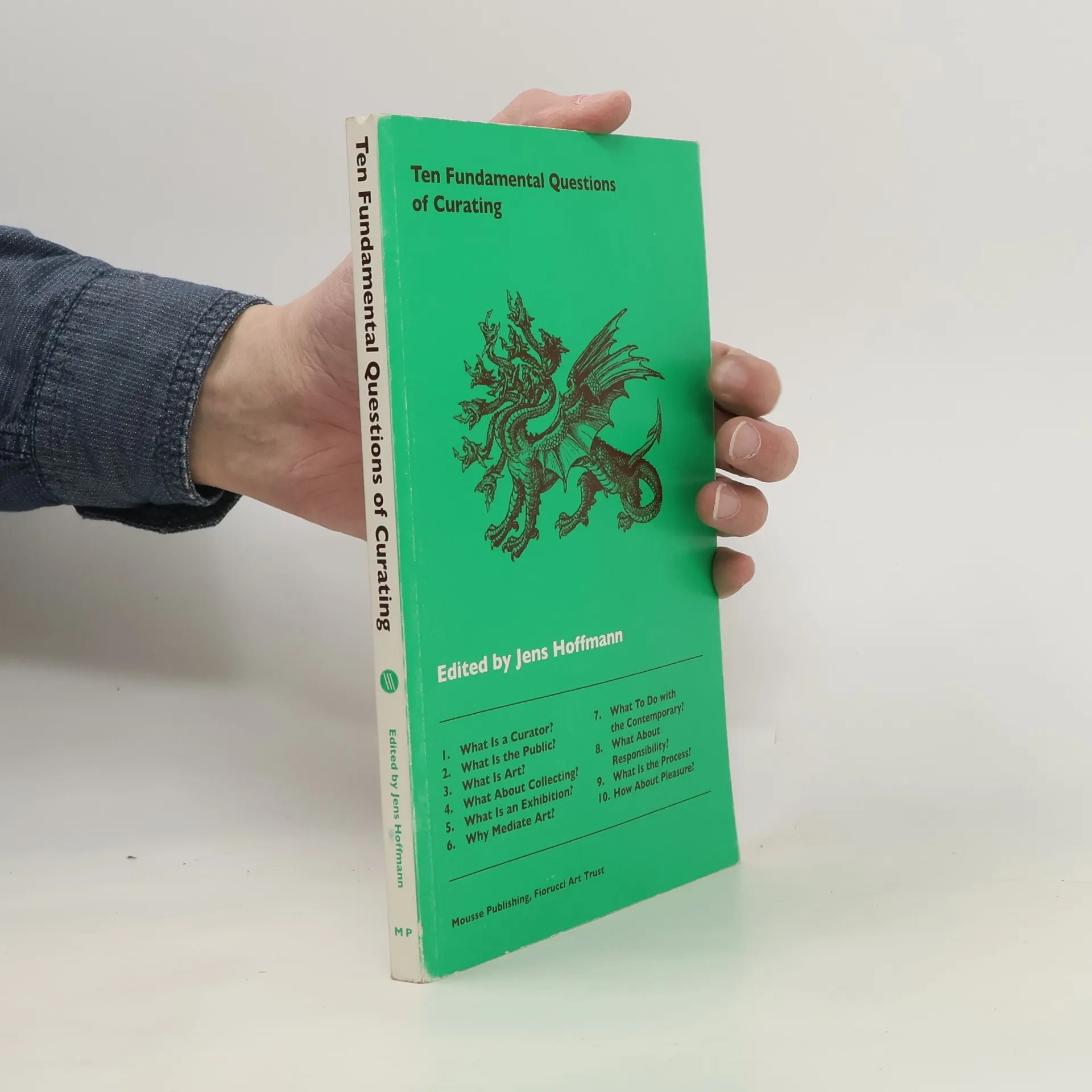
    Ten Fundamental Questions of Curating
    The Studio
    • 2021

      Warten & Ankommen (Normale Ausgabe)

      Bushaltestellen in Mecklenburg-Vorpommern

      • 240 pages
      • 9 hours of reading

      Die Reise von Jens Hoffmann durch Mecklenburg-Vorpommern zeigt eine einzigartige Perspektive auf die oft übersehenen Bushaltestellen der Region. Über drei Jahre hinweg hat er besondere Haltestellen entdeckt, die nicht nur als Verkehrsknotenpunkte dienen, sondern auch Geschichten und kulturelle Einblicke bieten. Hoffmanns Erlebnisse und Beobachtungen laden dazu ein, die Schönheit und Vielfalt der ländlichen Infrastruktur neu zu betrachten.


      Warten & Ankommen (Normale Ausgabe)
    • 2015

      Menschen entschlüsseln

      Ein Kriminalpsychologe erklärt, wie man spezielle Analyse- und Profilingtechniken im Alltag nutzt

      4.1(11)Add rating

      Wie gut kennen Sie Ihre Freunde und Kollegen? Ist der Mensch, mit dem Sie das Büro teilen, ein Fremder für Sie? Es ist gar nicht so leicht, andere Menschen richtig einzuschätzen. Denn viele der 15 bekannten Persönlichkeitsstile sind nicht gleich auf den ersten Blick zu erkennen, manche, wie der Narzissmus, fallen dagegen schnell auf. Aber was tut man, wenn der eigene Chef ein Narzisst ist? Oder sich der neue Flirt als hartnäckiger Querulant entpuppt? Dr. Jens Hoffmann ist Kriminalpsychologe und Experte für Profiling. In seinem Buch zeigt er die besten Tipps im Umgang mit Boss-Typen, Psychopathen, Narzissten, dramatischen Persönlichkeiten und anderen. Umrahmt von vielen Fallbeispielen aus seinem Berufsleben hat Dr. Jens Hoffmann sein Wissen so aufbereitet, dass jeder im Alltag davon profitiert und die Zeit der Täuschungen ein für alle Mal vorbei ist.

      Menschen entschlüsseln
    • 2014

      „(Curating) From A to Z“ offers a summary of the development of curatorial practice over the last two decades seen through the eyes of curator Jens Hoffmann. In this publication each letter of the alphabet evokes a particular word related to the world of exhibition making: From A (as in Artist) and B (as in Biennial) to R (as in Retrospective) and W (as in White Cube). Employing a diarist style, the curator presents his personal curatorial alphabet with a similar transparency and the same idiosyncratic character revealed in many of his exhibitions. The entries are not only stimulating and intellectually rigorous, but also emotionally engaging. Jens Hoffmann (b. 1974 in San Jose, Costa Rica) is a writer, exhibition maker, and educator. He currently is Deputy Director of The Jewish Museum, New York. He has published widely in journals and museum publications and has written over 200 texts on art and exhibition making over the last 15 years. His most recent books include „The Studio“ (2012), as well as „Show Time: A History of Exhibitions“ (2014). He is the founder and editor of „The Exhibitionist: Journal on Exhibition Making.“ Most recently he co-curated the 9th Shanghai Biennial (2012/13) and the 12th Istanbul Biennial (2011). Second edition.

      (Curating) From A to Z
    • 2013

      Ten Fundamental Questions of Curating

      • 144 pages
      • 6 hours of reading

      It has become almost obligatory to introduce a book on curating by noting the plethora of recent publications on the subject. How, in just a few short years, did we reach this point of saturation? What questions, exactly, do all these books address? Many attempt to offer an overview of the curatorial field as it exists today, or attempt to map its historical trajectory. Others propose a series of case studies under a common curatorial theme. All are hoping to contribute to this relatively new discipline and its accompanying canon. Edited by Jens Hoffmann, Ten Fundamental Questions of Curating offers a real critique of existing publications and modes of thinking by explicitly asking the questions that others have missed, ignored or deemed already What is a curator? What is the public? What is art? What about collecting? What is an exhibition? Why mediate art? What to do with the contemporary? What about responsibility? What is the process? How about pleasure? Here, Peter Eleey, Elena Filipovic, Juan A. Gaitán, Sofía Hernández Chong Cuy, Maria Lind, Chus Martínez, Jessica Morgan, Adriano Pedrosa, João Ribas and Dieter Roelstraete each propose and then address one question. Ten Fundamental Questions of Curating takes a back-to-basics approach--a return to a kind of zero-degree state--at a time when a recalibration of what a curator is and does seems both necessary and urgent.

      Ten Fundamental Questions of Curating
    • 2012

      The Studio

      • 238 pages
      • 9 hours of reading
      3.7(10)Add rating

      The artist's studio is continuously being reinvented in response to new conditions. This anthology examines current studio practice and its theoretical and historical development over the last century. It surveys a wide range of artists, focusing on the studio's transition from a site for production to a situation for creativity

      The Studio
    • 2008
    • 2006

      Stalking

      • 230 pages
      • 9 hours of reading

      "Stalking" ist mittlerweile ein bekannter Fachbegriff, der synonym mit "obsessiver Verfolgung" und "obsessiver Belästigung" gebraucht wird. – Aber was genau ist "Stalking"? Endlose Briefe, Telefonate und E-Mails, Auflauern und Verfolgen, Drohungen und Es gibt keine spezifische Verhaltensweise, die bei Stalking immer präsent ist – aber im Kern geht es immer um ein einseitiges Einer will, dass der andere an ihn denkt, der andere möchte ihn aus dem Gedächtnis verbannen. Hoffmann, der als der deutsche Stalking-Experte gilt, zeigt die unterschiedlichen Facetten von Stalking auf. Als theoretischer Hintergrund dienen psychologische Theorien der Bindungsforschung und Lerntheorie. Für Fachleute und Betroffene relevant sind die Analysen, wie gefährlich Stalking in extremen Ausprägungen werden kann und was dagegen getan werden kann.

      Stalking