Explore the latest books of this year!
Bookbot

Myrna Chase

    Seven Myths of the Russian Revolution
    Proposed Airborne Assaults during Operation Overlord
    Elie Halévy an Intellectual Biography
    Paradise Now!
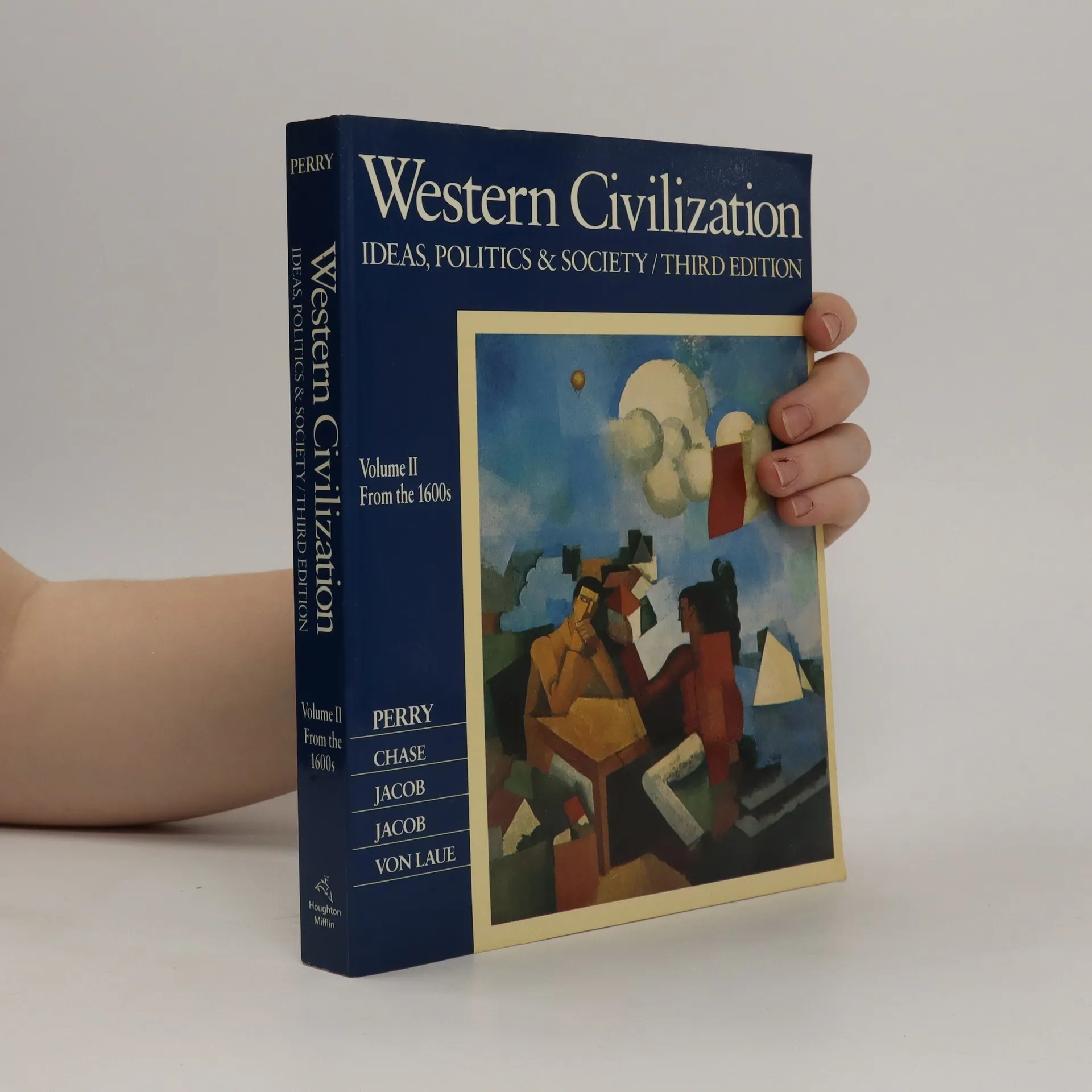
    Western civilization : ideas, politics & society. Volume II, From the 1600s
    The World Revolution of Westernization
    • The World Revolution of Westernization

      • 418 pages
      • 15 hours of reading

      The author argues that the global violence of this century is the consequence of the rapid process of westernization and the traumas this has caused to countries suddenly forced to catch up with Europe.

      The World Revolution of Westernization
    • This survey text presents the Western intellectual tradition within a chronology of political history. Known for its accessible writing style, Western Civilization appeals to students and instructors alike for its brevity, clarity, and careful selection of content. New technology resources, including Houghton Mifflin's Eduspace course management system, make learning more engaging and instruction more efficient.In the Eighth Edition, several new pedagogical features support students throughout the term. Chapter-opening focus questions direct students to important themes, while a glossary reinforces key terms and concepts. New icons in the text direct students to online resources such as maps, primary sources, and practice test questions. In addition, the new edition retains many popular features, including comparative timelines, full-color maps with physical geography essays, and primary source excerpts.

      Western civilization : ideas, politics & society. Volume II, From the 1600s
    • A funny and raging play about ambition, exploitation and the search for connection in a fractured world.

      Paradise Now!
    • "This fascinating volume is a major contribution to our understanding of the Russian Revolution, from World War I to consolidation of the Bolshevik regime. The seven myths include the exaggeration of Rasputin's influence; a purported conspiracy behind the February Revolution; the treasonous Bolshevik dependence on German support; the multiple Anastasia pretenders to the royal inheritance; the antisemitic claims about 'Judeo-Bolsheviks'; distortions about America's intervention in the civil war; and the 'inevitability' of Bolshevism. In each case the authors analyze the facts, uncover the origins of the myth, and trace its later perseverance (even in contemporary Russia). To assist readers, the volume includes three reference guides (people, terms, dates), nine maps, and twenty-nine illustrations. The result is immensely valuable for undergraduate courses in Russian history." --Gregory L. Freeze, Raymond Ginger Professor of History, Brandeis University

      Seven Myths of the Russian Revolution
    • "Chase renders queer bodies bare and exposed, showing them to contain at times uncomfortable, painful and deeply haunted spaces also capable of heartbreaking love, closeness and quietness." -Megan N. Liberty, Brooklyn Rail wild wild Wild West / Haunting of the Seahorse is a nonlinear tale illustrating Black queer bodies moving through fluid states of love, grief and desire within the canons of science fiction, fantasy and horror. Like a love letter, the book employs multisensory entanglements, a blending of the abstract and physical, to draw out complex histories of Blackness, meditations on mental health and queer futurity.

      wild wild Wild West & Haunting of the Seahorse
    • How Europe Made the Modern World

      • 248 pages
      • 9 hours of reading

      "One thousand years ago, a traveler to Baghdad or the Chinese capital Kaifeng would have discovered a vast and flourishing city of broad streets, spacious gardens, and sophisticated urban amenities; meanwhile, Paris, Rome, and London were cramped and unhygienic collections of villages, and Europe was a backwater. How, then, did it rise to world preeminence over the next several centuries? This is the central historical conundrum of modern times. How Europe Made the Modern World draws upon the latest scholarship in geography, demography, economics, law, and the history of technology, culture, institutions, and science, as well as other disciplines, to make sense of the Great Divergence. It avoids the twin dangers of Eurocentrism and anti-Westernism, strongly emphasizing the contributions of other cultures of the world to the West's rise, while rejecting the claim that there was nothing distinctive about Europe in the premodern era. Presenting stimulating arguments, an insightful interpretation, and detailed maps to illuminate key developments, this book will inspire students to think critically and engage in debates rather than accepting a single narrative of the rise of the West. It is an ideal primer for students studying in Western Civilization and World History courses"--

      How Europe Made the Modern World