

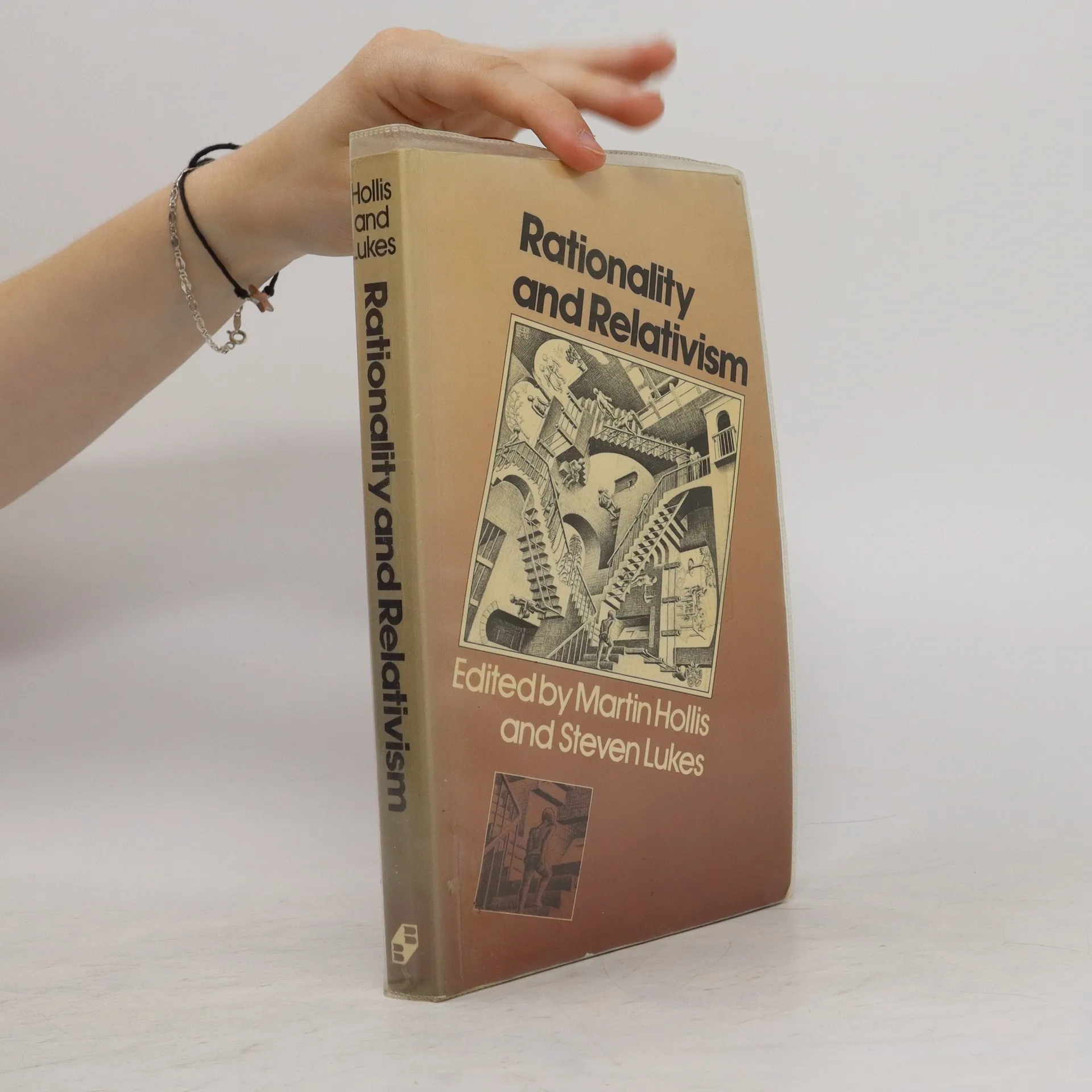


Rationality and Relativism
Authors
More about the book
Are there absolute truths that can be gradually approached over time through rational processes? Or are all modes and systems of thought equally valid if viewed from within their own internally consistent frames of reference? Are there universal forms of reasoning and understanding that enable us to distinguish between rational beliefs and those that are demonstrably false, or is everything relative? These central questions are addressed and debated by the distinguished contributors to this lively book. Some of them - Hollis, Lukes, Robin Horton, and Ernest Gellner - discuss new directions in their thinking since their earlier articles appeared in 1970 in the seminal volume Rationality (edited by Bryan Wilson). They are now joined in the debate by Ian Hacking, W. Newton-Smith, Charles Taylor, Jon Elster, Dan Sperber, and, in the jointly authored lead article, by Barry Barnes and David Bloor. Emerging from the debate are a variety of supportable interpretations and conclusions rather than a single, distinct "truth." The contributors represent the complete spectrum of positions between a relativism that challenges the very concept of a single world and the idea that there are ascertainable, objective universals.
Book purchase
Rationality and Relativism, Martin Hollis, Steven Lukes
- Language

- Released
- 1982
- Binding
- (Paperback)
Payment methods
No one has rated yet.
- Title
- Rationality and Relativism
- Language
- English
- Authors
- Martin Hollis, Steven Lukes
- Released
- 1982
- Format
- Paperback
- Pages
- 320
- ISBN10
- 0631131264
- ISBN13
- 9780631131267
- Series
- Categories
- Description
- Are there absolute truths that can be gradually approached over time through rational processes? Or are all modes and systems of thought equally valid if viewed from within their own internally consistent frames of reference? Are there universal forms of reasoning and understanding that enable us to distinguish between rational beliefs and those that are demonstrably false, or is everything relative? These central questions are addressed and debated by the distinguished contributors to this lively book. Some of them - Hollis, Lukes, Robin Horton, and Ernest Gellner - discuss new directions in their thinking since their earlier articles appeared in 1970 in the seminal volume Rationality (edited by Bryan Wilson). They are now joined in the debate by Ian Hacking, W. Newton-Smith, Charles Taylor, Jon Elster, Dan Sperber, and, in the jointly authored lead article, by Barry Barnes and David Bloor. Emerging from the debate are a variety of supportable interpretations and conclusions rather than a single, distinct "truth." The contributors represent the complete spectrum of positions between a relativism that challenges the very concept of a single world and the idea that there are ascertainable, objective universals.