

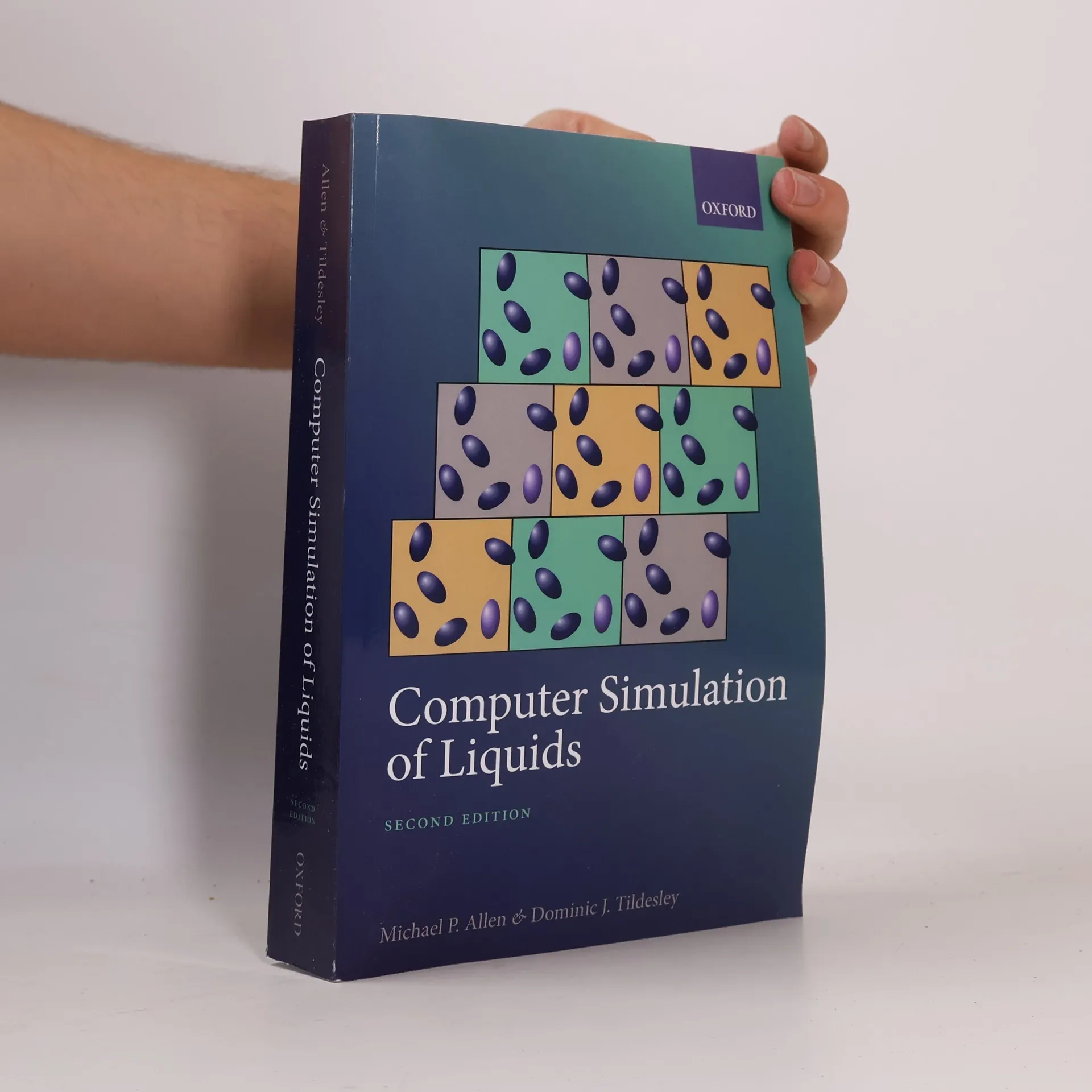
Computer Simulation of Liquids
Second Edition
Book rating
Parameters
- 640 pages
- 23 hours of reading
More about the book
This book provides a practical guide to molecular dynamics and Monte Carlo simulation techniques used in the modelling of simple and complex liquids. Computer simulation is an essential tool in studying the chemistry and physics of condensed matter, complementing and reinforcing both experiment and theory. Simulations provide detailed information about structure and dynamics, essential to understand the many fluid systems that play a key role in our daily lives: polymers, gels, colloidal suspensions, liquid crystals, biological membranes, and glasses. The second edition of this pioneering book aims to explain how simulation programs work, how to use them, and how to interpret the results, with examples of the latest research in this rapidly evolving field. Accompanying programs in Fortran and Python provide practical, hands-on, illustrations of the ideas in the text.
Publication

Book purchase
Computer Simulation of Liquids, D. J. Tildesley, Michael P. Allen
- Language

- Released
- 2017
- Binding
- (Paperback)
Payment methods
We’re missing your review here.
- Title
- Computer Simulation of Liquids
- Subtitle
- Second Edition
- Language
- English
- Authors
- D. J. Tildesley, Michael P. Allen
- Publisher
- Oxford University Press
- Released
- 2017
- Format
- Paperback
- Pages
- 640
- ISBN10
- 0198803206
- ISBN13
- 9780198803201
- Series
- Rating
- 4.7 out of 5
- Description
- This book provides a practical guide to molecular dynamics and Monte Carlo simulation techniques used in the modelling of simple and complex liquids. Computer simulation is an essential tool in studying the chemistry and physics of condensed matter, complementing and reinforcing both experiment and theory. Simulations provide detailed information about structure and dynamics, essential to understand the many fluid systems that play a key role in our daily lives: polymers, gels, colloidal suspensions, liquid crystals, biological membranes, and glasses. The second edition of this pioneering book aims to explain how simulation programs work, how to use them, and how to interpret the results, with examples of the latest research in this rapidly evolving field. Accompanying programs in Fortran and Python provide practical, hands-on, illustrations of the ideas in the text.