

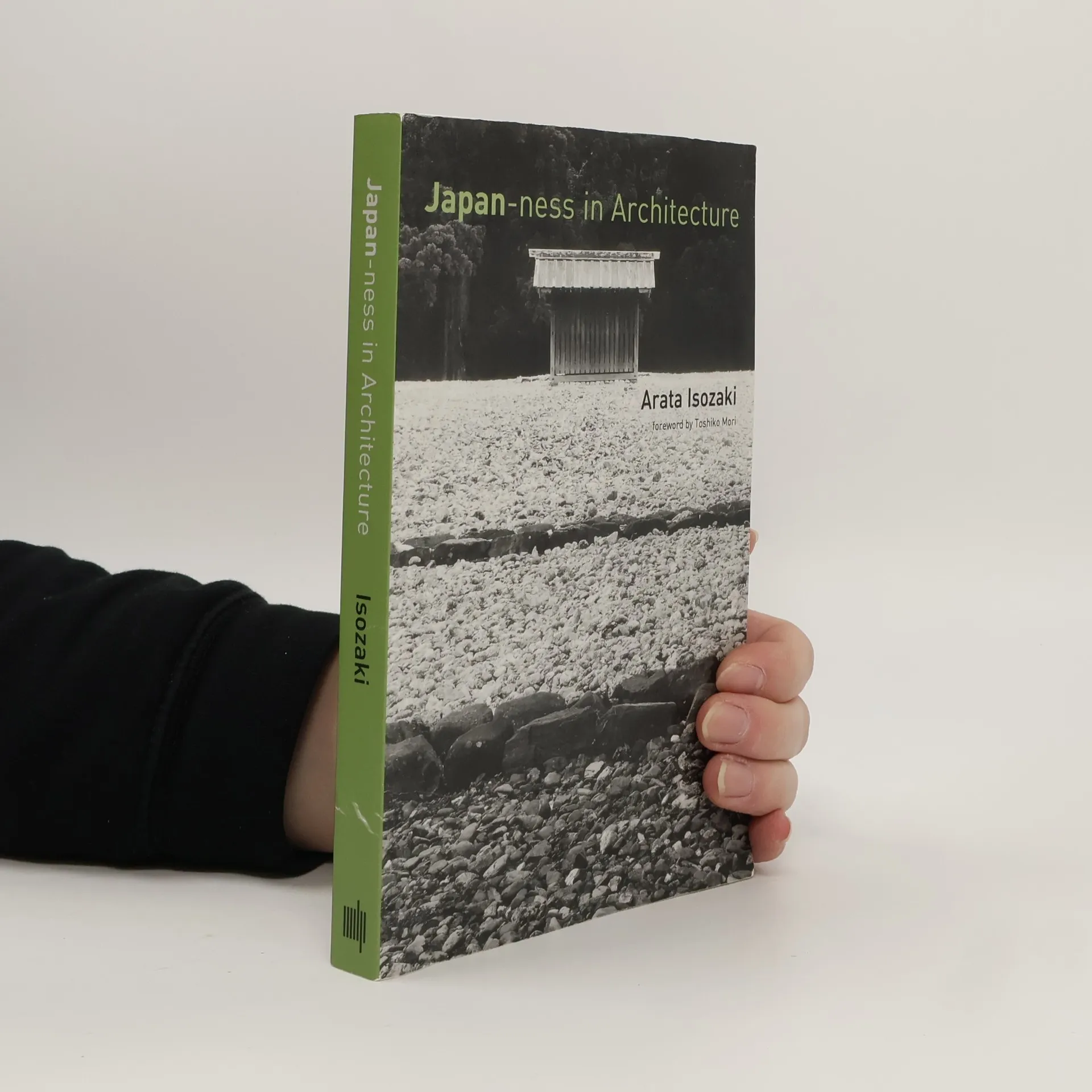


Japan-ness in Architecture
Book rating
Parameters
- 376 pages
- 14 hours of reading
More about the book
One of Japan's leading architects explores the concept of Japan-ness through significant events in Japanese architectural history from the seventh to the twentieth century, offering essays that contextualize buildings within their cultural milieu. Arata Isozaki perceives buildings as dynamic entities that embody social and historical narratives, urging us to interpret them continually rather than view them as static objects. He identifies essential Japanese characteristics in architecture, starting with modern architects' struggles to forge a uniquely Japanese identity amidst modernity. Isozaki reflects on historical examples such as the Ise shrine, the Todai-ji Temple, and the Katsura Imperial Villa, illustrating how these structures embody Japan-ness. He contrasts the Ise shrine's ritual relocation with Western notions of permanence, suggesting that such rituals counter modernity's search for origins. The Todai-ji Temple's reconstruction, guided by the monk Chogen, captures the era's revolutionary spirit, while the Katsura Imperial Villa reinterprets traditional styles to create its unique identity. Isozaki critiques the common perception of Japanese aesthetics, arguing that what is often seen as Japan-ness is a stylized simplification that lacks the vibrancy of cultural evolution. Through a blend of historical analysis, theoretical insights, and personal reflections, these essays affirm Isozaki's prominence as a leading arc
Book purchase
Japan-ness in Architecture, Arata Isozaki, David B. Stewart, Sabu Kohso, Toshiko Mori
- Language

- Released
- 2011
- Binding
- (Paperback)
Payment methods
We’re missing your review here.
- Title
- Japan-ness in Architecture
- Language
- English
- Authors
- Arata Isozaki, David B. Stewart, Sabu Kohso, Toshiko Mori
- Publisher
- MIT Press
- Released
- 2011
- Format
- Paperback
- Pages
- 376
- ISBN10
- 0262516055
- ISBN13
- 9780262516051
- Series
- Categories
- Tags
- Business, Psychological Topics, Philosophical Topics, Art, Architecture, USA, Medicine, Wars, Filmthema, Society, Japan, Journalism, Espionage, Culture, 21st Century, Survival, Criticism, Prison, Cold War, Russian History, History of Architecture, Theory of Architecture
- Rating
- 3.65 out of 5
- Description
- One of Japan's leading architects explores the concept of Japan-ness through significant events in Japanese architectural history from the seventh to the twentieth century, offering essays that contextualize buildings within their cultural milieu. Arata Isozaki perceives buildings as dynamic entities that embody social and historical narratives, urging us to interpret them continually rather than view them as static objects. He identifies essential Japanese characteristics in architecture, starting with modern architects' struggles to forge a uniquely Japanese identity amidst modernity. Isozaki reflects on historical examples such as the Ise shrine, the Todai-ji Temple, and the Katsura Imperial Villa, illustrating how these structures embody Japan-ness. He contrasts the Ise shrine's ritual relocation with Western notions of permanence, suggesting that such rituals counter modernity's search for origins. The Todai-ji Temple's reconstruction, guided by the monk Chogen, captures the era's revolutionary spirit, while the Katsura Imperial Villa reinterprets traditional styles to create its unique identity. Isozaki critiques the common perception of Japanese aesthetics, arguing that what is often seen as Japan-ness is a stylized simplification that lacks the vibrancy of cultural evolution. Through a blend of historical analysis, theoretical insights, and personal reflections, these essays affirm Isozaki's prominence as a leading arc