

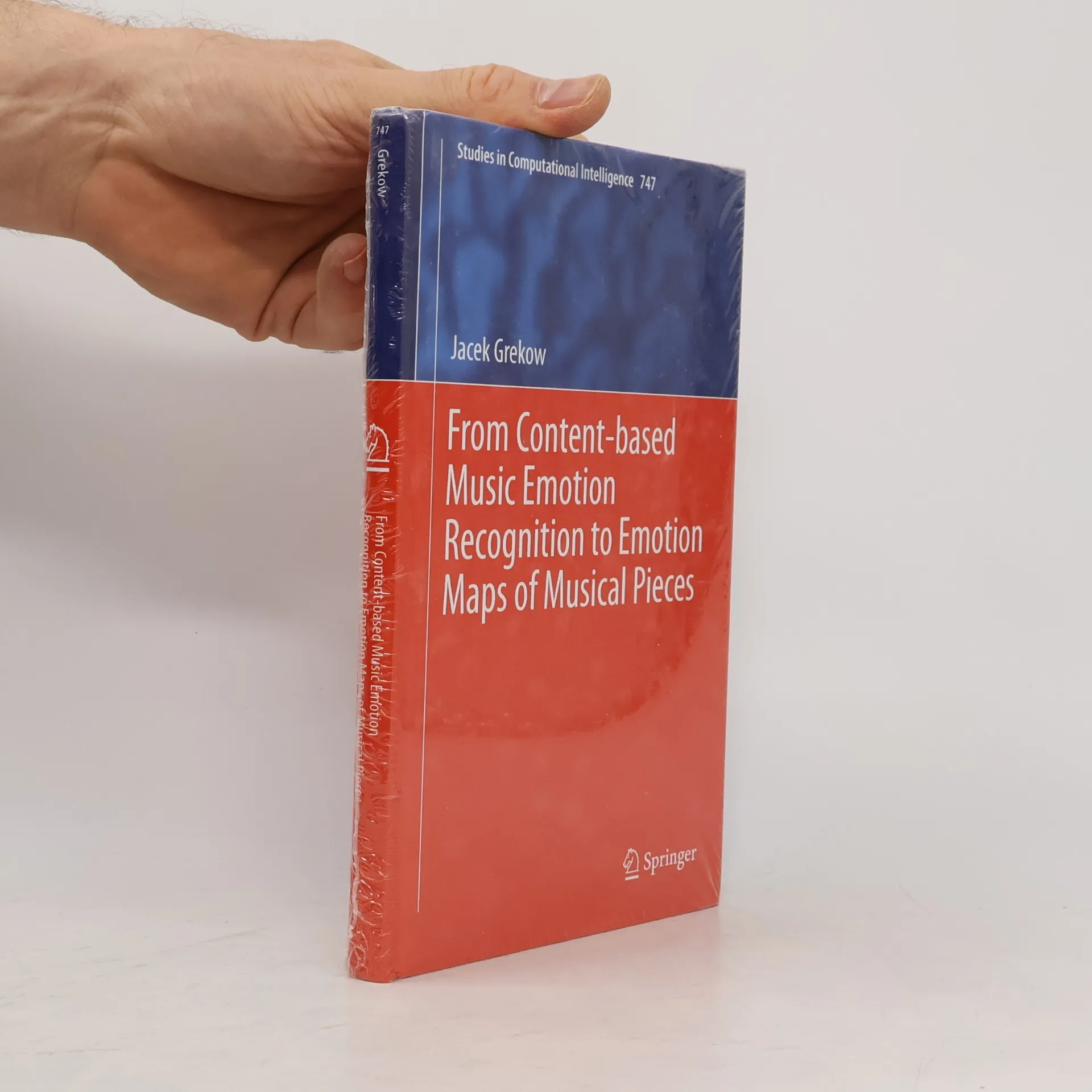

Studies in Computational Intelligence - 747: From Content-based Music Emotion Recognition to Emotion Maps of Musical Pieces
Authors
Parameters
- 152 pages
- 6 hours of reading
More about the book
The problems it addresses include emotion representation, annotation of music excerpts, feature extraction, and machine learning. The book chiefly focuses on content-based analysis of music files, a system that automatically analyzes the structures of a music file and annotates the file with the perceived emotions. Further, it explores emotion detection in MIDI and audio files. In the experiments presented here, the categorical and dimensional approaches were used, and the knowledge and expertise of music experts with a university music education were used for music file annotation. The automatic emotion detection systems constructed and described in the book make it possible to index and subsequently search through music databases according to emotion. In turn, the emotion maps of musical compositions provide valuable new insights into the distribution of emotions in music and can be used to compare that distribution in different compositions, or to conduct emotional comparisons of different interpretations of the same composition.
Book purchase
Studies in Computational Intelligence - 747: From Content-based Music Emotion Recognition to Emotion Maps of Musical Pieces, Jacek Grekow
- Language

- Released
- 2017
- Binding
- (Hardcover)
Payment methods
No one has rated yet.
- Title
- Studies in Computational Intelligence - 747: From Content-based Music Emotion Recognition to Emotion Maps of Musical Pieces
- Language
- English
- Authors
- Jacek Grekow
- Publisher
- Springer
- Released
- 2017
- Format
- Hardcover
- Pages
- 152
- ISBN10
- 331970608X
- ISBN13
- 9783319706085
- Series
- Tags
- Description
- The problems it addresses include emotion representation, annotation of music excerpts, feature extraction, and machine learning. The book chiefly focuses on content-based analysis of music files, a system that automatically analyzes the structures of a music file and annotates the file with the perceived emotions. Further, it explores emotion detection in MIDI and audio files. In the experiments presented here, the categorical and dimensional approaches were used, and the knowledge and expertise of music experts with a university music education were used for music file annotation. The automatic emotion detection systems constructed and described in the book make it possible to index and subsequently search through music databases according to emotion. In turn, the emotion maps of musical compositions provide valuable new insights into the distribution of emotions in music and can be used to compare that distribution in different compositions, or to conduct emotional comparisons of different interpretations of the same composition.