

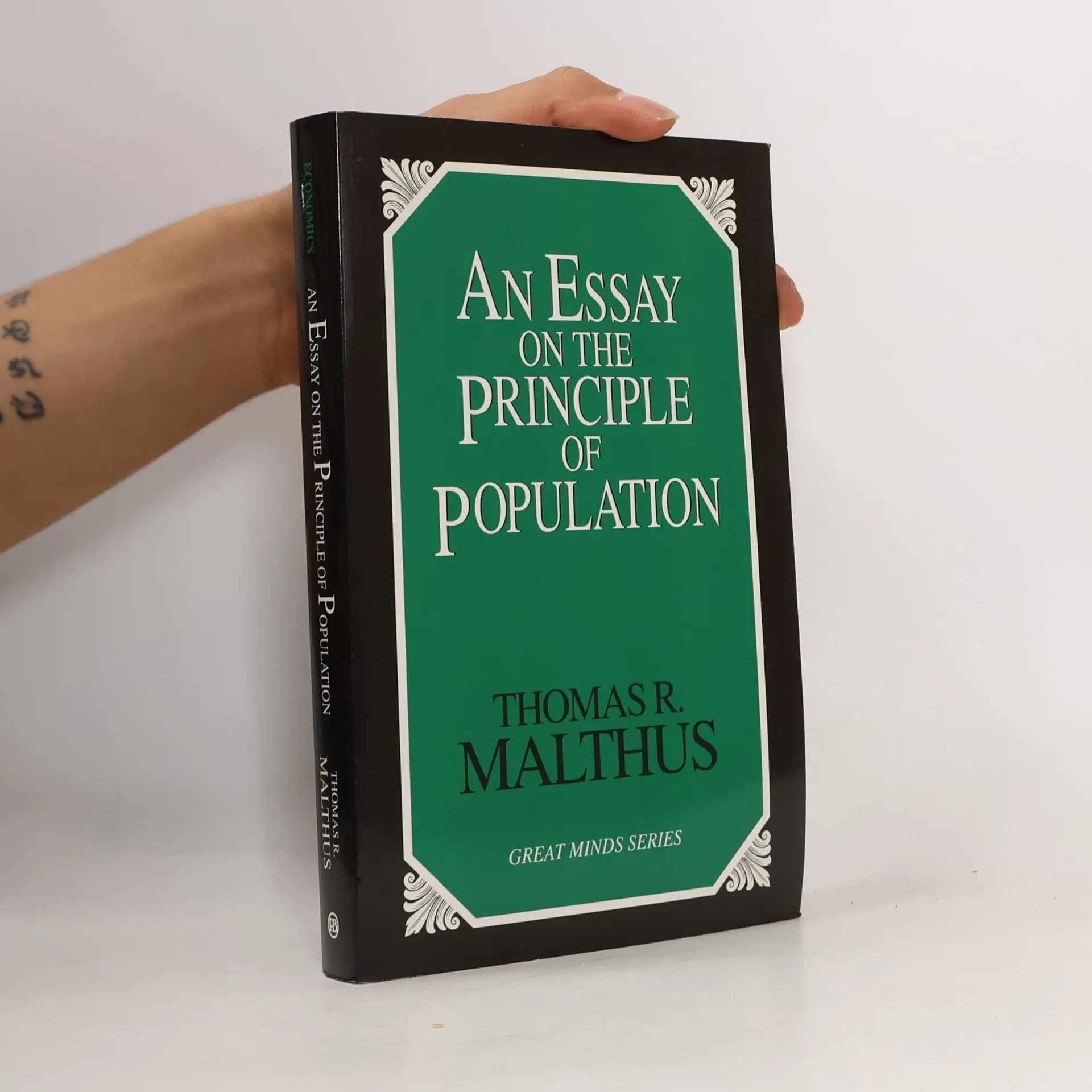
You'll get the exact copy in the photo



Parameters
- 400 pages
- 14 hours of reading
More about the book
Focusing on the critical theme of population dynamics, the book presents Thomas R. Malthus's argument that unchecked population growth outpaces food supply, leading to dire societal consequences. Through mathematical proofs and scientific evidence, Malthus contends that preventive measures are essential to avoid overcrowding, disease, war, and poverty. His pessimistic outlook on humanity's future sparked significant debate among contemporary optimists and laid foundational ideas that influenced Charles Darwin's research.
Book purchase
Great Minds Series: An Essay on the Principle of Population, Thomas Robert Malthus
- Language

- Released
- 1998
- Binding
- (Paperback),
- Book condition
- Very Good
- Price
- €18.39
Payment methods
No one has rated yet.
- Title
- Great Minds Series: An Essay on the Principle of Population
- Language
- English
- Authors
- Thomas Robert Malthus
- Publisher
- Globe Pequot Press
- Released
- 1998
- Format
- Paperback
- Pages
- 400
- ISBN10
- 1573922552
- ISBN13
- 9781573922555
- Series
- Categories
- Tags
- Historical Themes, Business, Nature, References & Manuals, Philosophical Topics, Politics, Science, USA, Health, Technology, Education & School System, School, Society, Linguistics, History of Europe, Leadership, Finance, Political Theories, Culture, American History, Race, Racism, Money, Ethics, Evolution, Social Justice, Democracy, Nature Observation, Marxism, Genetics, Socialism, Capitalism, Enlightenment, Government, Activism, Cosmology, Political Philosophy, Philosophy of Science, Atheism, Liberalism, Critical Thinking, Demography, Critical Theory, Population
- Description
- Focusing on the critical theme of population dynamics, the book presents Thomas R. Malthus's argument that unchecked population growth outpaces food supply, leading to dire societal consequences. Through mathematical proofs and scientific evidence, Malthus contends that preventive measures are essential to avoid overcrowding, disease, war, and poverty. His pessimistic outlook on humanity's future sparked significant debate among contemporary optimists and laid foundational ideas that influenced Charles Darwin's research.