Explore the latest books of this year!
Bookbot

Robert Ayres

    June 29, 1932 – October 23, 2023

    Robert U. Ayres is an American physicist and economist whose work frequently explores the intersection of physics, economics, and environmental studies. He examines the long-term impacts of technological development and industrial production on society and the planet. Ayres's style is characterized by a multidisciplinary approach, linking scientific rigor with critical assessments of social and economic systems. His extensive publications reflect a deep contemplation of sustainable development and the future of civilization.

    Computer Integrated Manufacturing
    The History and Future of Economics
    The History and Future of Technology
    On the Authorship Controversy: Evidence That Christopher Marlowe Wrote the Poems and Plays of William Shakespeare
    Turning Point
    Information, Entropy, and Progress
    • 2023

      The History and Future of Economics

      • 412 pages
      • 15 hours of reading

      Exploring the concept of energy as the fundamental substance of the universe, this book delves into the relationship between energy consumption and material transformation or information transmission. It critiques the labor theory of value as proposed by economists like Adam Smith and Karl Marx, suggesting that while it offers an initial understanding of value creation, it requires further refinement. The text aims to provide a deeper insight into the dynamics of value and energy in the context of economic theory.

      The History and Future of Economics
    • 2021

      The History and Future of Technology

      Can Technology Save Humanity from Extinction?

      • 848 pages
      • 30 hours of reading

      Focusing on the interplay between technology and societal evolution, Robert Ayres explores how technological advancements emerge primarily from societal needs rather than existing independently. He delves into the historical context of technology as a change agent, emphasizing its development in response to human demands and the evolutionary factors that shape these needs. This perspective challenges the notion of technology as a self-sustaining force, highlighting its deep connections to societal progress and challenges.

      The History and Future of Technology
    • 2020

      On Capitalism and Inequality

      Progress and Poverty Revisited

      • 248 pages
      • 9 hours of reading

      The book critically examines the current state of capitalism, highlighting the tension between its defenders and skeptics. It discusses how speculative practices, particularly in the financial sector, contribute to wealth inequality and environmental degradation. By analyzing evidence and arguments from both sides, the author delves into issues of wealth distribution, social mobility, and the impact of capitalism on billions of people. The exploration aims to provide a comprehensive understanding of the challenges facing modern capitalism.

      On Capitalism and Inequality
    • 2017

      The book delves into the enduring myth that William Shakespeare of Stratford-on-Avon authored the plays attributed to him, scrutinizing the historical evidence that contradicts this claim. It highlights the absence of formal education, library access, and contemporary acknowledgment from fellow playwrights, posing significant questions about the legitimacy of this literary tradition. Through a critical lens, the narrative examines how this deception has persisted for nearly 400 years despite ongoing challenges to its credibility.

      On the Authorship Controversy: Evidence That Christopher Marlowe Wrote the Poems and Plays of William Shakespeare
    • 2016

      Energy, Complexity and Wealth Maximization

      • 618 pages
      • 22 hours of reading

      This book explores the mechanisms of wealth creation, often perceived as evolutionary "progress." The extensive flow of goods and services between producers and consumers relies on energy inputs from finite fossil fuels, a system established over the past 150 years. It outlines three key requirements for wealth creation, emphasizing that this process adheres to physical laws, typically following episodes of "creative destruction" where natural resources are exploited. Knowledge and natural capital, especially energy, will continue to drive human wealth generation as they have historically. The text raises critical questions about the future: Will the wealth engine continue to function, or will it falter? Can the emerging immaterial wealth of information and ideas within the knowledge economy compensate for the depletion of natural resources? These complex questions lack straightforward answers, but the book provides valuable insights into the challenges we face today. Praise from notable figures highlights its importance: Vaclav Smil emphasizes the need for decision-makers to grasp energy fundamentals; Prof. Dr. Ernst Ulrich von Weizäcker calls it impressive and thought-provoking; and RK Pachauri urges that it is essential reading for concerned citizens and global leaders.

      Energy, Complexity and Wealth Maximization
    • 2013

      Computer Integrated Manufacturing

      Volume I: Revolution in Progress

      • 280 pages
      • 10 hours of reading

      The study delves into the significance of Computer Integrated Manufacturing (CIM) amidst global issues like nuclear disarmament and climate change. It posits that a new industrial revolution is emerging, characterized by the replacement of human capabilities with electronic sensors and computers in manufacturing processes. This transformation could have profound and unforeseen consequences, reminiscent of the first industrial revolution, which reshaped society in ways that were not initially anticipated. The work aims to explore these implications in a contemporary context.

      Computer Integrated Manufacturing
    • 2009

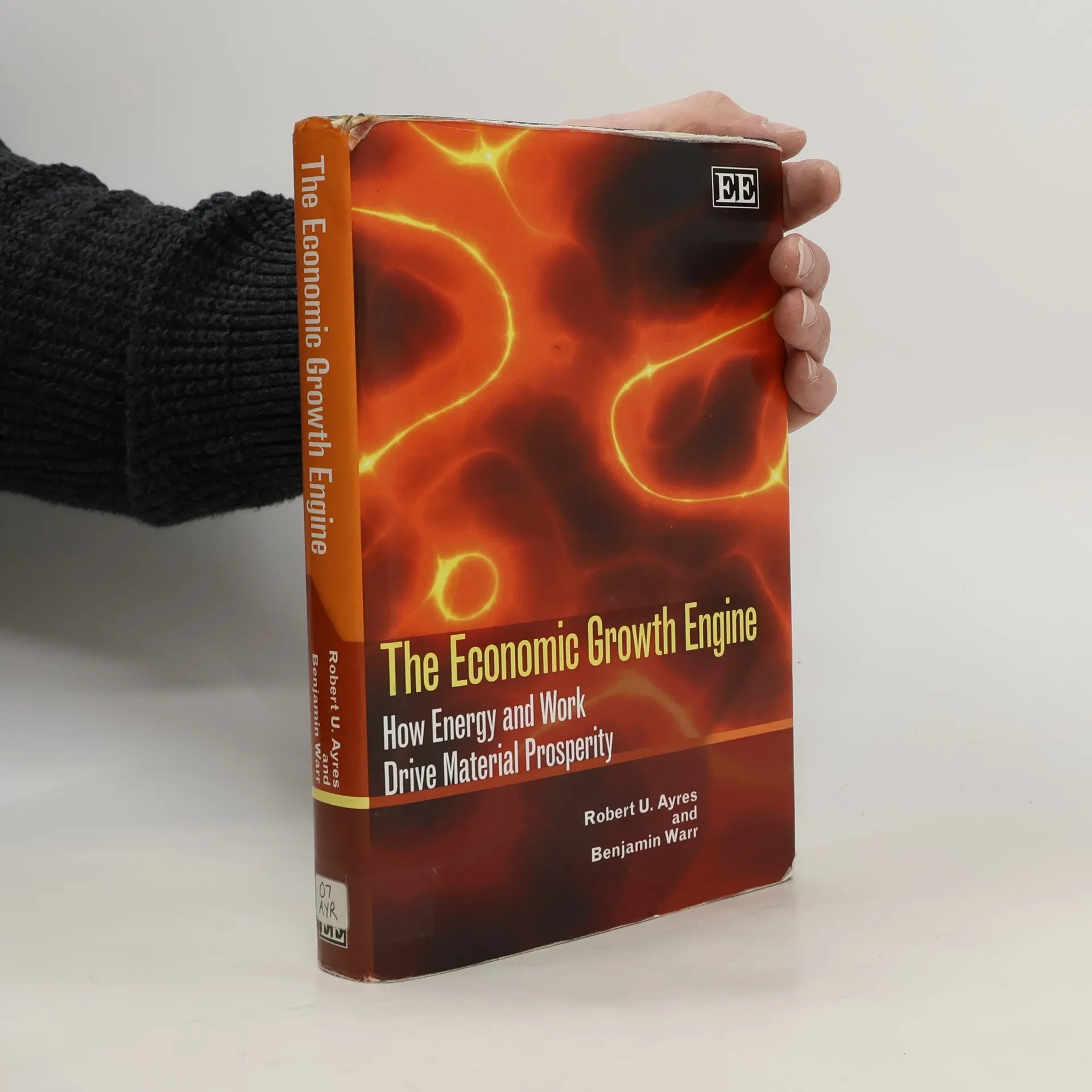
      The Economic Growth Engine

      How Energy and Work Drive Material Prosperity

      • 411 pages
      • 15 hours of reading

      `Would you want your great-children in 2100AD to have a 22nd-century industrial economy? If so, read this book to grasp how strongly wealth depends on energy and its efficient use. Start treating fossil energy, not as continuing income, but as one-time energy capital to spend on efficiency and long-term sustainable energy production. Otherwise, your descendants will inherit a broken 20th-century economy that only worked with cheap fossil fuels. They will not be rich and they will wonder what their ancestors were thinking.'- John R. Mashey, PhD, Silicon Graphics `Current economic theory attributes most income growth to technical progress. However, since technical progress can neither be defined nor measured, no one really knows what policies will encourage income growth. Ayres and Warr show that access to useful work, which can be defined and measured, explain the bulk of post-1900 income changes in Japan, Britain and the USA. They see rising real prices for fossil fuel and stagnating efficiencies of converting raw energy into useful work as a threat to continued income growth. This brilliant and original work has profound policy implications for future income growth without significant improvements in energy conversion efficiency.'- Thomas Casten, Recycled Energy Development LLC `Following the up-and-down energy shock of 2008, Ayres and Warr offer a unique analysis critical to our economic future. They argue that "useful work" produced by energy and energy services is far more important to overall GDP growth than conventional economic theory assumes. Their new theory, based on extensive empirical and theoretical analysis, has important implications for economists, businessmen and policymakers - for anybody concerned with our economic future. Ayres and Warr argue persuasively that economic growth is not only endogenous but has been driven for the past two centuries largely by the declining effective cost of energy. If their new theory is correct, the inevitable future rise of the real cost of energy (beyond the $147 oil price peak in July 2008), could halt economic growth in the US and other advanced countries unless we dramatically improve energy with technology.'- J. Paul Horne, independent international market economist `This book addresses a very important topic, namely economic growth analysis from the angle of energy and material flows. The treatment is well balanced in terms of research and interpretation of the broader literature. The book not only contains a variety of empirical indicators, statistical analyses and insights, but also offers an unusually complete and pluralistic view on theorizing about economic growth and technological change. This results in a number of refreshing perspectives on known ideas and literatures. The text is so attractively written that I found it very difficult to stop reading. All in all, this is a very original and important contribution to the everlasting debate on growth versus environment.'- Jeroen C.J.M. van den Bergh, University of Barcelona, Spain and Free University, Amsterdam, The Netherlands The historic link between output (GDP) growth and employment has weakened. Since there is no quantitively verifiable economic theory to explain past growth, this unique book explores the fundamental relationship between thermodynamics (physical work) and economics. The authors take a realistic approach to explaining the relationship between technological progress, thermodynamic efficiency and economic growth. Their findings are a step toward the integration of neo-classical and evolutionary perspectives on endogenous economic growth, concluding in a fundamental explanation of endogenous growth that is both quantifiable and consistent with the laws of thermodynamics. For two centuries fossil and other sources of energy (work) have been replacing human and animal muscles. Now our civilization is truly addicted to fossil energy availability at ever low prices. Can increasing efficiency compensate for coming scarcity? This is the crucial question. The most important implication of this is that future economic growth is not guaranteed because the efficiency gains that have driven growth in the past may not continue in the future. Exploring the theory of growth with an emphasis on the role of energy, useful work and technological change, this book will be of great interest to academics and students focussing on growth theory, energy and ecological economics. It will also prove insightful to those concerned with policy making or responding to changes in policy related to the energy-growth nexus.

      The Economic Growth Engine
    • 1997

      Turning Point

      End of the Growth Paradigm

      • 192 pages
      • 7 hours of reading

      The book critiques the current model of economic growth, arguing that it not only falls short of delivering benefits but also jeopardizes future security. It proposes a long-term strategy for economic revival called eco-restructuring, which emphasizes transitioning from goods production to services, closing material cycles, and reducing dependence on non-renewable resources. This approach aims to create a more sustainable and secure economic future.

      Turning Point
    • 1997

      Information, Entropy, and Progress

      A New Evolutionary Paradigm

      • 324 pages
      • 12 hours of reading

      Exploring evolution across diverse scales, this work connects geology, biology, and social systems through the lens of thermodynamics and information theory. The author introduces the concept of "distinguishability" information, illustrating how this universal knowledge influences evolutionary processes. By examining the interplay between resource use and self-organization, the book challenges conventional views and offers a fresh perspective on the dynamics of evolution, making it essential for those interested in economics and related fields.

      Information, Entropy, and Progress