

More about the book
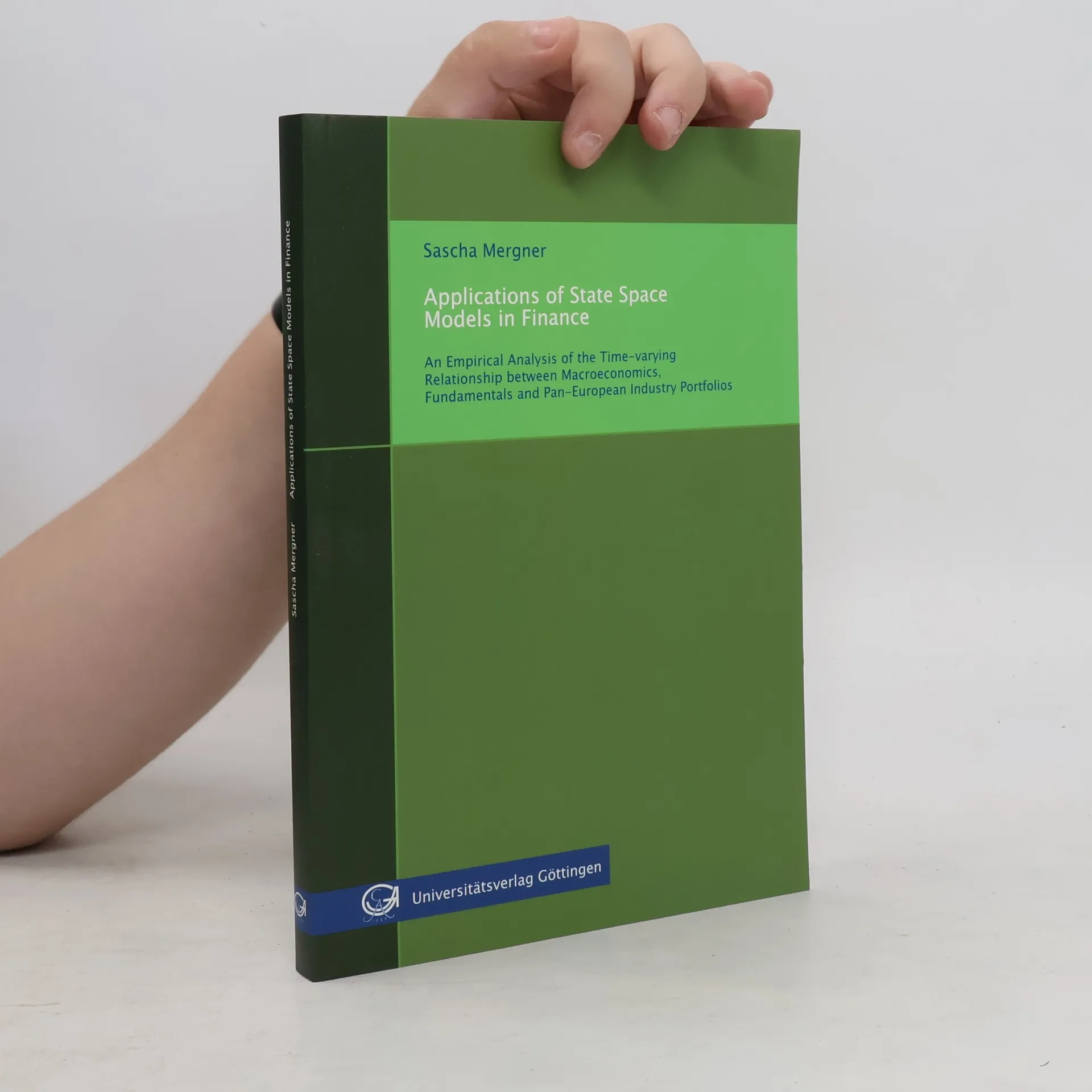
State space models play a key role in the estimation of time-varying sensitivities in financial markets. The objective of this book is to analyze the relative merits of modern time series techniques, such as Markov regime switching and the Kalman filter, to model structural changes in the context of widely used concepts in finance. The presented material will be useful for financial economists and practitioners who are interested in taking time-variation in the relationship between financial assets and key economic factors explicitly into account. The empirical part illustrates the application of the various methods under consideration. As a distinctive feature, it includes a comprehensive analysis of the ability of time-varying coefficient models to estimate and predict the conditional nature of systematic risks for European industry portfolios.
Book purchase
Applications of state space models in finance, Sascha Mergner
- Language

- Released
- 2009
- Binding
- (Paperback)
Payment methods
No one has rated yet.
- Title
- Applications of state space models in finance
- Language
- English
- Authors
- Sascha Mergner
- Publisher
- Univ.-Verl. Göttingen
- Released
- 2009
- Format
- Paperback
- Pages
- 235
- ISBN10
- 3941875221
- ISBN13
- 9783941875227
- Series
- Categories
- Description
- State space models play a key role in the estimation of time-varying sensitivities in financial markets. The objective of this book is to analyze the relative merits of modern time series techniques, such as Markov regime switching and the Kalman filter, to model structural changes in the context of widely used concepts in finance. The presented material will be useful for financial economists and practitioners who are interested in taking time-variation in the relationship between financial assets and key economic factors explicitly into account. The empirical part illustrates the application of the various methods under consideration. As a distinctive feature, it includes a comprehensive analysis of the ability of time-varying coefficient models to estimate and predict the conditional nature of systematic risks for European industry portfolios.