



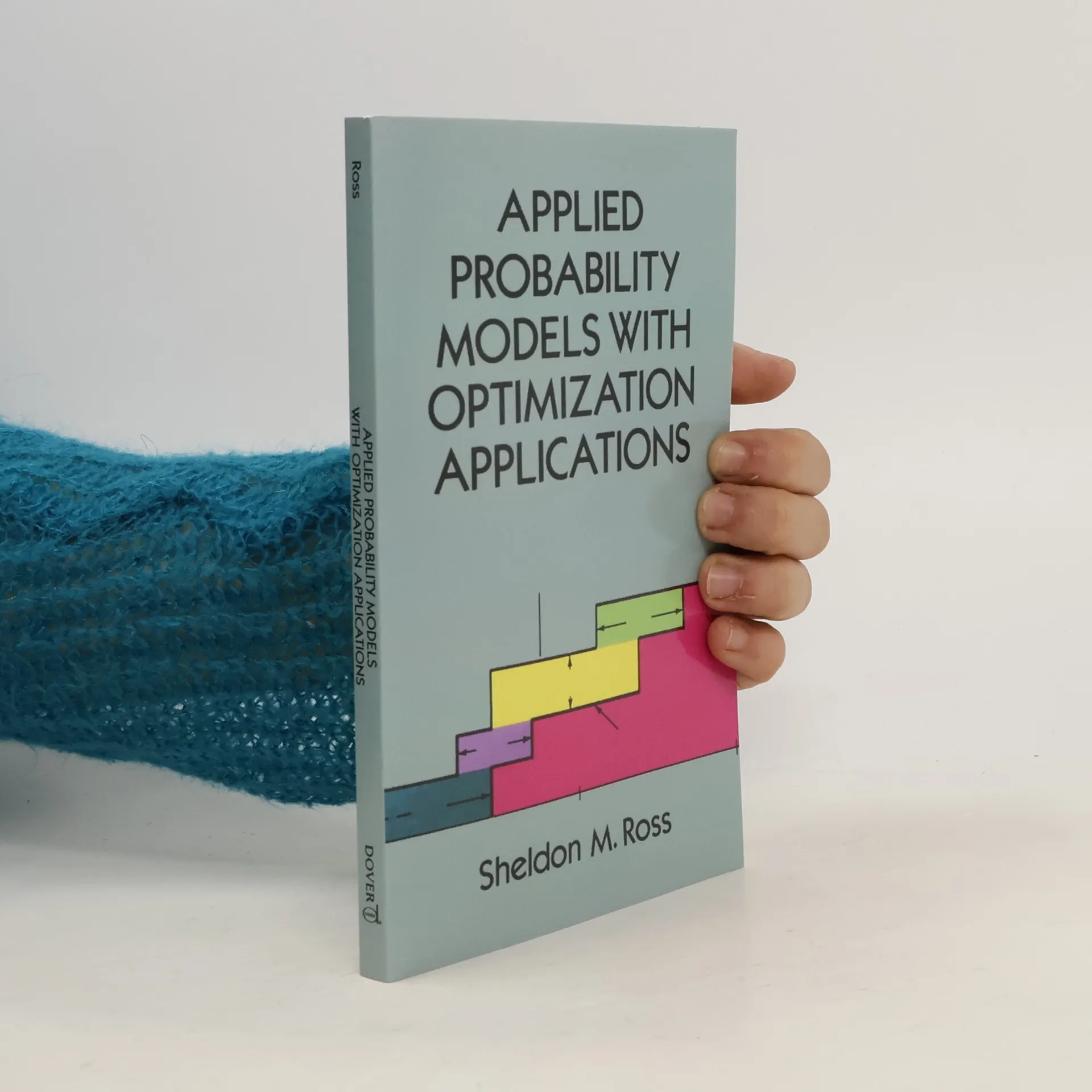
Concise advanced-level introduction to stochastic processes that frequently arise in applied probability. Largely self-contained text covers Poisson process, renewal theory, Markov chains, inventory theory, Brownian motion and continuous time optimization models, much more. Problems and references at chapter ends. "excellent introduction." -- Journal of the American Statistical Association. Bibliography. 1970 edition.
Sheldon M. Ross Books
Sheldon M. Ross is a distinguished author whose work significantly shapes the fields of statistics and applied probability. His writings are characterized by a profound depth and a comprehensive approach to tackling intricate problems. Ross focuses on elucidating theoretical concepts and demonstrating their practical applications across engineering and scientific disciplines. His extensive research and publications have made substantial contributions to the advancement of these fields.


A First Course in Probability Pearson New International Edition - Ninth Edition
- 464 pages
- 17 hours of reading
A First Course in Probability, Ninth Edition, features clear and intuitive explanations of the mathematics of probability theory, outstanding problem sets, and a variety of diverse examples and applications. This book is ideal for an upper-level undergraduate or graduate level introduction to probability for math, science, engineering and business students. It assumes a background in elementary calculus.
Introduction to Probability and Statistics for Engineers and Scientists
- 704 pages
- 25 hours of reading
Focusing on the interplay between probability and statistical problems, this edition enhances intuitive understanding for engineers and scientists. It features real data from various fields, including life sciences and business, complemented by diverse exercises and examples. End-of-chapter reviews emphasize key concepts and practical risks. The latest edition includes insights on Big Data and R programming. Ideal for upper-level undergraduates, graduates, and professionals, it serves as a comprehensive reference for foundational content and applications in engineering and science.
Introduction to Probability Models
- 870 pages
- 31 hours of reading
The book offers a thorough foundation in probability models, making it essential for students in various fields such as engineering, computer science, and social sciences. Renowned for its practical applications, it features a wealth of exercises and real-world examples, guiding readers from basic concepts to advanced topics. This comprehensive course text has been a trusted resource for four decades, recognized for its educational value and efficacy in teaching probability.
Simulation
- 336 pages
- 12 hours of reading
Focusing on the practical application of computerized simulation studies, this edition guides readers through constructing and analyzing simulations to interpret real-world phenomena. It covers essential techniques for generating random numbers and using them to model stochastic behavior over time. The book emphasizes the importance of statistical methods for analyzing simulated data and validating models, making it a valuable resource for actuaries, engineers, and computer scientists seeking effective solutions across various fields.