


Explore the latest books of this year!
Bookbot

David Luenberger

    January 1, 1937
    Linear and Nonlinear Programming
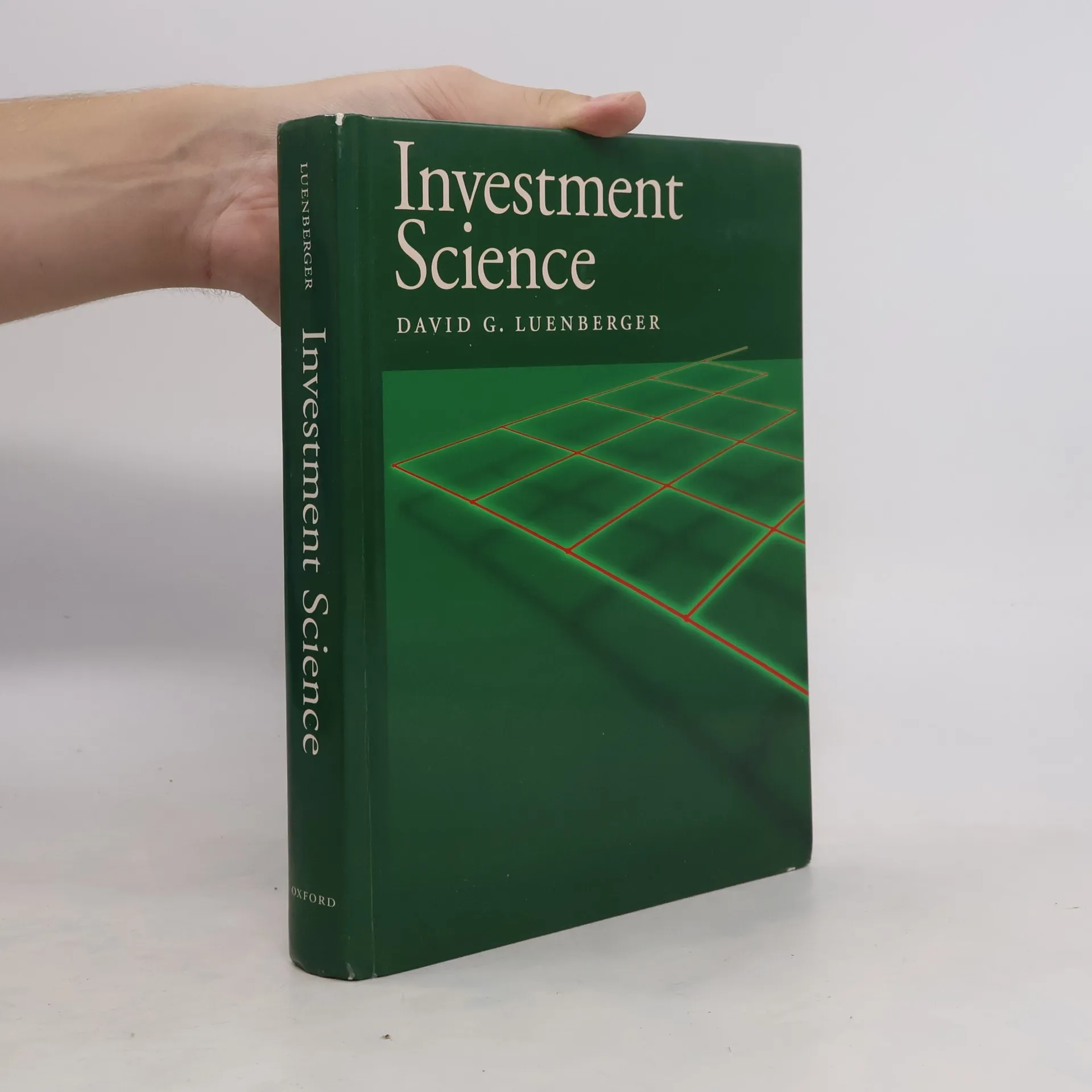
    Investment Science
    • 2015

      Linear and Nonlinear Programming

      • 559 pages
      • 20 hours of reading

      This new edition emphasizes state-of-the-art practical optimization techniques, highlighting the connection between the analytical nature of optimization problems and the algorithms used to solve them. The material is organized into three parts. Part I serves as a self-contained introduction to linear programming, covering key theoretical elements, effective numerical algorithms, and significant applications. Part II, independent of Part I, delves into unconstrained optimization theory, presenting optimality conditions and basic algorithms while exploring algorithm properties and convergence notions. Part III extends these concepts to constrained optimization problems and can be approached without prior knowledge from Part I, as used in various universities. A notable addition is a chapter on Conic Linear Programming, an advanced topic with diverse applications. The edition also introduces an accelerated steepest descent method with superior convergence properties, along with proofs for both standard and accelerated methods. End-of-chapter exercises are included for all chapters. Reviews of the previous edition praise it as a classic textbook in optimization, essential for students, researchers, and specialists across various disciplines.

      Linear and Nonlinear Programming
    • 1997

      Investment Science

      • 512 pages
      • 18 hours of reading

      Fueled by recent theoretical advancements in finance and the rapid growth of information technology, investment theory is gaining significant intellectual attention. These developments are being integrated into university curricula, financial institutions, and individual investor knowledge. Modern investment theory, articulated through mathematics, is now crucial for both academic and practical training. This resource serves as an essential tool for teaching contemporary investment concepts, presenting sound fundamentals and practical problem-solving methods. David Luenberger offers accessible mathematical coverage of key topics in introductory investments, including fixed-income securities, modern portfolio theory, capital asset pricing theory, and derivatives like futures and options. He creatively employs binomial lattices to address a range of finance problems while maintaining a level of mathematical sophistication that remains within algebra, elementary statistics/probability, and calculus. Appendices on probability and calculus are provided for reference, alongside examples and exercises to reinforce the principles discussed. Suitable for investment management courses across various disciplines, this resource has been successfully tested at institutions like Boston University and Stanford University. It is also valuable for executives, managers, and financial analysts involved in investment evaluation and structuring ac

      Investment Science