

David Young transitioned from a career in journalism to the world of fiction, completing an inaugural Crime Thriller MA where he won the course prize for his debut novel. Set in 1970s communist East Germany, this novel became a bestseller, exploring gripping historical narratives. Young's work plunges readers into compelling, often tense, scenarios rooted in the past. He now writes full-time, crafting stories that captivate audiences with their intricate plots and atmospheric settings.
In King Jesus and the Beauty of Obedience-Based Discipleship, David Young
presents a bold call for obedience-based discipleship and argues that it alone
is the proper response to the kingship of Jesus
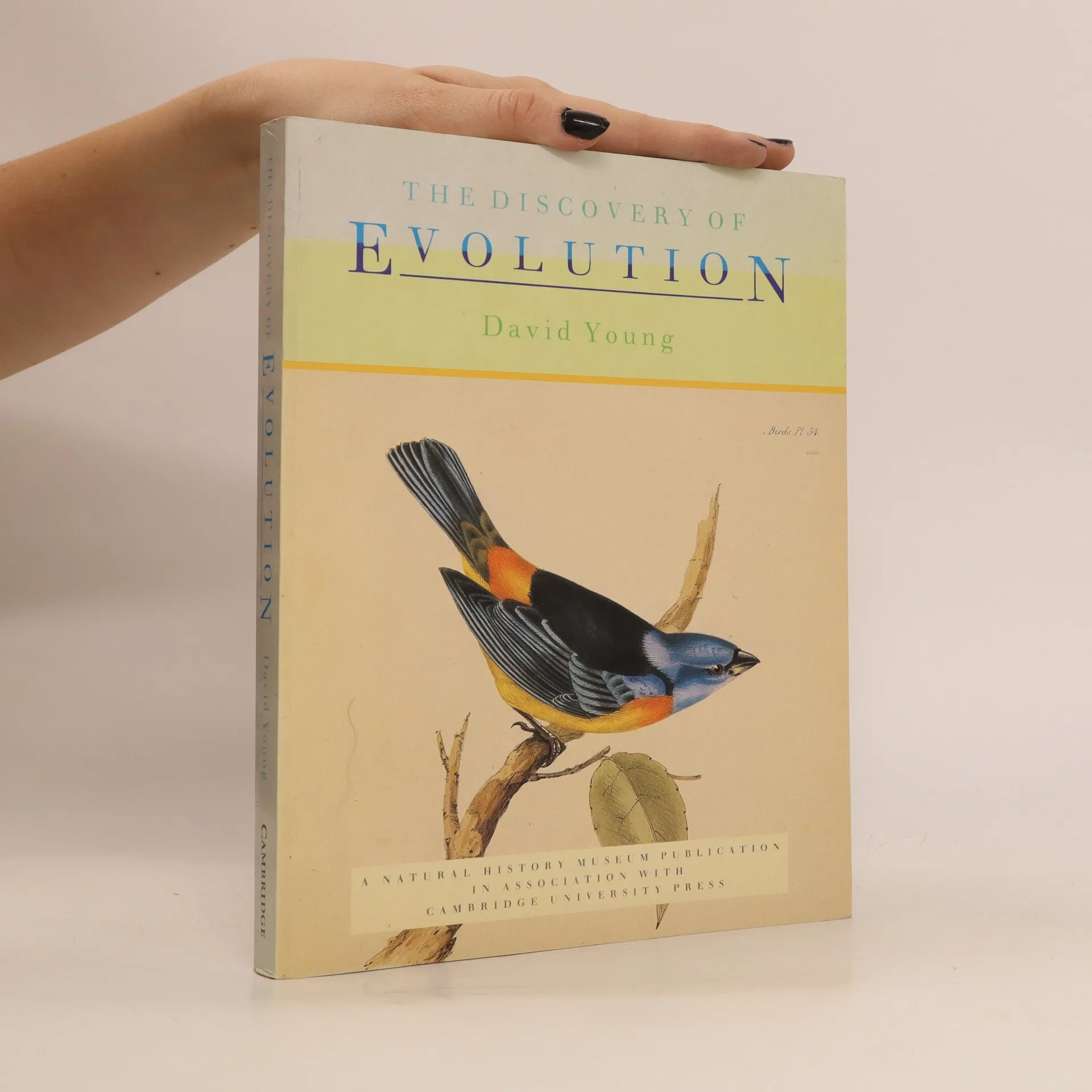
David Young invites his readers on a journey of adventure and discovery; a journey for the mind, and an adventure in the realm of ideas. By retracing the steps of men who developed the theory of biological evolution, we see how scientists came to recognize the nature and importance of natural selection. The journey begins in the seventeenth century, when even the most accomplished naturalists knew next to nothing of biology as we understand it today. Steadily increasing knowledge and the quickening pace of research began to uncover much new evidence, and in the middle of the century Charles Darwin and Alfred Russel Wallace incorporated this evidence in a comprehensive theory of evolution. In the twentieth century biology has become steadily more specialized, so the book picks out some of the main developments that bring us to studies of evolution being carried out today.

Tired of Falling for Mirages? These days, reasons for irritability pop up as regularly as Facebook advertisements. Of all the reasons to be irritable, this one has to be the worst: We often want things that turn out not to exist. People can spend thier lives wholeheartedly pursuing things that are unreal. These mirages burst like soap bubbles, and we are left disappointed and frustrated. The purpose of this book is to expose five things people want from God that don't exist -so that we can retrain our desires to focus on what does exist. When we pursue what does exist, we will find our souls satisfied. DANIEL J. MCCOY Daniel is happily married to Susanna, and they have 3 daughters and 2 sons. Daniel works as editorial director for Renew.org. He has his bachelor's in theology (Ozark Christian College), and his PhD in theology (North-West University). He is the co-author of The Atheist's Fatal Flaw (Baker, 2014) with Norman Geisler, as well as the general editor of The Popular Handbook of World Religions (Harvest House, 2021). His passionis to help people understand that they can totally trust Jesus.
A gorgeous selection of the humane and moving poetry of David Young, a celebrated poet of the midwestern landscape and the people who live in it, with an expanded section featuring sixteen new poems exclusive to the paperback edition. A newly expanded career-spanning volume from one of our most valuable living American poets, offering poems that display an exquisite ear tuned to the natural world, to love and friendship, and to the continually renewable possibilities of language, and new poems that reflect a continued artistic interest in these subjects. Young’s settings are at once local and universal—an adolescence in Omaha, late summer on Lake Erie, a sleepless night in the backyard during a meteor shower. He moves with dazzling ease between culture and nature, between the literary and the philosophical, microcosm and macrocosm. Here are poems on Osip Mandelstam and Chairman Mao, the meaning of boxcars on the track, the beautiful names of the months, and a fox at the field’s edge, charged in each case by Young’s fierce intelligence and candor in the face of grief and loss. “We float through space. Days pass,” Young writes in “The Portable Earth-Lamp.” “Sometimes we know we are part of a crystal / where light is sorted and stored.” His metaphysical reach, balancing remarkable humility with penetrating vision, is one of the great gifts of this exemplary career in poetry.
The authors chose the term 'global' for the book's title to convey the idea that the book is truly global in its coverage. What distinguishes this book from others in financial accounting and corporate financial reporting is the seamless way it approaches the world's two dominant accounting regimes: US Generally Accepted Accounting Principles (GAAP) and International Financial Reporting Standards (IFRS). The tendency in the field is to present the material from a US GAAP perspective, with some discussion, usually at the end of the chapter, on financial reporting practices under IFRS and how they might differ from those of GAAP on the chapter topic. Or, when the book is written from an IFRS perspective, US GAAP is ignored entirely. The problem with this latter approach is that at least 40% of the world's total stock market capitalization is accounted for by companies reporting under US GAAP. Meanwhile, more than half is accounted for by IFRS. Investors in the global capital markets cannot neglect either of these two approaches. The world will have one dominant accounting regime some day, but for the foreseeable future, we are left with two distinctive, though increasingly overlapping, sets of standards. The challenge is to integrate these approaches in such a way that critical differences are addressed, but in a way that is accessible to the reader.
A secret State. A dark conspiracy. A terrible crime. Karin Mu¨ller of the German Democratic Republic's People's Police is called to a factory in the east of the country. A man has been murdered - bound and trapped as a fire burned nearby, slowly suffocating him. But who is he? Why was he targeted? Could his murderer simply be someone with a grudge against the factory's nationalisation, as Mu¨ller's Stasi colleagues insist? Why too is her deputy Werner Tilsner behaving so strangely? As more victims surface, it becomes clear that there is a cold-blooded killer out there taking their revenge. Soon Mu¨ller begins to realise that in order to solve these terrible crimes, she will need to delve into the region's dark past. But are the Stasi really working with her on this case? Or against her? For those who really run this Republic have secrets they would rather remain uncovered. And they will stop at nothing to keep them that way. A gripping and evocative crime thriller, moving between the devastating closing weeks of World War II and the Stasi-controlled 1970s, STASI 77 is David Young's most compelling and powerful novel yet.
The body of a teenage boy is found weighted down in a lake. Karin Müller, newly appointed Major of the People's Police, is called to investigate. But her power will only stretch so far, when every move she makes is under the watchful eye of the Stasi. Then, when the son of Müller's team member goes missing, it quickly becomes clear that there is a terrifying conspiracy at the heart of this case, one that could fast lead Müller and her young family into real danger. Can she navigate this complex political web and find the missing boy, before it's too late?
"East Germany, 1975. Two infant twins have vanished from a city that's supposedly free of crime. Oberleutnant Karin Müller is drafted in from Berlin to take the case - and rescue her own reputation. But amidst the eerie nameless streets, the Stasi insist she run the investigation without destroying the public's blissful ignorance of the danger lurking in the heart of their propaganda-filled community. And she must act fast, because the child-snatcher might not stop at two..."-pg. 4 of cover.