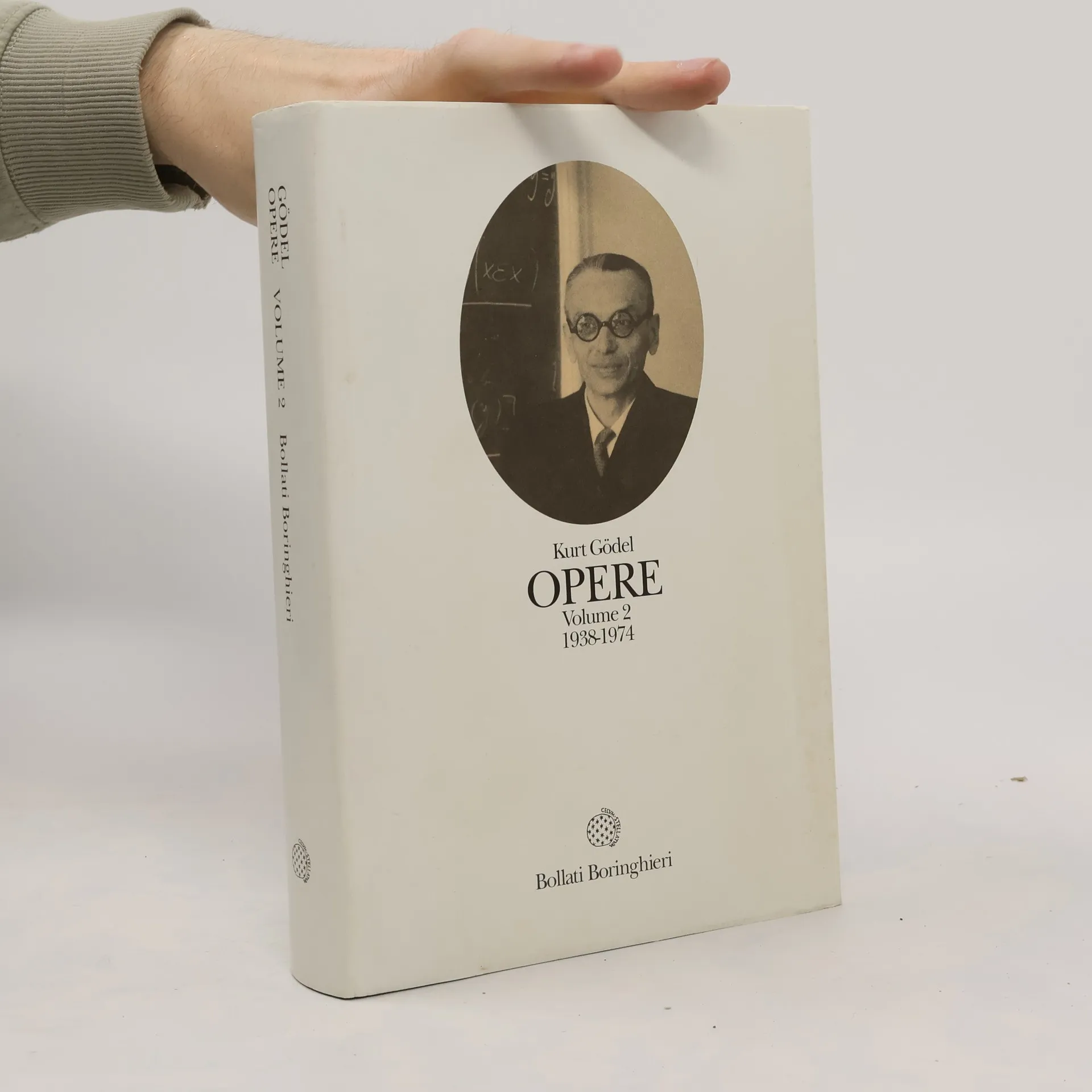
Kurt Gödel (1906-1978) was the most outstanding logician of the twentieth century. This second volume of a comprehensive edition of Gödel's works collects the remainder of his published work, covering the period 1938-1974. (Volume I included all of his publications from 1929-1936). Each article or closely related group of articles is preceded by an introductory note that elucidates it and places it in historical context. The aim is to make the full body of Gödel's work as accessible and useful to as wide an audience as possible, without in any way sacrificing the requirements of historical and scientific accuracy.
Kurt Gödel Books
April 28, 1906 – January 14, 1978
Kurt Gödel was an Austrian-American logician, mathematician, and philosopher who profoundly impacted 20th-century scientific and philosophical thought. He is most celebrated for his two incompleteness theorems, which demonstrated that within any consistent axiomatic system powerful enough to describe natural number arithmetic, there exist true statements that cannot be proven from the axioms. To establish these theorems, Gödel pioneered a technique known as Gödel numbering, which encodes formal expressions as natural numbers. His work also clarified connections between various logical systems and showed that the continuum hypothesis is not disprovable from the accepted axioms of set theory.


Die Maximen Philosophie von Kurt Gödel, niedergeschrieben zwischen 1934 und 1955, umfasst philosophische Überlegungen und angewandte Individualethik. Band 2 der historisch-kritischen Edition behandelt Gödels Ethik und deren Verbindung zur Stoa sowie antiker Diätetik. Eine Einführung bietet Kontext zu seinen Gedanken.
Principia mathematica (Volume III)
- 504 pages
- 18 hours of reading
This book has been considered by academicians and scholars of great significance and value to literature. This forms a part of the knowledge base for future generations. We have represented this book in the same form as it was first published. Hence any marks seen are left intentionally to preserve its true nature.
Philosophie I Maximen 0 / Philosophy I Maxims 0
- 241 pages
- 9 hours of reading
Der Mathematiker Kurt Gödel hat über einen Zeitraum von 22 Jahren (1934-1955) philosophische Bemerkungen, die so genannten Maximen Philosophie (Max Phil), niedergeschrieben. Sie sind in 15 Notizbüchern in der Kurzschrift Gabelsberger überliefert. Das erste Notizheft enthält allgemeine philosophische Überlegungen, die Hefte zwei und drei bestehen aus Gödels Individualethik. Die dann folgenden Notizbücher machen deutlich, dass Gödel eine Wissenschaftsphilosophie entworfen hat, in der er seine Erörterungen zu Physik, Psychologie, Biologie, Mathematik, Sprache, Theologie und Geschichte in den Kontext einer Metaphysik stellt.Erstmals wird nun an der Kurt-Gödel-Forschungsstelle der Berlin-Brandenburgischen Akademie der Wissenschaften eine vollständige, historisch-kritische Edition von Gödels philosophischen Notizbüchern vorbereitet. Im Rahmen dieser Edition erscheint jährlich ein Band. Band 1, von Gödel mit ›Philosophie I Max 0‹ betitelt, umfasst philosophische Überlegungen Gödels sowie anderer für ihn bedeutender Autoren, die er an den Anfang seines philosophischen Gesamtprojektes gestellt hat. Die Einleitung der Herausgeberin Eva-Maria Engelen bietet einen Überblick über das Korpus.
Kurt Gödel: Philosophische Notizbücher/Philosophical Notebooks/Maximen V/Maxims V
- 208 pages
- 8 hours of reading
Der Mathematiker Kurt Gödel hat über einen Zeitraum von 22 Jahren (1934-1955) philosophische Bemerkungen, die so genannten Maximen Philosophie (Max Phil), niedergeschrieben. Sie sind in 15 Notizbüchern in der Kurzschrift Gabelsberger überliefert. Das erste Heft enthält allgemeine philosophische Überlegungen, die Hefte zwei und drei bestehen aus Gödels Individualethik. Die dann folgenden zeigen, dass Gödel eine Wissenschaftsphilosophie entworfen hat, in der er seine Erörterungen zu Physik, Psychologie, Biologie, Mathematik, Sprache, Theologie und Geschichte in den Kontext einer Metaphysik stellt. Erstmals wird nun an der Kurt-Gödel-Forschungsstelle der Berlin-Brandenburgischen Akademie der Wissenschaften eine vollständige, historisch-kritische Edition von Gödels Philosophischen Notizbüchern vorbereitet. Im Rahmen dieser Edition erscheint jährlich ein Band. Band 5 ist schon deshalb besonders interessant, weil Gödel zu Beginn von ›Maximen V‹ seine Zufriedenheit damit erkennen lässt. Er bekundet, dass er hier zu eigenständigem Denken gelangt ist, das nicht in erster Linie in Auseinandersetzung mit anderen Autoren zustande gekommen ist. Darüber hinaus findet sich hier, neben zahlreichen bemerkenswerten philosophischen Überlegungen, eine bisher unbekannte Deutung seines (zweiten) Unvollständigkeitssatzes, die über die mathematische hinausreicht.
Der Mathematiker Kurt Gödel hat über einen Zeitraum von 22 Jahren (1934-1955) philosophische Bemerkungen, die so genannten Maximen Philosophie (Max Phil), niedergeschrieben. Sie sind in 15 Notizbüchern in der Kurzschrift Gabelsberger überliefert. Das erste Heft enthält allgemeine philosophische Überlegungen, die Hefte zwei und drei bestehen aus Gödels Individualethik. Die dann folgenden zeigen, dass Gödel eine Wissenschaftsphilosophie entworfen hat, in der er seine Erörterungen zu Physik, Psychologie, Biologie, Mathematik, Sprache, Theologie und Geschichte in den Kontext einer Metaphysik stellt. Erstmals wird nun an der Kurt-Gödel-Forschungsstelle der Berlin-Brandenburgischen Akademie der Wissenschaften eine vollständige, historisch-kritische Edition von Gödels Philosophischen Notizbüchern vorbereitet. Im Rahmen dieser Edition erscheint jährlich ein Band. In Band 4 setzt Gödel sich mit Grundlagenfragen der Mathematik und Logik sowie der Philosophie der Mathematik auseinander. Zudem stehen das Verhältnis verschiedener wissenschaftlicher Disziplinen zueinander und deren spezifische Fragestellungen im Zentrum seiner Überlegungen. Zu nennen sind hier insbesondere Philosophie, Psychologie, aber auch Theologie.
Opere. Volume 1938-1974. A cura di Solomon Feferman, con la collaborazione di John W. Dawson Jr, Stephen C. Kleene, Gregory H. Moore, Robert M. Solovay e Jean van Heijenoort. Edizione italiana a cura di Edoardo Ballo, Gabriele Lolli e Corrado Mangione 8vo. pp. 388. . Ottimo (Fine). . . .
Úplnost a neúplnost
- 138 pages
- 5 hours of reading
Další kniha z řady základních textů evropské vzdělanosti iniciovaná Petrem Vopěnkou. A po desetiletích teprve druhá přeložená kniha zásadních textů jednoho z největších matematiků, logiků a myslitelů dvacátého století. Gödelovy věty (z roku 1931) o neúplnosti jsou i přes svojí stručnost stále vlivným textem nejen exaktních věd (zejm. matematické logiky). Přesahují do filosofie (a nejen matematiky), neboť svou podstatou stanovují omezenost i tak exaktní vědy, kterou matematika je (a ve svém důsledku třeba i nemožnost dokázat úplnou bezespornou teorii, což má důsledky i pro aritmetiku přirozených čísel). Kniha vedle těchto stěžejních textů obsahuje úvodní poznámku a bohatou předmluvu Vítězslava Švejdara, na závěr je doplněna autorovou bibliografií.
Soubor publikovaných i nepublikovaných filosofických esejů jednoho z největších logiků 20. století.