Roy Harris is Emeritus Professor of General Linguistics at the University of Oxford and an Honorary Fellow of St Edmund Hall. His extensive academic experience, including teaching posts in Hong Kong, Boston, and Paris, and visiting fellowships across South Africa, Australia, and India, has shaped his profound insights into the nature of language. Harris's work delves into the intricate relationship between language, thought, and society, exploring how linguistic structures and usage reflect and influence human cognition and social interactions. His scholarly contributions offer a deep examination of the fundamental ways language shapes our understanding of the world and each other.
Set against the backdrop of an epic space journey, the story follows four generations aboard the Protostar, a massive ship, as they uncover their family's legacy and the sacrifices made to seek a new world. A century after their departure, the narrative delves into the origins of their mission, revealing the passion and determination that drove them to embark on this monumental quest for survival and civilization's future.
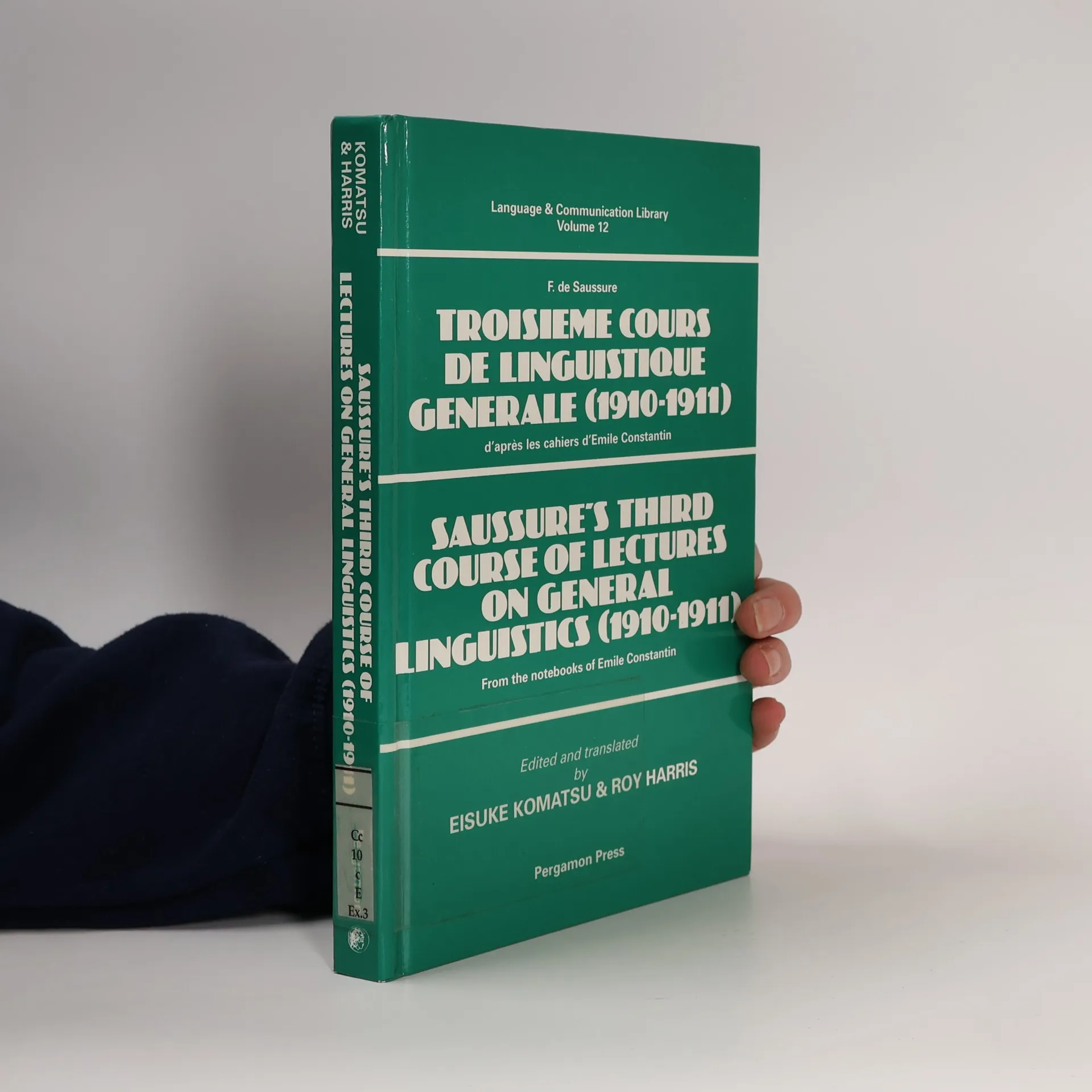
The notes taken by Saussure's student Emile Constantin were not available to the editors of the published Cours de linguistique générale (1916), and came to light only after the second world war. They have never been published in their entirety. The third and last course of lectures, of which Constantin kept this very full record, is generally considered to represent a more advanced version of Saussure's teaching than the earlier two. It is clear that Constantin's notebooks offer a text which differs in a number of significant respects from the Cours published by Saussure's original editors, and bring forward ideas which do not emerge in the 1916 publication. They constitute unique evidence concerning the final stages of Saussure's thinking about language. This edition of the notes is accompanied by an introduction and a full English translation of the text. There has been no attempt made by Komatsu and Harris, to turn the English into readable prose. Constantin's notes, even as revised by their author, retain the infelicities, repetitions, abruptness - occasionally incoherences - that betray the circumstances of their origin. The volume constitutes an important landmark in the history of modern linguistics and provides essential documentation for all scholars and libraries specializing in the subject.
The book presents a provocative argument that reason is not an inherent trait of the human mind but rather a construct shaped by the evolution of literacy in European cultures. Harris critiques the traditional view of rational thought, tracing its development from Classical Greece to contemporary symbolic logic, suggesting that Western notions of reason are deeply intertwined with cultural and historical contexts rather than being universally innate.