
Explore the latest books of this year!
Bookbot

Mark Stevenson

    Mark Stevens is an acclaimed commercial writer, author, and blogger whose work has graced television, radio, newspapers, magazines, and billboards. His debut e-book presents a collection of eight tall tales, each a blend of the silly, the strange, the absurd, and the far-fetched. Stevens crafts narratives with a keen sense of humor and an eye for the wonderfully unbelievable, making his stories equally outlandish and amusing. His writing style is characterized by playful language and unexpected twists that consistently delight readers.

    Education Forward
    Letters of stone
    The Tiger Who Ate Too Much Cheese
    "Do You See What I See?"
    An optimist's tour of the future
    • Mark Stevenson has been to the future a few years ahead of the rest of us - and reckons it has a lot going for it. His voyage of discovery takes him to Oxford to meet Transhumanists (they intend to live forever), to Boston where he confronts a robot with mood swings, to an underwater cabinet meeting in the Indian Ocean, and Australia to question the Outback's smartest farmer. He clambers around space planes in the Mojave desert, gets to grips with the potential of nanotechnology, delves deep into the possibilities of biotech, sees an energy renaissance on a printer, a revolution in communications, has his genome profiled, and glimpses the next stage of human evolution ... and tries to make sense of what's in store.Insightful and often very funny, An Optimist's Tour of the Future is a book that tracks one curious man's journey to find out 'what's in store?'

      An optimist's tour of the future
    • "Do You See What I See?"

      • 320 pages
      • 12 hours of reading

      Exploring themes of perception and perspective, this book invites readers to question their understanding of reality. Through engaging narratives and thought-provoking illustrations, it challenges the way we see the world and encourages deeper contemplation of our surroundings. The work emphasizes the importance of empathy and connection, prompting readers to consider how their viewpoints shape their experiences and interactions with others.

      "Do You See What I See?"
    • Tiger eats too much cheese and feels poorly. Can his friend bear help him? Join in their adventures in town to find out.

      The Tiger Who Ate Too Much Cheese
    • Letters of stone

      • 288 pages
      • 11 hours of reading

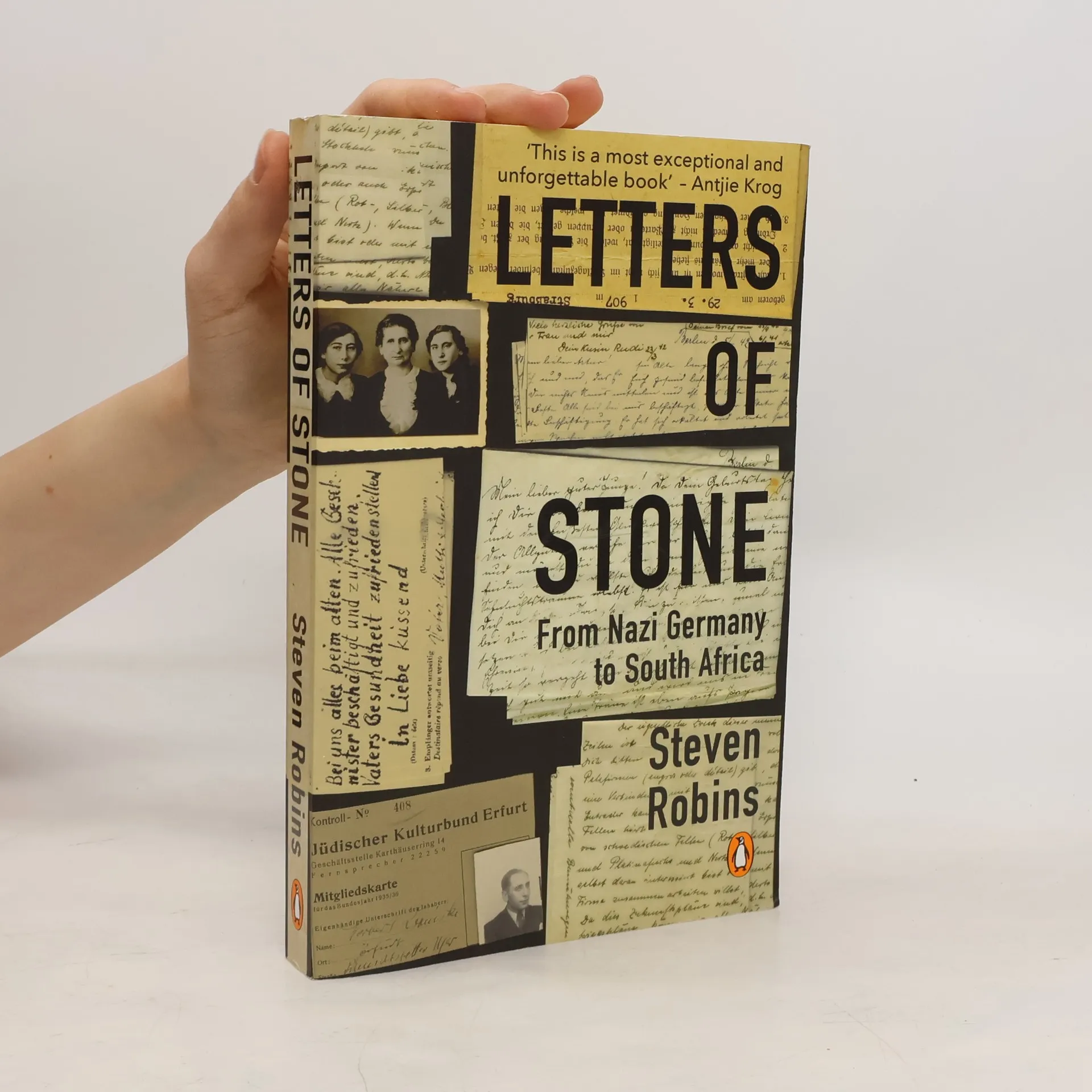
      As a young boy growing up in Port Elizabeth in the 1960s and 1970s, Steven Robins was haunted by an old photograph of three unknown women on a table in the dining room. Only later did he learn that the women were his father's mother and sisters, photographed in Berlin in 1937, before they were killed in the Holocaust. Steven's father, who had fled Nazi Germany before it was too late, never spoke about the fate of his family who remained there. Steven became obsessed with finding out what happened to the women, but had little to go on. In time he stumbled on official facts in museums in Washington DC and Berlin, and later he discovered almost one hundred letters sent to his father and uncle from the family in Berlin during the Nazi terror. The women in the photograph could now tell their story. Letters of Stone tracks Steven's journey of discovery about the lives and fates of the Robinski family, in southern Africa, Berlin, Riga and Auschwitz. It also explores the worldwide rise of eugenics and racial science before the war, which justified the murder of Jews by the Nazis and caused South Africa and other countries to close their doors to Jewish refugees. Most of all, this book is a poignant reconstruction of a family trapped in an increasingly terrifying and deadly Nazi state, and of the immense pressure on Steven's father in faraway South Africa, which forced him to retreat into silence

      Letters of stone
    • Too often, we think of school as a fixed-rail path we all have to follow: teachers teach, students learn, exams are taken, futures set. That's how it's been since the introduction of compulsory schooling in the 19th century. But parents, teachers and corporations around the world are now voicing their dissatisfaction with education systems that are no longer fit for purpose. Too many of our young people are not being adequately prepared for the unprecedented challenges they will face in a world that is changing as rapidly as ours is. We should be preparing them for the test of life, not a life of tests. A group of distinctive voices - working in education and beyond - has produced a collection of essays that presents a call to action, a positive way forward, and a programme of change. Education Forward challenges us all to find another story for the future of schools.

      Education Forward