Control
- 288 pages
- 11 hours of reading
A short, highly directed guide to an area of science that is little understood but increasingly part of public discourse by the Sunday Times bestselling author of HOW TO ARGUE WITH A RACIST


Adam Rutherford is a British author focused on science communication. His work delves into genetics and the origins of life, aiming to make complex scientific subjects accessible to a broad audience. Rutherford uses his storytelling prowess to engage and educate readers about our biological heritage. His writing is noted for its clarity and compelling style, making him a valuable voice in scientific literature.



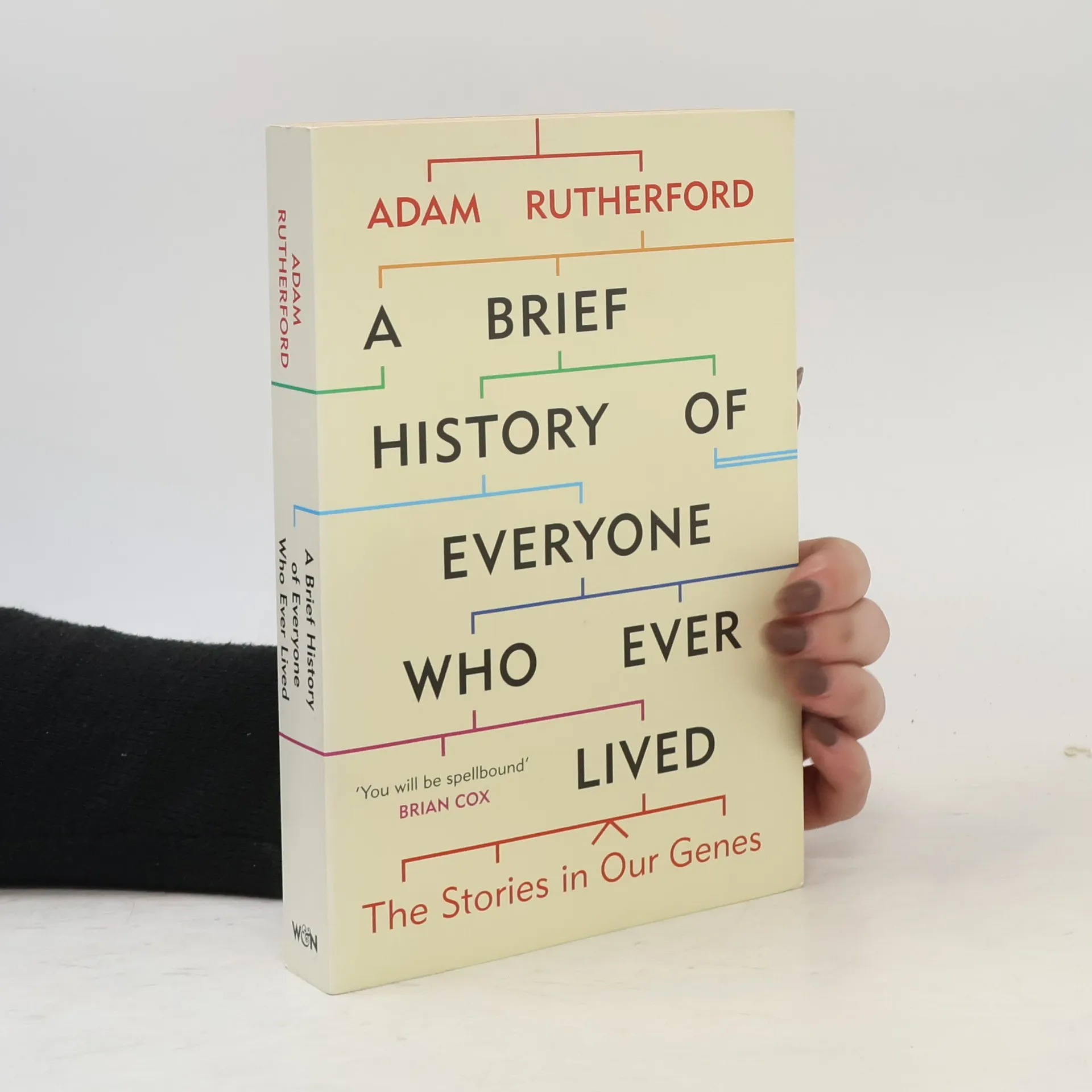


A short, highly directed guide to an area of science that is little understood but increasingly part of public discourse by the Sunday Times bestselling author of HOW TO ARGUE WITH A RACIST
In Rutherford and Fry's comprehensive guidebook, they tell the complete story of the universe and absolutely everything in it - skipping over some of the boring parts. This is a celebration of the weirdness of the cosmos, the strangeness of humans and the fact that amid all the mess, we can somehow make sense of life. Our brains have evolved to tell us all sorts of things that feel intuitively right but just aren't true- the world looks flat, the stars seem fixed in the heavenly firmament, a day is 24 hours... This book is crammed full of tales of how stuff really works. With the power of science, Rutherford and Fry show us how to bypass our monkey-brains, taking us on a journey from the origin of time and space, via planets, galaxies, evolution, the dinosaurs, all the way into our minds, and wrestling with some truly head- scratching questions that only science can answer- What is time, and where does it come from? Why are animals the size and shape they are? How horoscopes work (Spoiler- they don't, but you think they do) Does my dog love me? Why nothing is truly round
'A brilliant, authoritative, surprising, captivating introduction to human genetics. You'll be spellbound' Brian Cox This is a story about you. It is the history of who you are and how you came to be. It is unique to you, as it is to each of the 100 billion modern humans who have ever drawn breath. But it is also our collective story, because in every one of our genomes we each carry the history of our species - births, deaths, disease, war, famine, migration and a lot of sex. In this captivating journey through the expanding landscape of genetics, Adam Rutherford reveals what our genes now tell us about human history, and what history can now tell us about our genes. From Neanderthals to murder, from redheads to race, dead kings to plague, evolution to epigenetics, this is a demystifying and illuminating new portrait of who we are and how we came to be. *** 'A thoroughly entertaining history of Homo sapiens and its DNA in a manner that displays popular science writing at its best' Observer 'Magisterial, informative and delightful' Peter Frankopan 'An extraordinary adventure...From the Neanderthals to the Vikings, from the Queen of Sheba to Richard III, Rutherford goes in search of our ancestors, tracing the genetic clues deep into the past' Alice Roberts
Introduction -- Skin in the game -- Your ancestors are my ancestors -- Black Power -- White matter -- Conclusion and recapitulation.
THE SUNDAY TIMES BESTSELLER AS HEARD ON BBC RADIO 4 BOOK OF THE WEEK 'The ultimate anti-racism guide' Caroline Criado Perez 'Seriously important' Bill Bryson 'A fascinating debunking of racial pseudoscience' Guardian Racist pseudoscience may be on the rise, but science is no ally to racists. Instead science and history can be powerful allies against bigotry, granting us the clearest view of how people actually are, rather than how we judge them to be. HOW TO ARGUE WITH A RACIST dismantles outdated notions of race by illuminating what modern genetics can and can't tell us about human difference. It is a vital manifesto for a twenty-first century understanding of human evolution and variation, and a timely weapon against the misuse of science to justify racism. Updated edition includes a new Preface from the author
WHAT MAKES US HUMAN? Waging war? Sex for pleasure? Creating art? Mastery of fire? In this thrilling tour of the animal kingdom, Adam Rutherford tells the story of how we became the unique creatures we are today. Illuminated by the latest scientific discoveries, THE BOOK OF HUMANS is a dazzling compendium of what unequivocally fixes us as animals, and reveals how we are extraordinary among them.