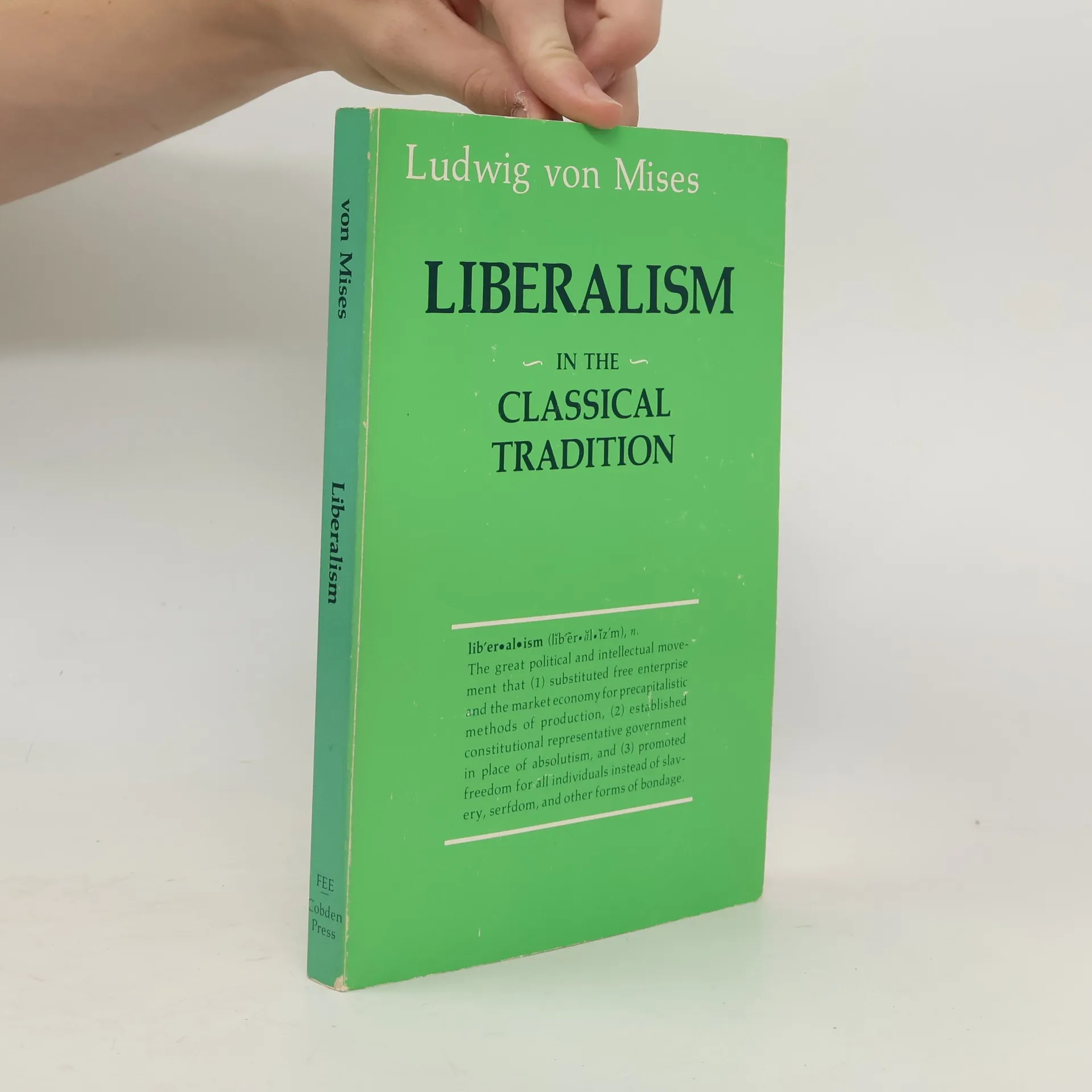
Gives a fundamental examination of the nature of bureaucracies and free markets in juxtaposition to various political systems. This book demonstrates how the efficiencies of private ownership and control of public good production ultimately trump the guesswork of publicly administered 'planning' through codes and 'officialdom'.
This book presents the theoretical and practical arguments for liberalism. Mises contrasts liberalism with other conceivable systems of social organization such as socialism, communism, and fascism. He is also more specific here than elsewhere in applying the liberal program to economic policy, domestic and foreign.
Shortly after fleeing a war-torn Europe, Ludwig von Mises completed his trilogy on economic systems in the United States. This concise treatise, published posthumously in 1998, addresses a world caught between failing planned economies and struggling free markets. Mises warns that mixed economic systems lead to political instability and stagnation, supporting his claims with a model of interventionism and analyses of price control, credit expansion, subsidies, welfare, corporatism, and the war economy. Notably, he discusses the draft as a form of socialism. This work is essential for understanding the post-socialist era and should not be confused with his earlier critique on price control. The volume includes an introduction and chapters covering topics such as capitalism vs. socialism, the roles of capitalist and socialist states, and various forms of economic interference, including restrictive measures and price controls. Mises examines the consequences of these interventions, such as unemployment and inflation, as well as issues related to credit expansion and capital flight. This book serves as a crucial resource for comprehending the complexities of economic systems and their implications.