
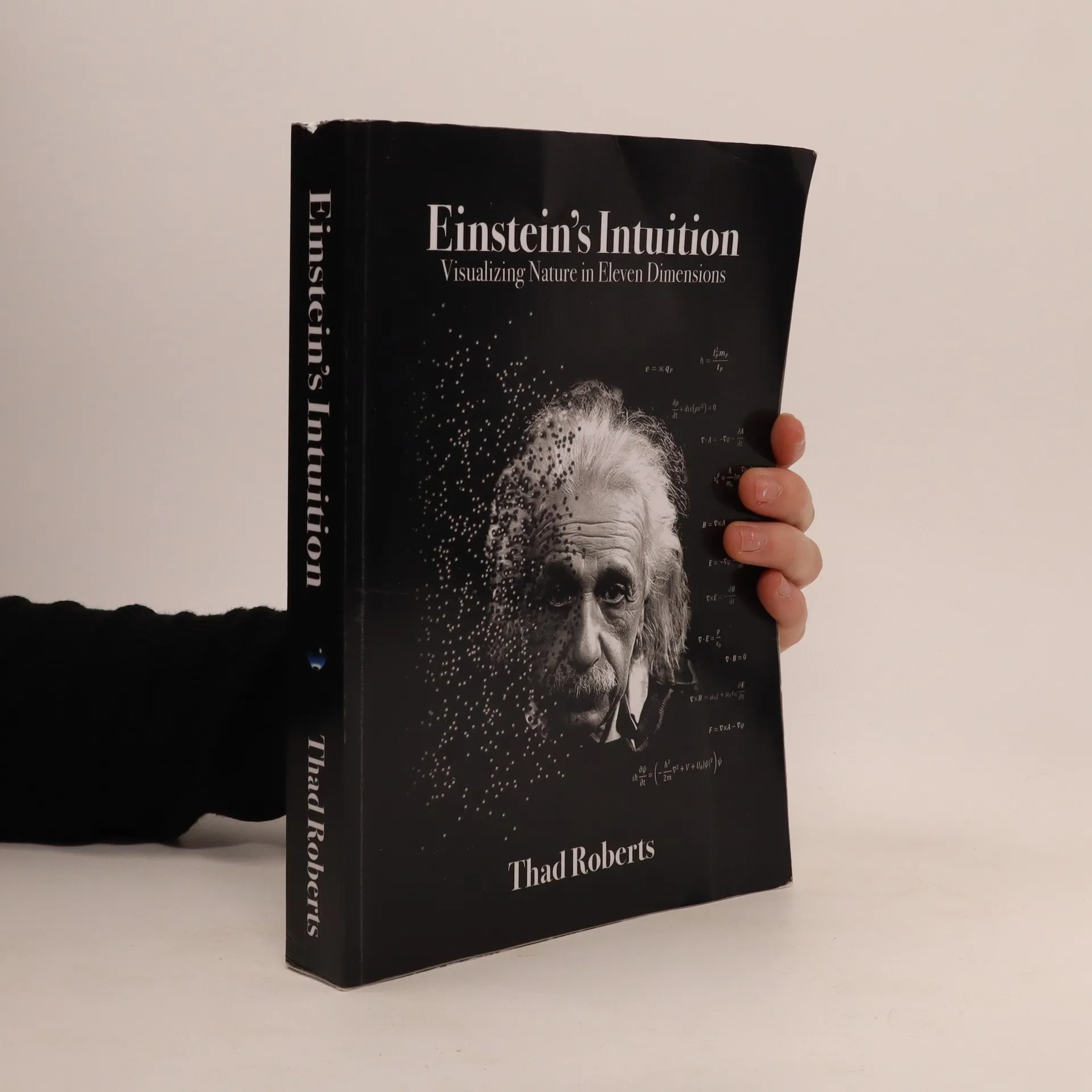

Thad Roberts is a theoretical physicist and philosopher of physics whose work delves into profound questions about the universe. His book, ‘Einstein’s Intuition’, lucidly explores the mysteries of modern physics, artfully challenging traditional assumptions about reality to construct a new perspective on quantum mechanics and general relativity. Roberts draws on a unique viewpoint, forged through unconventional life experiences and intense study, to develop theories aiming to unify fundamental realms of physics. His writing is characterized by deep contemplation and a drive to share novel insights.
Exploring the intersection of geometry and fundamental physics, this work delves into the minimal self-balanced manifold represented by the hyperbolic figure eight knot. It establishes a connection between geometric boundary conditions and Planck constants, while the hyperbolic vortex equation links charge and mass boundaries. Additionally, it discusses the 17 tessellations that outline the charge and mass values of fundamental particles, ultimately revealing how these uniquely balanced partitions contribute to the constants of Nature.
Exploring the structure of reality, this book delves into the relationship between minimal partition balance and hyperbolic geometry. It reveals how the minimum volume complement of the hyperbolic figure eight knot partitions into an n-hypersphere, setting the stage for understanding fundamental constants like the Planck constants. The text connects these concepts through the hyperbolic vortex equation, detailing the 17 tessellations that establish charge and mass values of fundamental particles, while linking to the gamma and Riemann zeta functions to illustrate the balance of Nature's constants.
Presented in clear language with supportive graphics, the author takes readers on a journey through human knowledge, delving into the mysteries of modern physics, such as dark energy, dark matter, and quantum phenomena. He proposes that the next step in understanding these mysteries is to view the vacuum of space as a superfluid made up of interactive quanta, which are further composed of subquanta. This approach introduces fractal geometry to the vacuum and paves the way for a geometric explanation of complex physical phenomena. The author's model, known as quantum space theory, is celebrated for providing an intuitively accessible representation of eleven dimensions and for extending the insights of general relativity. It translates the four fundamental forces into distinct geometric distortions while revealing deterministic dynamics that underpin quantum mechanics. This elegant framework aligns with Einstein's intuition and offers a fresh perspective on modern physics, generating several testable predictions. Praised for its mathematical beauty and scientific value, the work promises a vivid and satisfying understanding of the universe, fundamentally changing readers' perceptions of reality.