

Explore the latest books of this year!
Bookbot

Willard Van Orman Quine

    June 25, 1908 – December 25, 2000
    Willard Van Orman Quine
    The Web of Belief
    Elementary Logic
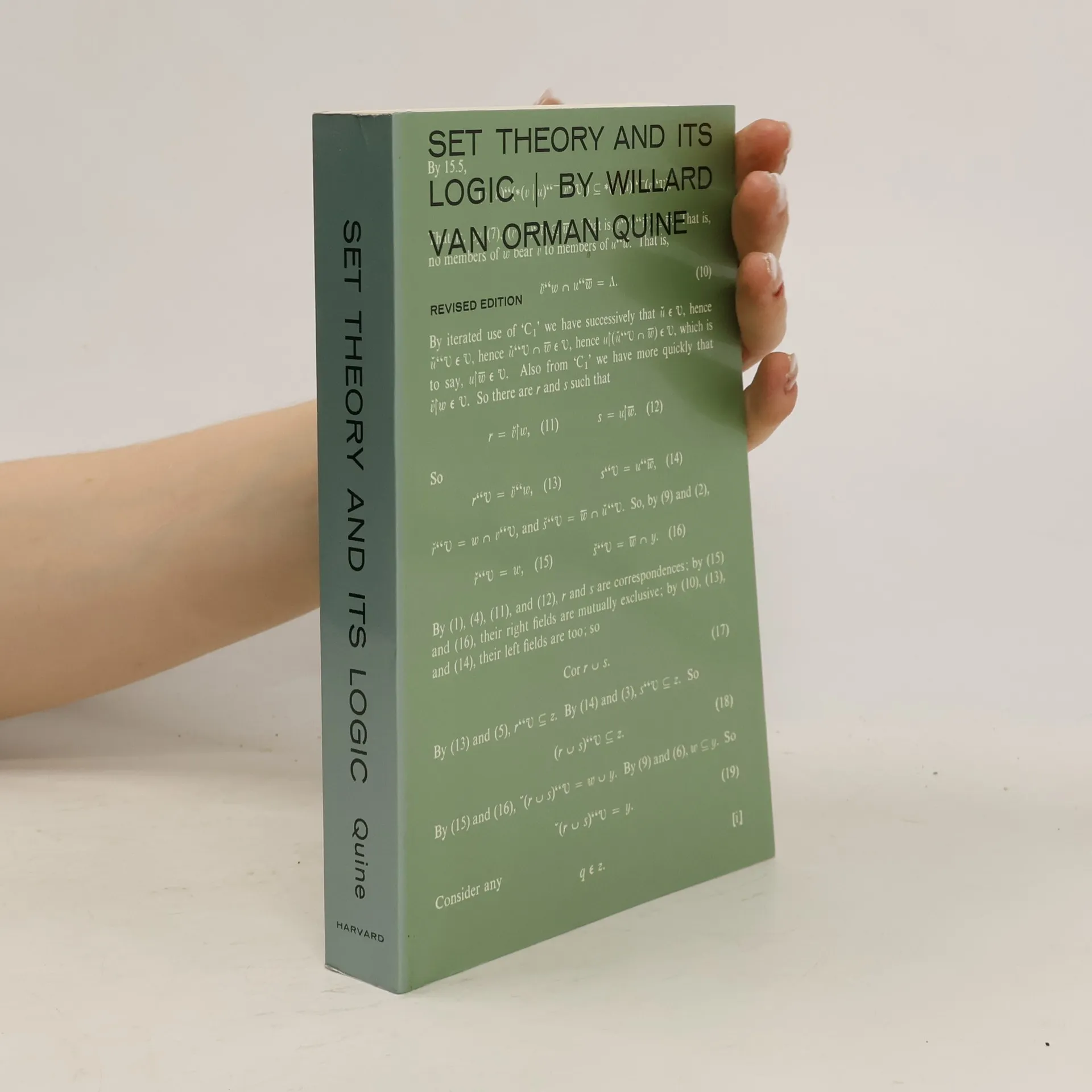
    Set theory and its logic
    Methods of Logic
    Ontological Relativity and Other Essays
    Theories and Things
    • Theories and Things

      • 226 pages
      • 8 hours of reading
      4.5(32)Add rating

      Here are the most recent writings, some of them unpublished, of the preeminent philosopher of our time. Philosophical reflections on language are brought to bear upon metaphysical and epistemological questions such as these: What does it mean to assume objects, concrete and abstract? How do such assumptions serve science? What is the empirical content of a scientific theory? Further essays deal with meaning, moral values, analytical philosophy and its history, metaphor, the nature of mathematics; several are concerned with logic; and there are essays on individual philosophers. The volume concludes with some general reflections on the contemporary scene and two playful pieces on the Times Atlas and H. L. Mencken.

      Theories and Things
    • Quine's widely used textbook of modern formal logic now offers a number of new features: updated notations, selective answers to exercises, expanded treatment of natural deduction, and new discussions of predicate-functor logic and the affinities between higher set theory and the elementary logic of terms.

      Methods of Logic
    • Set theory and its logic

      • 380 pages
      • 14 hours of reading
      3.9(28)Add rating

      This is an extensively revised edition of Mr. Quine's introduction to abstract set theory and to various axiomatic systematizations of the subject. The treatment of ordinal numbers has been strengthened and much simplified, especially in the theory of transfinite recursions, by adding an axiom and reworking the proofs. Infinite cardinals are treated anew in clearer and fuller terms than before.Improvements have been made all through the book; in various instances a proof has been shortened, a theorem strengthened, a space-saving lemma inserted, an obscurity clarified, an error corrected, a historical omission supplied, or a new event noted.

      Set theory and its logic
    • Elementary Logic

      • 144 pages
      • 6 hours of reading
      3.9(59)Add rating

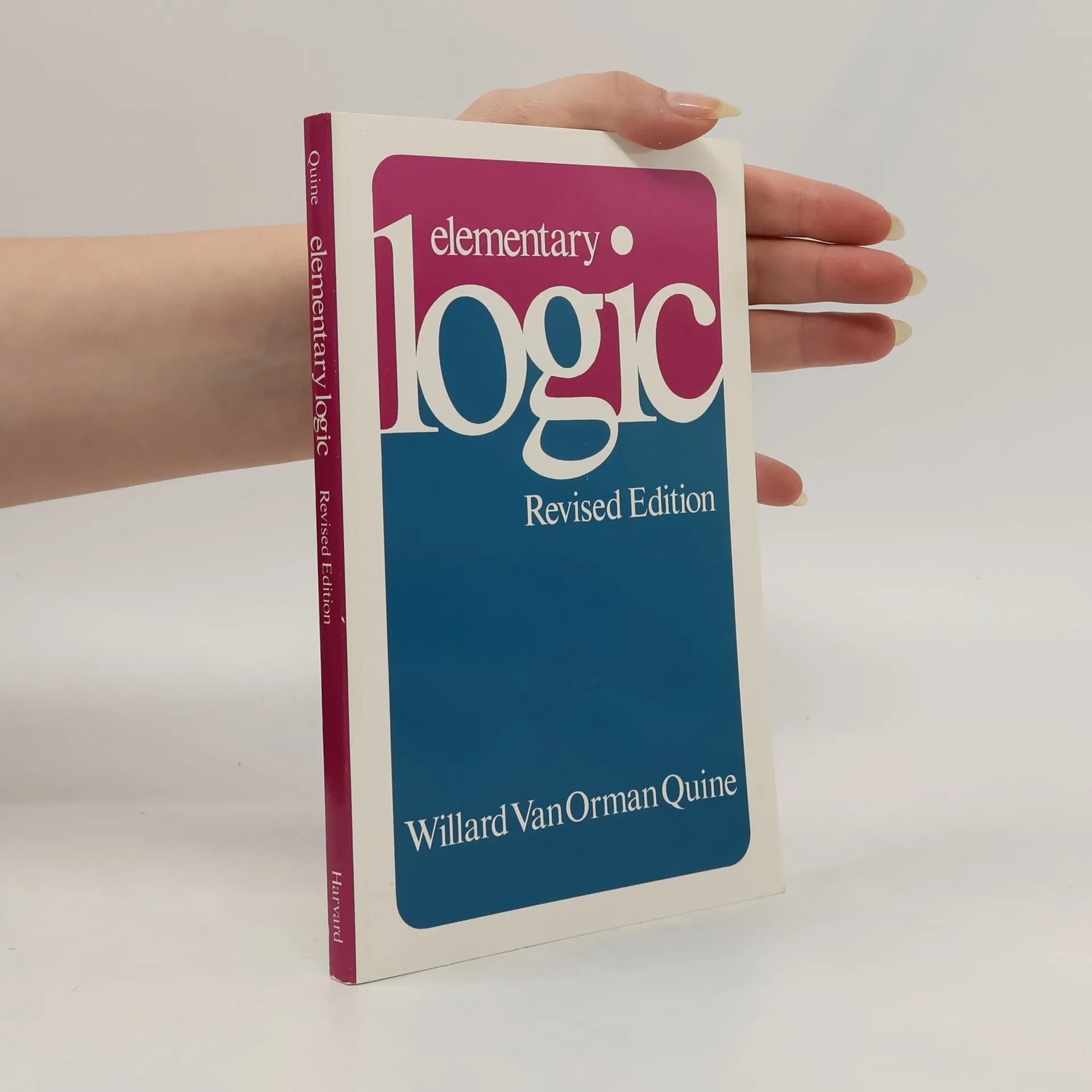
      Now much revised since its first appearance in 1941, this book, despite its brevity, is notable for its scope and rigor. It provides a single strand of simple techniques for the central business of modern logic. Basic formal concepts are explained, the paraphrasing of words into symbols is treated at some length, and a testing procedure is given for truth-function logic along with a complete proof procedure for the logic of quantifiers. Fully one third of this revised edition is new, and presents a nearly complete turnover in crucial techniques of testing and proving, some change of notation, and some updating of terminology. The study is intended primarily as a convenient encapsulation of minimum essentials, but concludes by giving brief glimpses of further matters.

      Elementary Logic
    • A compact, coherent introduction to the study of rational belief, this text provides points of entry to such areas of philosophy as theory of knowledge, methodology of science, and philosophy of language. The book is accessible to all undergraduates and presupposes no philosophical training.

      The Web of Belief
    • Provides philosophers, logicians, and historians with a full translation of Quine's 1942 Portuguese language book, making this crucial stage of his intellectual development available to English speakers. It includes an accompanying historical-philosophical essay setting this work in context and identifying its importance for semantics and ontology.

      The Significance of the New Logic
    • »Wort und Gegenstand« gilt als das Hauptwerk W. V. Quines und als eines der wichtigsten philosophischen Bücher der zweiten Hälfte des 20. Jahrhunderts. Es gliedert sich in folgende Kapitel: Sprache und Wahrheit Übersetzung und Bedeutung Die Ontogenese des Bezeichnens Die Launen des Bezeichnens Reglementierung Flucht vor der Intension Ontische Entscheidung.

      Wort und Gegenstand
    • Unterwegs zur Wahrheit

      Konzise Einleitung in die theoretische Philosophie.

      Acht Jahre vor seinem Tod fasst W. V. Quine in „Unterwegs zur Wahrheit“ seine philosophischen Ansichten prägnant zusammen. In fünf Kapiteln behandelt er zentrale erkenntnistheoretische Fragen und kritisiert die Ontologie. Der Anhang bietet Einblicke in seine Weltsicht. Eine klare Einführung in Quines Denken und die theoretische Philosophie.

      Unterwegs zur Wahrheit