

A collection of essays that span the career of a prominent anthropologist and address the fundamental questions of the field.
Marshall Sahlins Books
December 27, 1930 – April 5, 2021
Sahlins is an American anthropologist renowned for his ethnographic work in the Pacific and his significant contributions to anthropological theory. His writings delve into the profound understanding of human cultures and their transformations, exploring how people across diverse global regions adapt and evolve within their unique historical and social contexts. Sahlins' analytical approach offers readers insightful perspectives on the complexities of human behavior and the cultural logic that underpins it. His influence on anthropology and social sciences remains substantial.



Stone Age Economics
- 346 pages
- 13 hours of reading
Since its first publication over forty years ago Marshall Sahlins's Stone Age Economics has established itself as a classic of modern anthropology and arguably one of the founding works of anthropological economics. Ambitiously tackling the nature of economic life and how to study it comparatively, Sahlins radically revises traditional views of the hunter-gatherer and so-called primitive societies, revealing them to be the original "affluent society." Sahlins examines notions of production, distribution and exchange in early communities and examines the link between economics and cultural and social factors. A radical study of tribal economies, domestic production for livelihood, and of the submission of domestic production to the material and political demands of society at large, Stone Age Economics regards the economy as a category of culture rather than behaviour, in a class with politics and religion rather than rationality or prudence. Sahlins concludes, controversially, that the experiences of those living in subsistence economies may actually have been better, healthier and more fulfilled than the millions enjoying the affluence and luxury afforded by the economics of modern industrialisation and agriculture. This Routledge Classics edition includes a new foreword by David Graeber, London School of Economics.
Reflecting the decline in college courses on Western Civilization, Marshall Sahlins aims to accelerate the trend by reducing "Western Civ" to about two hours. He cites Nietzsche to the effect that deep issues are like cold baths; one should get into and out of them as quickly as possible. The deep issue here is the ancient Western specter of a presocial and antisocial human nature: a supposedly innate self-interest that is represented in our native folklore as the basis or nemesis of cultural order. Yet these Western notions of nature and culture ignore the one truly universal character of human sociality: namely, symbolically constructed kinship relations. Kinsmen are members of one another: they live each other's lives and die each other's deaths. But where the existence of the other is thus incorporated in the being of the self, neither interest, nor agency or even experience is an individual fact, let alone an egoistic disposition. "Sorry, beg your pardon," Sahlins concludes, Western society has been built on a perverse and mistaken idea of human nature.
The New Science of the Enchanted Universe
- 208 pages
- 8 hours of reading
The majority of known human societies have been organized along "immanentist" lines, where religion, gods, and spirits are integral to daily life. In these societies, plants and animals possess souls, and ancestors remain active participants in the lives of the living. This "enchanted" worldview blurs the lines between economics, politics, religion, philosophy, and culture. Approximately 2,500 years ago, during the Axial Age, a significant transformation occurred as civilizations emerged from Greece, the Near East, northern India, and China, leading to a cultural revolution. This shift created a new societal structure where religious elements transitioned from immanent to transcendent, allowing for the concept of a god or gods existing in a separate realm. In transcendentalist societies, there is a clear division of labor among economic, political, and cultural spheres. Today, these transcendentalist perspectives dominate, often leading to misinterpretations of immanentist societies through a transcendental lens. This confusion has hindered the social sciences and obscured our understanding of Indigenous religions and worldviews. Drawing on extensive ethnographic and historical research, the author presents a diagnosis of these issues and advocates for a "new science" to better comprehend the realities of immanentist societies and respect diverse cultures.
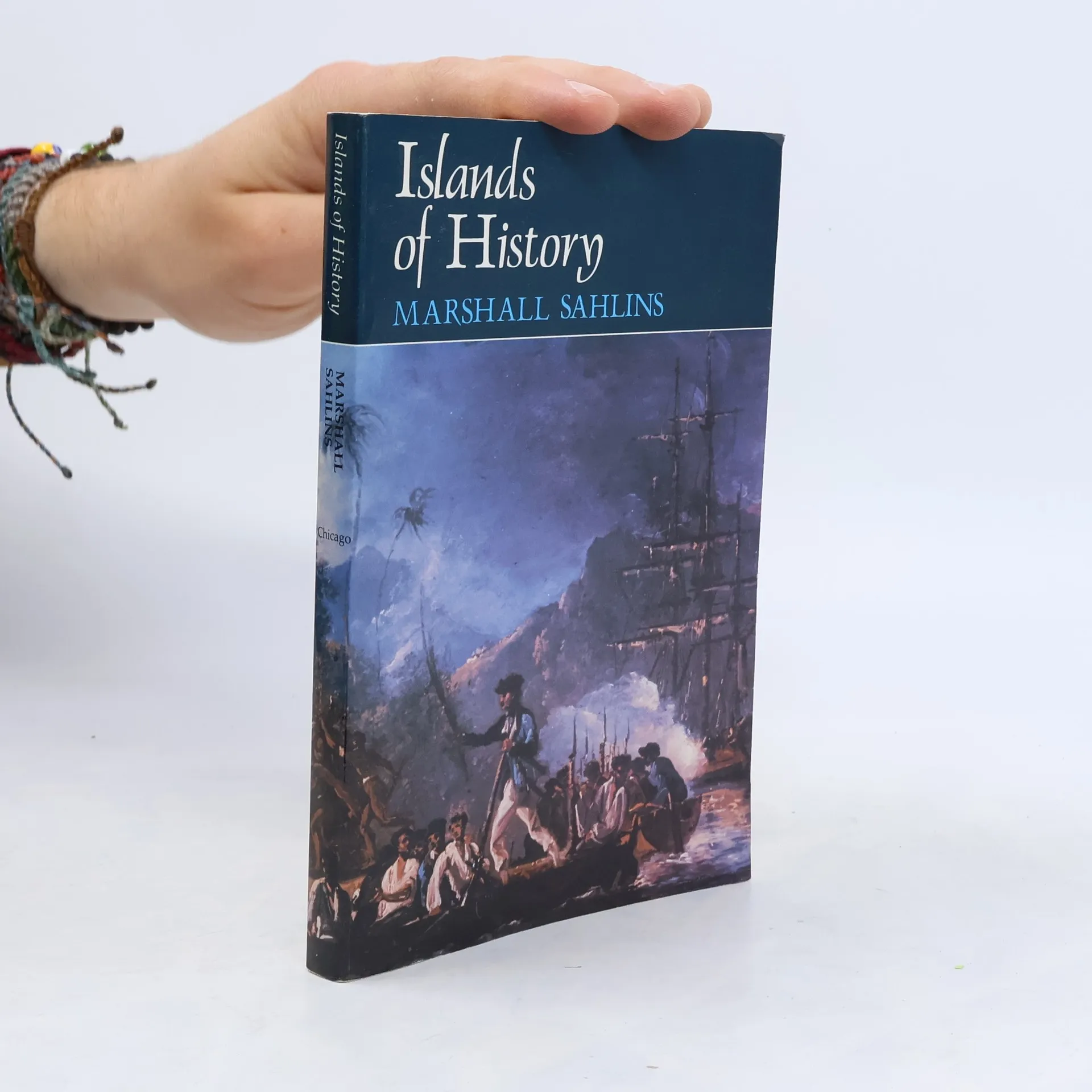
Marshall Sahlins centers these essays on islands—Hawaii, Fiji, New Zealand—whose histories have intersected with European history. But he is also concerned with the insular thinking in Western scholarship that creates false dichotomies between past and present, between structure and event, between the individual and society. Sahlins's provocative reflections form a powerful critique of Western history and anthropology.
Die ursprüngliche Wohlstandsgesellschaft
- 143 pages
- 6 hours of reading
Marshall Sahlins bricht mit dem ökonomischen Paradigma, dass mehr Arbeit mehr Wohlstand bringt. Er stellt die Annahme in Frage, dass Armut nur mit geringem Besitz zu tun hat, und zeigt, dass Reichtum auch im Weniger-Bedürfen liegen kann. Dies bietet einen radikalen Ansatz zur Betrachtung von Wohlstand und Ungleichheit.
Der Tod des Kapitän Cook
Geschichte als Metapher und Mythos als Wirklichkeit
- 192 pages
- 7 hours of reading
Als Kapitän Cook mit seiner Crew am 17. Januar 1779 auf der Suche nach der Nordwestpassage in Hawaii anlangt, wird er von den Inselbewohnern frenetisch empfangen. Zu dieser Zeit feiern die Einheimischen die turnusmäßige Ankunft und Herrschaftsübernahme des Friedensgottes Lono, der nun in Gestalt Cooks leibhaftig einzutreffen scheint. Das Missverständnis endet tödlich. In seinem 1981 zuerst veröffentlichten und heute zu den Klassikern der Anthropologie und der Kulturgeschichte zählenden Forschungsbericht zeigt Marshall Sahlins, wie die einander Fremden in dem nun einsetzenden intensiven materiellen und sexuellen Austausch Tabus überschreiten und Mythen umgestalten, um die große überlieferte Erzählung zu bewahren. Marshall Sahlins’ legendäre Studie, die in der Anthropologie eine Grundsatzdebatte über die Verstehbarkeit ›fremder‹ Kulturen auslöste, liefert fundamentale Überlegungen zum Verhältnis von Struktur und Geschichte, die auch in den derzeitigen Diskussionen um transkulturelle Verflechtungen und Wandel in der (post-)kolonialen Welt von größter Bedeutung sind.
Neue Wissenschaft des verwunschenen Universums
Eine Anthropologie fast der gesamten Menschheit
Was, wenn wir nicht nur niemals modern gewesen sind, sondern Geisterwesen, Ahnen und Götter nach wie vor unter uns leben? Dann würde es sich bezahlt machen, von jenen zu lernen, die ihre Existenz immer schon anerkannt haben: immanentistische Gesellschaften. Mit diesem Begriff bezeichnet Marshall Sahlins Gesellschaften, die sowohl historisch als auch geografisch den größeren Teil der Menschheit ausmachen – und die Geister als reale Personen betrachten, als Metamenschen, die mit den Menschen in einer kosmischen Gemeinschaft leben, mit ihnen interagieren und ihr Schicksal beeinflussen. Marshall Sahlins liest ältere und neuere Ethnografien und nimmt uns so mit auf eine Reise um die Welt, von den Inuit am Polarkreis bis zu den Dinka in Ostafrika, von den Arawete-Schwemmgärtnern in Amazonien bis zu den Gartenbauern auf den Trobriand-Inseln. Und er zeigt, dass in den meisten Kulturen auch heute noch die Menschen nur ein kleiner Teil eines verwunschenen Universums sind, das durch die transzendenten Kategorien der »Religion« missverstanden wird.
