Dividuum 1
- 208 pages
- 8 hours of reading
Gerald Raunig is a philosopher and art theorist whose work critically examines the intersection of art, politics, and social structures. He investigates how artistic practices function as potent tools for critique and political action within contemporary societies. His analyses frequently delve into themes of revolution, capital, and the emergence of collective modes of operation. Raunig's approach bridges theoretical rigor with a keen focus on the practical implications of art and culture.


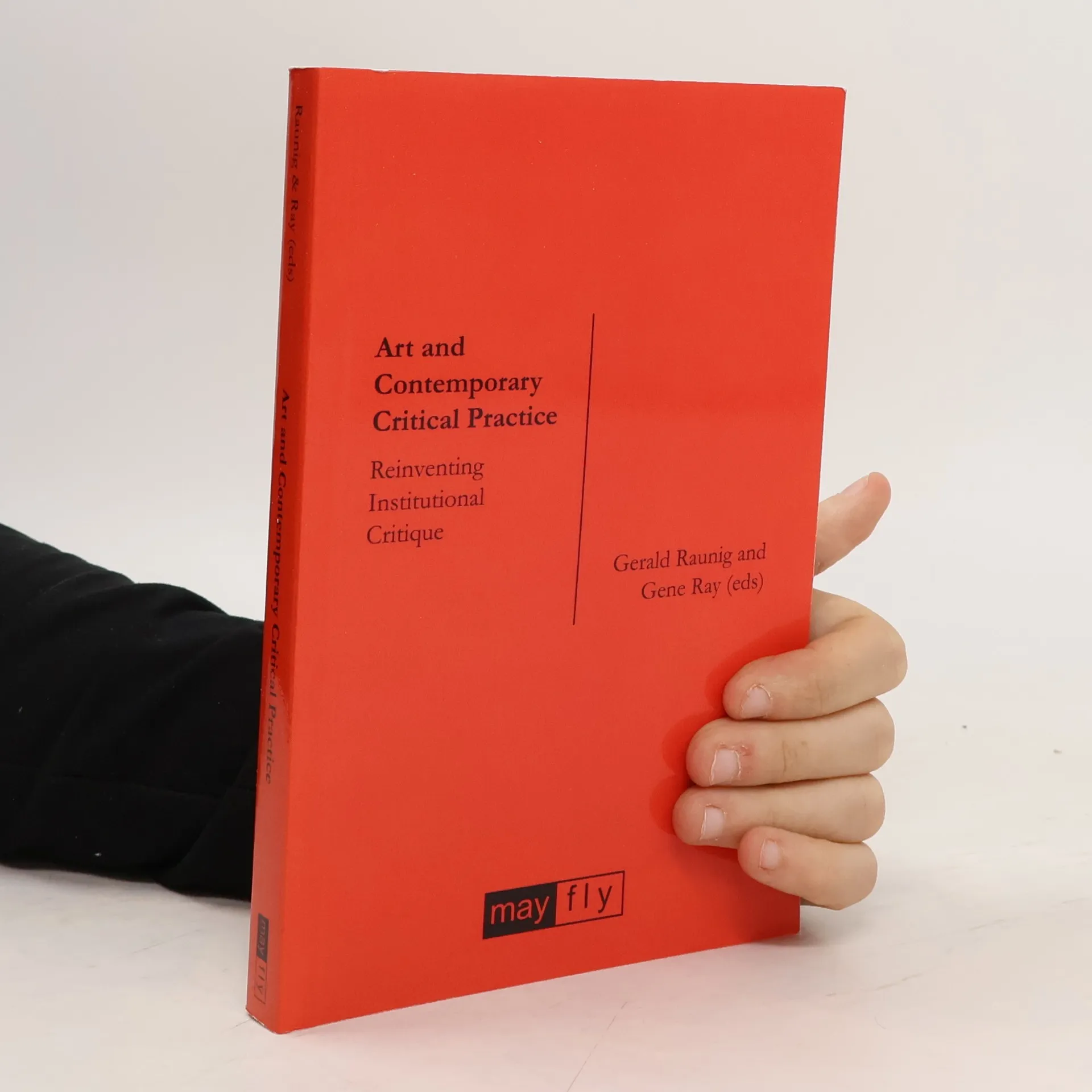
Reinventing Institutional Critique
'Institutional critique' is best known through the critical practice that developed in the late 1960s and early 1970s by artists who presented radical challenges to the museum and gallery system. Since then it has been pushed in new directions by new generations of artists registering and responding to the global transformations of contemporary life. The essays collected in this volume explore this legacy and develop the models of institutional critique in ways that go well beyond the field of art. Interrogating the shifting relations between 'institutions' and 'critique', the contributors to this volume analyze the past and present of institutional critique and propose lines of future development. Engaging with the work of philosophers and political theorists such as Michel Foucault, Judith Butler, Gilles Deleuze, Antonio Negri, Paolo Virno and others, these essays reflect on the mutual enrichments between critical art practices and social movements and elaborate the conditions for politicized critical practice in the twenty-first century.
With the economy deindustrialized and the working class decentralized, a call for alternative horizons for resistance: the university and the art world. What was once the factory is now the university. As deindustrialization spreads and the working class is decentralized, new means of social resistance and political activism need to be sought in what may be the last places where they are possible: the university and the art world. Gerald Raunig's new book analyzes the potential that cognitive and creative labor has in these two arenas to resist the new regimes of domination imposed by cognitive capitalism. Drawing on Gilles Deleuze's concept of “modulation” as the market-driven imperative for the constant transformation and reinvention of subjectivity, in Factories of Knowledge, Industries of Creativity, Raunig charts alternative horizons for resistance. Looking at recent social struggles including the university strikes in Europe, the Spanish ¡Democracia real YA! organization, the Arab revolts, and the Occupy movement, Raunig argues for a reassessment of the importance of cultural and knowledge production. The central role of the university, he asserts, is not as a factory of knowledge but as a place of creative disobedience.
Dissemblage unfolds a wild abundance of material of unruliness, from the multilingual translation machines of Al-Andalus to the queer mysticism of the High Middle Ages, from the small voices of the falsetto in 20th century jazz and soul to today's disjointures and subjunctures against the smooth city in machinic capitalism. In this volume Gerald Raunig not only develops a conceptual ecology of concepts of joining and jointing, but also undertakes an experiment in theoretical form. Semi-fictional interweaves with meticulously researched historical sources, mystical writings with letters from friends, philosophical fragments with poetic ritornellos. More than a narrative about dissemblages from social surrounds, thing-worlds, and ghost-worlds, the book itself is a dividual multiplicity in form and content, out of joint, in the joints, dissemblage.
In this poetical-philosophical manifesto, Gerald Raunig develops a materialist philosophy of multiplicity. On the basis of seventeen conceptual innovations, from windy kin to transversal intellect, from dissemblage to technecologies, from minor masculinity to condividual revolution, Raunig reformulates the question of revolutionary multiplicity. Always near to contemporary social struggles and movements, the book starts from the contention that we are in need of a storm against identitarian domination, unification and homogeneity. Raunig argues that the conceptual and political experimentations with multiplicity around and after 1968 did not go far enough: today, anti-identitarian, queer and multitudinarian positions should not just be defended but pushed further, over unexpected folds and along the flattest surfaces, beyond previous approaches and previous historical experiences. Making Multiplicity is a conceptual manifesto which sets a new tone in poststructural philosophy. The seventeen concepts developed here form an assemblage that invites us to think, read, write, and indeed, make multiplicity.
Maschinischer Kapitalismus und molekulare Revolution, Band 1
Die jahrhundertelange Konjunktur des Individuums gerät ins Wanken. Es beginnt das Zeitalter des Dividuellen. Die schlechte Nachricht von Gerald Raunigs Philosophie der Dividualität ist, dass sich das Dividuelle im maschinischen Kapitalismus vor allem als Verschärfung von Ausbeutung und Indienstnahme zeigt: In Algorithmen, Derivaten, Big Data und Social Media wirkt Dividualität als ausufernde Erweiterung von herrschaftlicher Teilung und Selbstzerteilung. Die gute Nachricht: Genau auf dem Terrain des Dividuellen wird auch eine neue Qualität von Widerstand möglich, als kritische Mannigfaltigkeit, molekulare Revolution und Con-division
Maschinischer Kapitalismus und molekulare Revolution, Band 2
Nach DIVIDUUM (2015) legt Gerald Raunig den zweiten Band von "Maschinischer Kapitalismus und molekulare Revolution" vor: Ungefüge entfaltet eine wilde Materialfülle der Ungefügigkeit, von den vielsprachigen Übersetzungsmaschinen in al-Andalus über die queere Mystik des Hochmittelalters und die kleinen Stimmen des Falsetts in Jazz und Soul des 20. Jahrhunderts bis zu heutigen Unfugen und Umfugen gegen die glatte Stadt der Ziffer im maschinischen Kapitalismus.Ungefüge entwickelt nicht nur eine konzeptuelle Ökologie von Begriffen des Fugens und Fügens, der Verfügbarkeit und der Unfügsamkeit, sondern unternimmt auch ein Experiment der theoretischen Form. Halbfiktives verwebt sich mit akribisch untersuchten historischen Quellen, mystische Schriften mit Freundesbriefen, philosophische Fragmente mit poetischen Ritornellen. Mehr als eine Erzählung über Ungefüge aus sozialen Umgebungen, Ding- und Geisterwelten, ist das Buch selbst formal und inhaltlich eine dividuelle Mannigfaltigkeit, aus den Fugen, in den Fugen, Ungefüge
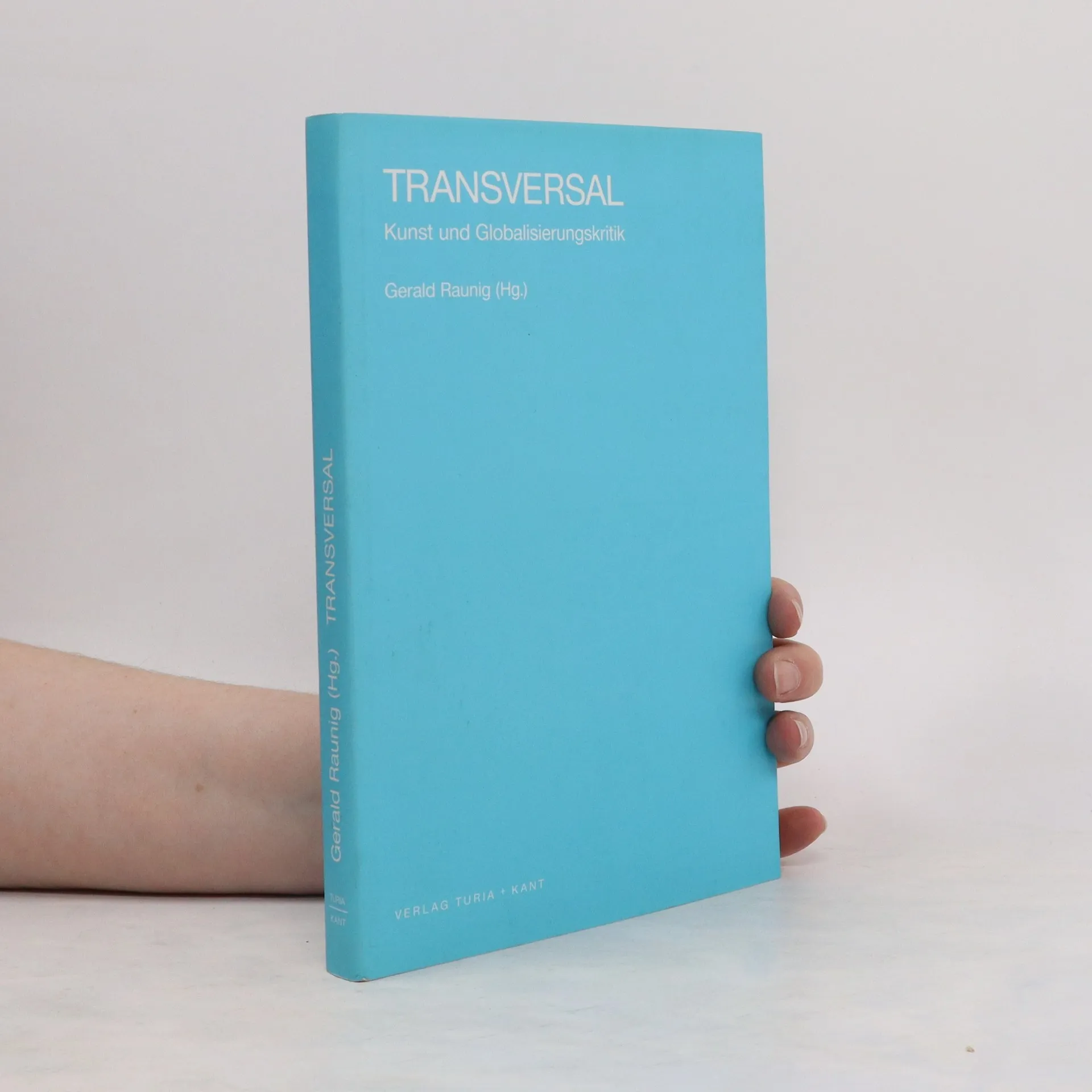
Transversal stellt das im allgemeinen gut geordnete Verhältnis von Kunst und Politik in Frage. Im Zusammenhang mit der Kritik an der ökonomischen Globalisierung entstanden neue Formen der Überlagerung von Kunstpraxen, politischem Aktivismus und Theorieproduktion. Das Buch folgt den Spuren dieser temporären < > und trägt zur Verortung und zur Kritik des Phänomens Globalisierung im kulturellen Umfeld bei. Es ist ein Leitfaden zum Verständnis neuer Kunstformen im Zeitalter der Globalisierung. Es ist der erste Band zum transnationalen Projekt 'republic art', das von Eipcp durchgeführt wird und zwischen 2002 und 2005 zwölf Ausstellungen und zwölf Symposien in verschiedenen Teilen Europas umfasst. Ziel ist die Untersuchung und Entwicklung neuer Formen von Kunst im Zusammenhang