


Parameters
More about the book
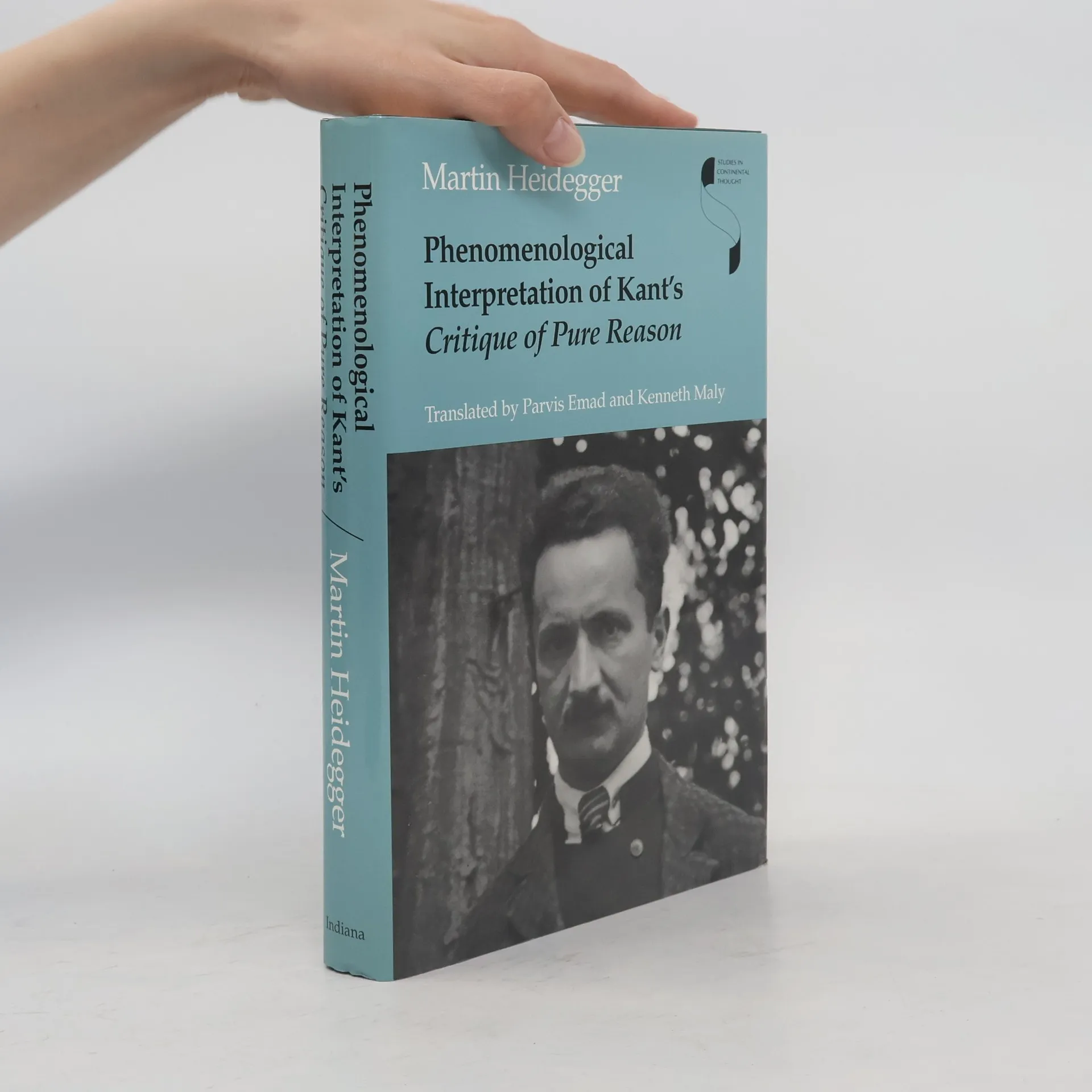
The text of Martin Heidegger's 1927--28 university lecture course on Immanuel Kant's Critique of Pure Reason presents a close interpretive reading of the first two parts of this masterpiece of modern philosophy. In this course, Heidegger continues the task he enunciated in Being and Time as the problem of dismatling the history of ontology, using temporality as a clue. Within this context the relation between philosophy, ontology, and fundamental ontology is shown to be rooted in the genesis of the modern mathematical sciences. Heidegger demonstrates that objectification of beings as beings is inseparable from knowledge a priori, the central problem of Kant's Critique. He concludes that objectification rests on the productive power of imagination, a process that involves temporality, which is the basic constitution of humans as beings.

Book purchase
Phenomenological interpretation of Kant's Critique of Pure Reason, Martin Heidegger
- Language

- Released
- 1997
- Binding
- (Hardcover)
Payment methods
We’re missing your review here.
- Title
- Phenomenological interpretation of Kant's Critique of Pure Reason
- Language
- English
- Authors
- Martin Heidegger
- Publisher
- Indiana Univ. Press
- Released
- 1997
- Format
- Hardcover
- ISBN10
- 0253332583
- ISBN13
- 9780253332585
- Original title
- Phänomenologische Interpretation von Kants Kritik der reinen Vernunft
- Rating
- 4.4 out of 5
- Description
- The text of Martin Heidegger's 1927--28 university lecture course on Immanuel Kant's Critique of Pure Reason presents a close interpretive reading of the first two parts of this masterpiece of modern philosophy. In this course, Heidegger continues the task he enunciated in Being and Time as the problem of dismatling the history of ontology, using temporality as a clue. Within this context the relation between philosophy, ontology, and fundamental ontology is shown to be rooted in the genesis of the modern mathematical sciences. Heidegger demonstrates that objectification of beings as beings is inseparable from knowledge a priori, the central problem of Kant's Critique. He concludes that objectification rests on the productive power of imagination, a process that involves temporality, which is the basic constitution of humans as beings.