
The most ubiquitous, and perhaps the most intriguing, number pattern in mathematics is the Fibonacci sequence. In this simple pattern beginning with two ones, each succeeding number is the sum of the two numbers immediately preceding it (1, 1, 2, 3, 5, 8, 13, 21, ad infinitum). Far from being just a curiosity, this sequence recurs in structures found throughout nature - from the arrangement of whorls on a pinecone to the branches of certain plant stems. All of which is astounding evidence for the deep mathematical basis of the natural world. With admirable clarity, two veteran math educators take us on a fascinating tour of the many ramifications of the Fibonacci numbers. They begin with a brief history of a distinguished Italian discoverer, who, among other accomplishments, was responsible for popularizing the use of Arabic numerals in the West. Turning to botany, the authors demonstrate, through illustrative diagrams, the unbelievable connections between Fibonacci numbers and natural forms (pineapples, sunflowers, and daisies are just a few examples). In art, architecture, the stock market, and other areas of society and culture, they point out numerous examples of the Fibonacci sequence as well as its derivative, the "golden ratio." And of course in mathematics, as the authors amply demonstrate, there are almost boundless applications in probability, number theory, geometry, algebra, and Pascal's triangle, to name a few. Accessible and appealing to even the most math-phobic individual, this fun and enlightening book allows the reader to appreciate the elegance of mathematics and its amazing applications in both natural and cultural settings
Alfred S. Posamentier Books
Alfred S. Posamentier is a leading American educator focusing on mathematics and science education. His work emphasizes the necessity of critical thinking in mathematics and innovative teaching approaches. Posamentier advocates for increased funding in these fields and for parental involvement in education. He is a recognized commentator and author of numerous curricular solutions that shape current educational practices.



Math Tricks
- 245 pages
- 9 hours of reading
In his latest book, mathematician Alfred S. Posamentier provides easily understandable, easily presentable and easily replicated tricks that one can do with mathematics.
The Joy of Geometry
- 162 pages
- 6 hours of reading
If you remember anything about high school geometry class, it's probably doing proofs. But geometry is more than axioms, postulates, theorems, and proofs. It's the science of beautiful and extraordinary geometric relationships--most of which is lost in high school classrooms w...
Math Makers
- 440 pages
- 16 hours of reading
"Two veteran math educators concisely profile leading mathematicians throughout history highlighting their often unusual personalities and lives while giving average readers insights into the importance of their mathematical discoveries."--
In this delightful layperson's introduction to one of math's most interesting phenomena, Drs. Posamentier and Lehmann review pi's history from prebiblical times to the 21st century, the many amusing and mind-boggling ways of estimating pi over the centuries, quirky examples of obsessing about pi, and useful applications of pi in everyday life, including statistics.
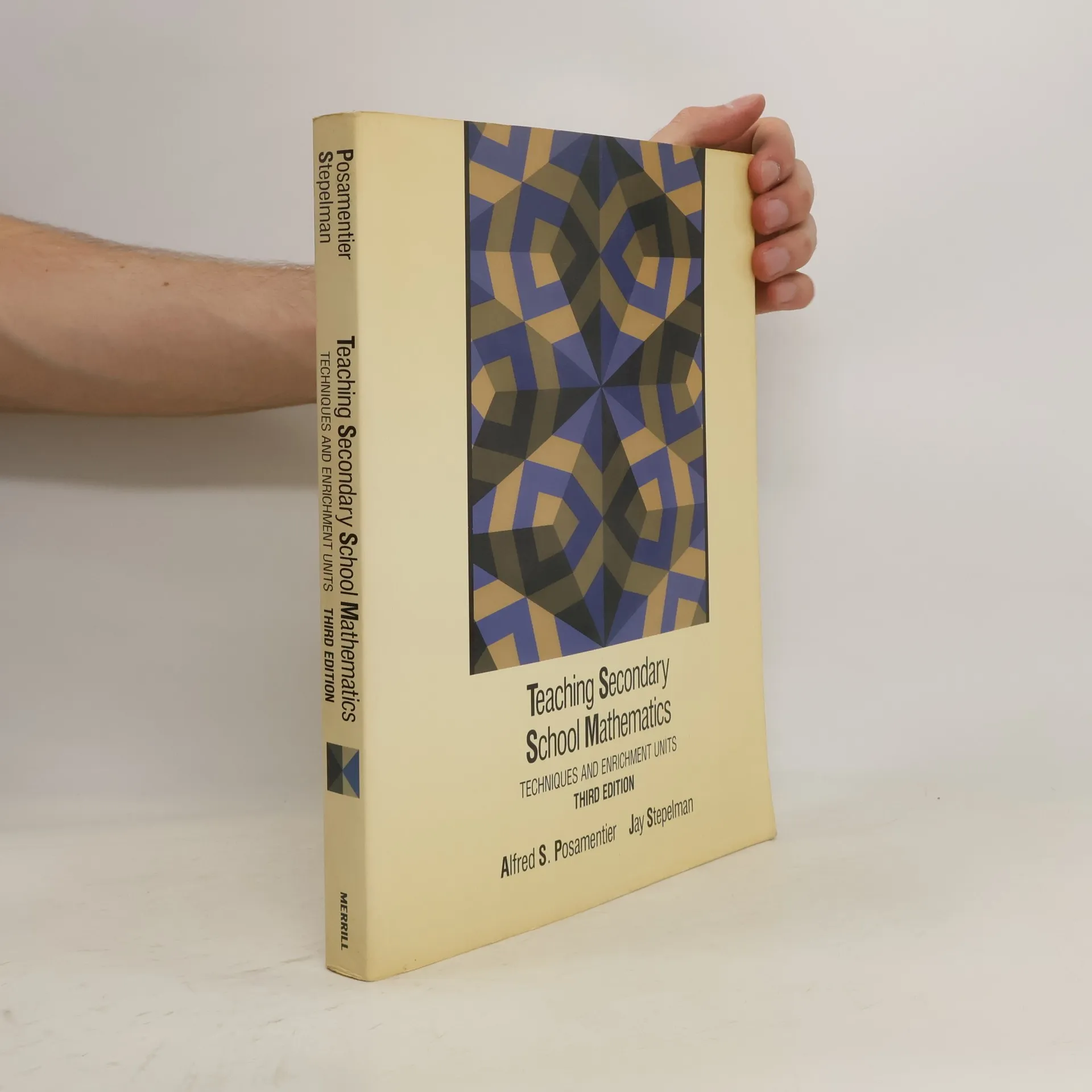
This practical book leads the way in secondary mathematics instruction with unique enrichment units, technology updates, and a highly readable style. It provides step-by step techniques on preparing lessons and tests, motivating students, designing assignments, and organizing the classroom. Also included are ¿hands-on¿ activities enrichment units, teaching strategies, and pre- and post-tests that are cross-referenced to methods presented earlier in the text. Explores the use of technology, with special emphasis on the application and uses of the Geometer's Sketchpad software program. Also updates the graphics calculator's application in the classroom and includes extensive references to the World Wide Web. Provides a more detailed discussion of problem-solving strategies, in a particularly strong chapter on problem solving, which reflects the mandate that problem solving, be one of the prime concerns for mathematics instruction today.
Geometric Gems: An Appreciation for Geometric Curiosities - Volume III: The Wonders of Circles
- 280 pages
- 10 hours of reading
Exploring the fascinating world of plane geometry, this book delves into the circle and its unexpected curiosities, offering insights that go beyond typical school lessons. Presented in an accessible manner, it requires only basic geometric knowledge to appreciate the intriguing relationships and proofs. Aimed at a broad audience, it seeks to enhance the enjoyment of geometry for general readers and serves as a valuable resource for mathematics teachers looking to inspire their students with captivating circle properties.
Geometric Gems: An Appreciation for Geometric Curiosities - Volume II: The Wonders of Quadrilaterals
- 320 pages
- 12 hours of reading
Focusing on the triangle, this book reveals a vast array of geometric curiosities that extend beyond standard school teachings. It presents a rich collection of triangle-related wonders, explained in an accessible manner that requires only basic geometry knowledge. Aimed at a general audience, it seeks to deepen appreciation for geometry while also serving as a valuable resource for mathematics teachers, offering engaging properties to inspire students.
MATHEMATICS ENTERTAINMENT FOR THE MILLIONS
- 304 pages
- 11 hours of reading
The book reveals how mathematics can be engaging and enjoyable, challenging the negative perceptions shaped by uninspired educational methods. It aims to inspire readers by showcasing the entertaining aspects of math, encouraging a more positive and enriching approach to the subject.
CREATIVE SECONDARY SCHOOL MATHEMATICS
- 556 pages
- 20 hours of reading
Focusing on enhancing the secondary school mathematics curriculum, this book offers 125 individual units designed for grades 7 through 12. Each unit includes a pre-assessment, instructional objectives, detailed topic descriptions, teaching suggestions, and a post-assessment. These motivational units aim to engage students and foster a love for mathematics, filling the gaps often left due to time constraints in traditional teaching methods.