

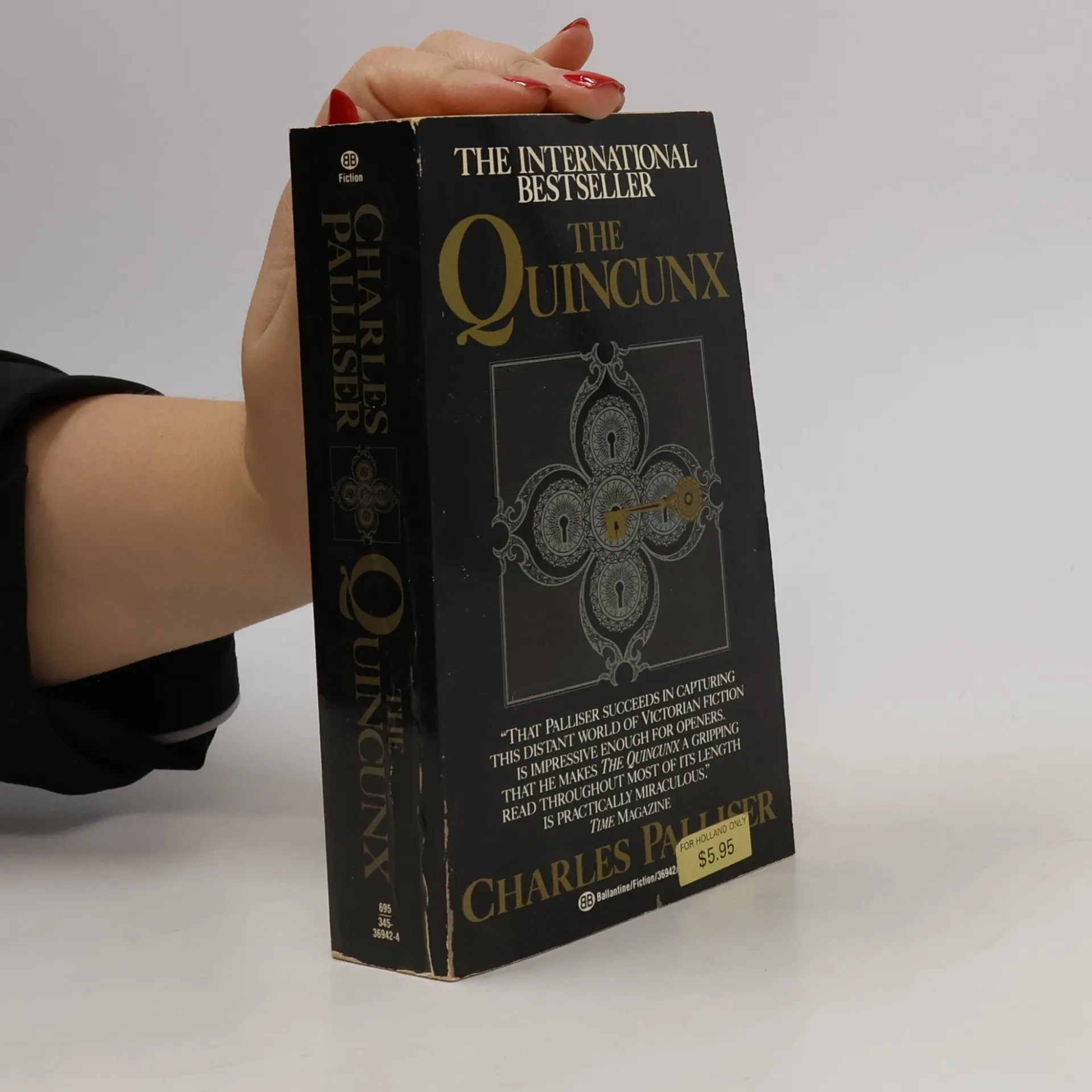
The protagonist, a young man naive enough to be blind to all clues about his own hidden history (and to the fact that his very existence is troubling to all manner of evildoers) narrates a story of uncommon beauty which not only brings readers face-to-face with dozens of piquantly drawn characters at all levels of 19th-century English society but re-creates with precision the tempestuous weather and gnarly landscape that has been a motif of the English novel since Wuthering Heights. The suspension of disbelief happens easily, as the reader is led through twisted family trees and plot lines. The quincunx of the title is a heraldic figure of five parts that appears at crucial points within the text (the number five recurs throughout the novel, which itself is divided into five parts, one for each of the family galaxies whose orbits the narrator is pulled into). Quintuple the length of the ordinary novel, this extraordinary tour de force also has five times the ordinary allotment of adventure, action and aplomb.
Charles Palliser Books
Charles Palliser is celebrated for his masterful use of complex, often labyrinthine narrative structures that draw readers into intricately crafted worlds. His style is marked by a deep exploration of character psychology and precise language that evokes the atmosphere of past eras. He sets his stories within meticulously constructed historical backdrops, examining themes of identity, memory, and hidden truths. Palliser's works offer an invitation to an intellectual and emotional journey that challenges the boundaries between reality and fiction.

Betrayals
- 308 pages
- 11 hours of reading
At once a hypnotic murder mystery, scathing literary parody, soap opera, and brilliant pastiche, this novel is a virtuoso performance by a modern master of literary gamesmanship in the tradition of Nabokov and Barth. It unfolds through seemingly unrelated narratives, each in a different style and genre. An obituary for a Scottish scientist reveals a colleague's relish for his death. Early in the century, a train in the Scottish Highlands derails during a snowstorm, leading to the death—or murder—of a passenger. An inept publisher's reader summarizes a tacky hospital romance that culminates in a gory murder reminiscent of Jack the Ripper. A report on a contemporary academic scandal spirals into plagiarism, shattered reputations, paranoia, and possible murder disguised as suicide. As the author teases out each situation, it becomes clear they all revolve around a common theme: a distinguished figure in an intellectual pursuit becomes obsessed with a rival's success and schemes their demise, only to fail due to their own monomania. Each plotter becomes a victim of their own machinations, and the betrayer often becomes the betrayed in a complex dance of deception, revenge, and revelation. This challenging, engrossing, and original work is a joy to read, filled with laughter, suspense, and the marvel of a cleverly constructed fictional puzzle.
Dr Courtine, an unworldly academic is visiting an old friend in the Cathedral town of Thurchester in the late 1870s. On his first night he is told the story of the town ghost, a legend deeply mired in the medieval intrigues of the Cathedral when two prominent churchmen met their deaths in unexplained circumstances. The story of dark deeds in the ancient close captures Courtine¿s donnish imagination, and he is also embarking on some amateur sleuthing of his own ¿ attempting to track down an elusive 11th century manuscript to prove his theories about the life of King Alfred. Suitably distracted, Courtine becomes the unwitting witness to a terrible crime committed on his own doorstep ¿