

First Published in 1995. Routledge is an imprint of Taylor & Francis, an informa company.
Leonard Lawlor Books
This author delves into nineteenth- and twentieth-century Continental philosophy, exploring the intricate relationship between thought and chance. Their work critically examines distinctions within philosophical discourse, notably the differences between the thinking of Ricoeur and Derrida. Furthermore, the author is instrumental in furthering the study of Merleau-Ponty's concept of the flesh through editorial contributions and as a founding editor of a trilingual international journal dedicated to his thought.

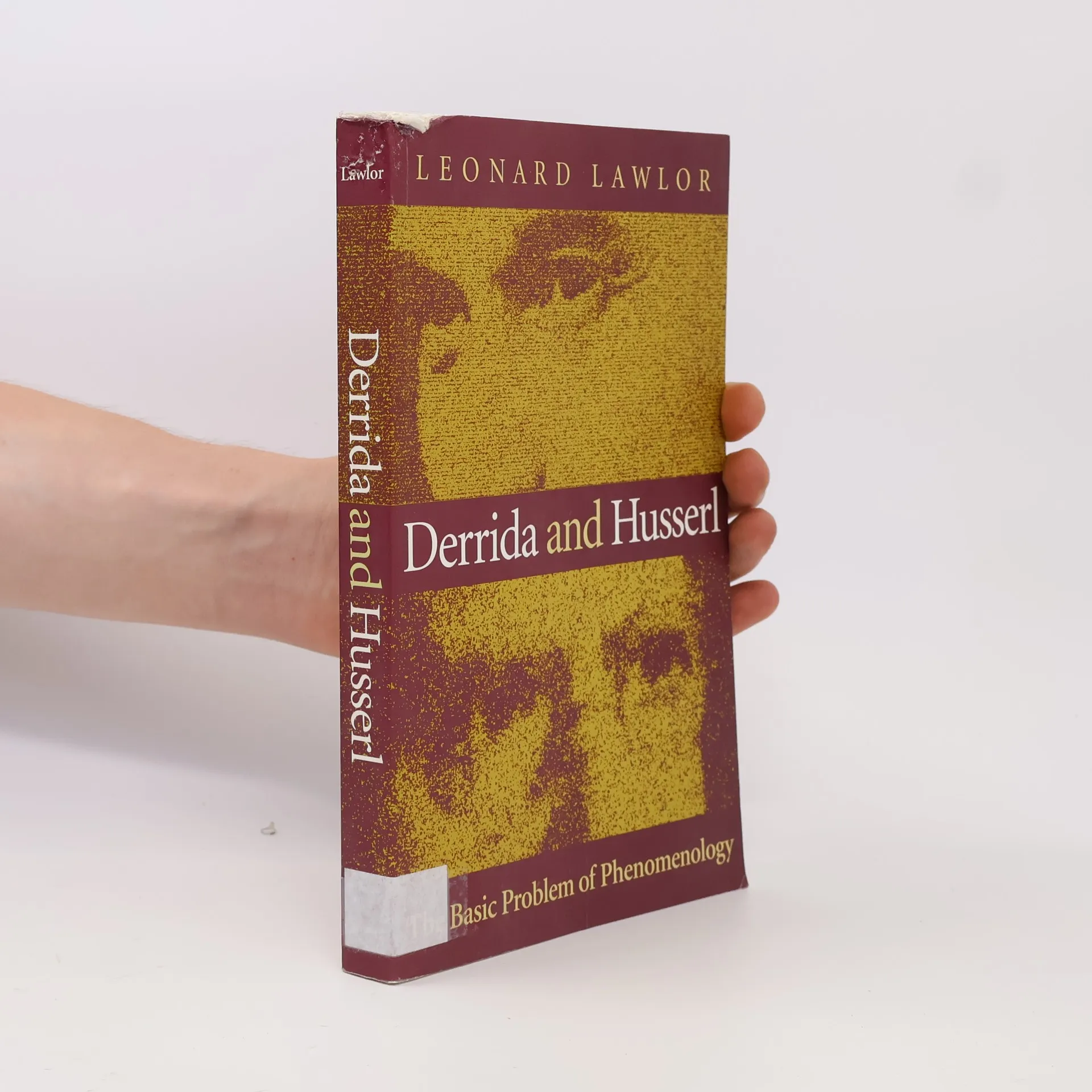
What is the nature of the relationship of Jacques Derrida and deconstruction to Edmund Husserl and phenomenology? Is deconstruction a radical departure from phenomenology or does it trace its origins to the phenomenological project? In Derrida and Husserl, Leonard Lawlor illuminates Husserl’s influence on the French philosophical tradition that inspired Derrida’s thought. Beginning with Eugen Fink’s pivotal essay on Husserl’s philosophy, Lawlor carefully reconstructs the conceptual context in which Derrida developed his interpretation of Husserl. Lawlor’s investigations of the work of Jean Cavaillès, Tran-Duc-Thao, and Jean Hyppolite, as well as recent texts by Derrida, reveal the depth of Derrida’s relationship to Husserl’s phenomenology. Along the way, Lawlor revisits and sheds light on the origin of many important Derridean concepts, such as deconstruction, the metaphysics of presence, différance, intentionality, the trace, and spectrality.
The Cambridge Foucault Lexicon
- 758 pages
- 27 hours of reading
The Cambridge Foucault Lexicon is a reference tool that provides clear and incisive definitions and descriptions of all of Foucault's major terms and influences, including history, knowledge, language, philosophy, and power. It also includes entries on philosophers about whom Foucault wrote and who influenced Foucault's thinking, such as Deleuze, Heidegger, Nietzsche, and Canguilhem. The entries are written by scholars of Foucault from a variety of disciplines such as philosophy, gender studies, political science, and history. Together, they shed light on concepts key to Foucault and to ongoing discussions of his work today.