

Science tells us that an oil crisis is inevitable. Why and when? And what will our future look like without our favorite fuel? Our rate of oil discovery has reached its peak and will never be exceeded; rather, it is certain to decline―perhaps rapidly―forever forward. Meanwhile, over the past century, we have developed lifestyles firmly rooted in the promise of an endless, cheap supply. In this book, David Goodstein, professor of physics at Caltech, explains the underlying scientific principles of the inevitable fossil fuel shortage we face. He outlines the drastic effects a fossil fuel shortage will bring down on us. And he shows that there is an important silver lining to the need to switch to other sources of energy, for when we have burned up all the available oil, the earth's climate will have moved toward a truly life-threatening state. With its easy-to-grasp explanations of the science behind every aspect of our most urgent environmental policy decisions, Out of Gas is "a handbook for the future of civilization" ( Booklist ).
David L. Goodstein Book order (chronological)


Rescued from obscurity, Feynman's Lost Lecture is a blessing for all Feynman followers. Most know Richard Feynman for the hilarious anecdotes and exploits in his best-selling books " Surely You're Joking, Mr. Feynman! " and " What Do You Care What Other People Think? " But not always obvious in those stories was his brilliance as a pure scientist—one of the century's greatest physicists. With this book and CD, we hear the voice of the great Feynman in all his ingenuity, insight, and acumen for argument. This breathtaking lecture—"The Motion of the Planets Around the Sun"—uses nothing more advanced than high-school geometry to explain why the planets orbit the sun elliptically rather than in perfect circles, and conclusively demonstrates the astonishing fact that has mystified and intrigued thinkers since Newton: Nature obeys mathematics. David and Judith Goodstein give us a beautifully written short memoir of life with Feynman, provide meticulous commentary on the lecture itself, and relate the exciting story of their effort to chase down one of Feynman's most original and scintillating lectures.
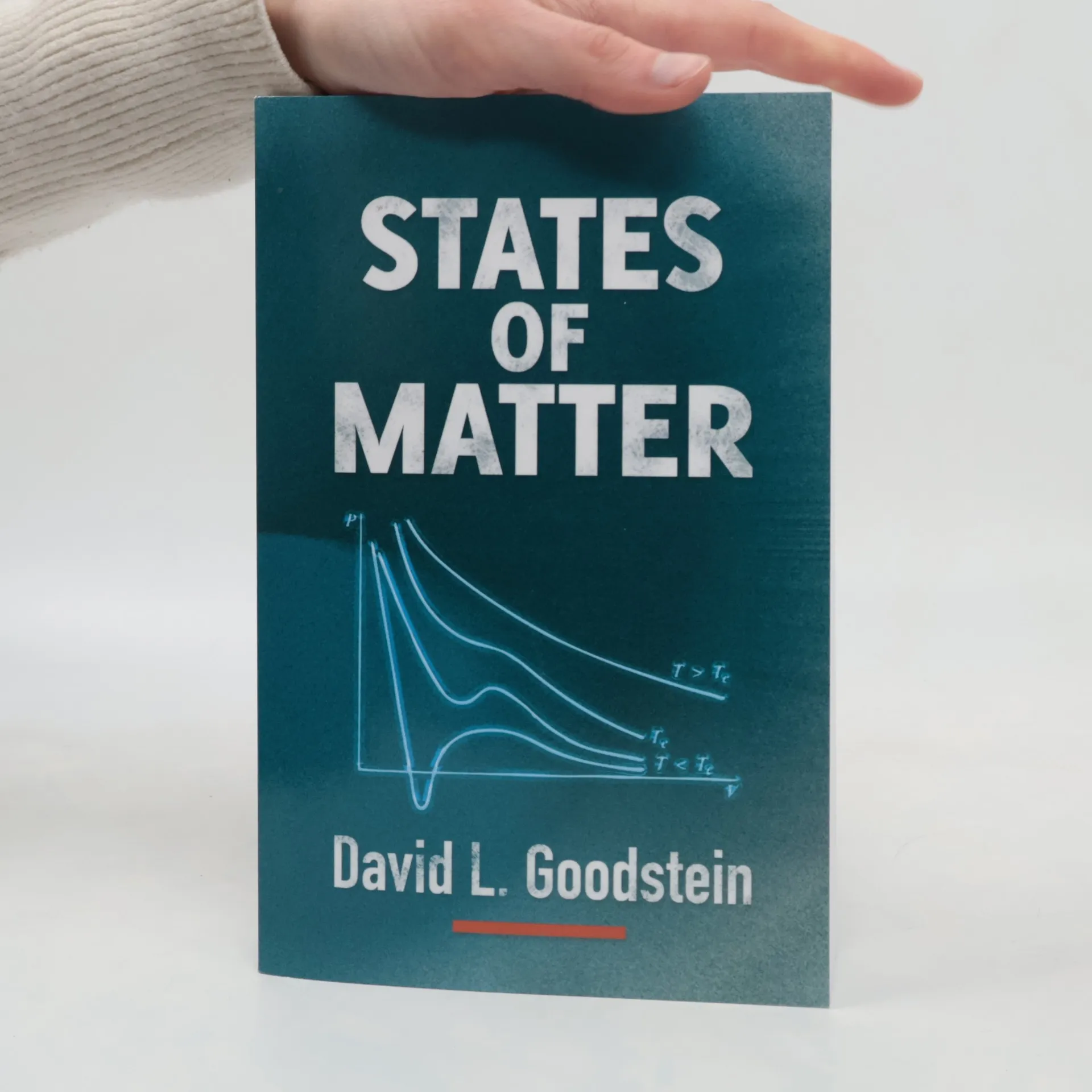
States of Matter
- 512 pages
- 18 hours of reading
This unique overview by a prominent CalTech physicist provides a modern, rigorous, and integrated treatment of the key physical principles and techniques related to gases, liquids, solids, and their phase transitions. No other single volume offers such comprehensive coverage of the subject, and the treatment consistently emphasizes areas in which research results are likely to be applicable to other disciples.Starting with a chapter on thermodynamics and statistical mechanics, the text proceeds to in-depth discussions of perfect gases, electrons in metals, Bose condensation, fluid structure, potential energy, Weiss molecular field theory, van der Waals equation, and other pertinent aspects of phase transitions. Many helpful illustrative problems appear at the end of each chapter, and annotated bibliographies offer further guidance.