
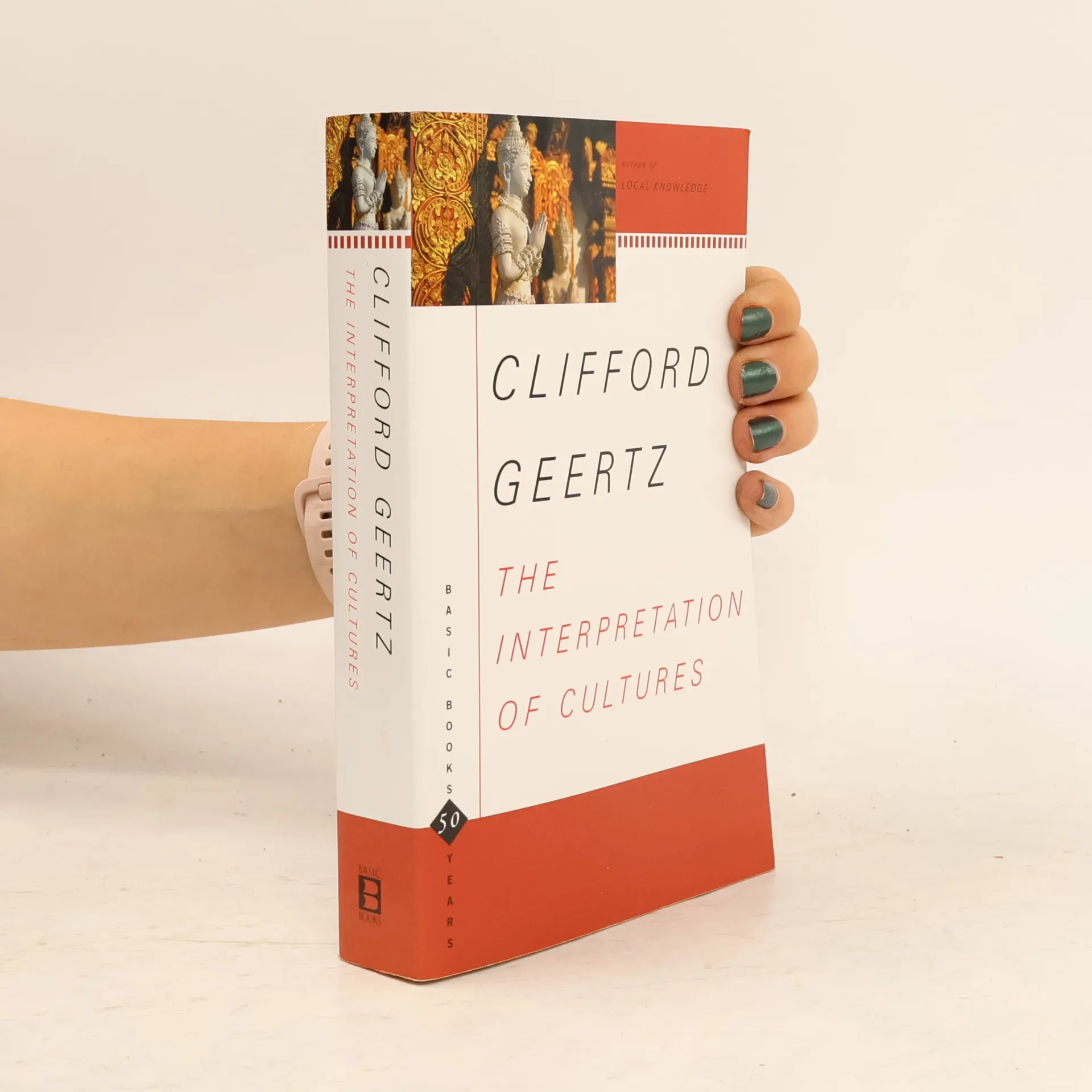
This author gained renown for his profound anthropological studies. His work focuses on the interpretation of cultures and human behavior. He was particularly dedicated to the detailed description and analysis of social phenomena.
In The Interpretation of Cultures, the most original anthropologist of his
generation moved far beyond the traditional confines of his discipline to
develop an important new concept of culture. This groundbreaking book, winner
of the 1974 Sorokin Award of the American Sociological Association, helped
define for an entire generation of anthropologists what their field is
ultimately about.
In essays covering everything from art and common sense to charisma and constructions of the self, the eminent cultural anthropologist and author of The Interpretation of Cultures deepens our understanding of human societies through the intimacies of "local knowledge." A companion volume to The Interpretation of Cultures , this book continues Geertz's exploration of the meaning of culture and the importance of shared cultural symbolism. With a new introduction by the author.
"In four brief chapters," writes Clifford Geertz in his preface, "I have attempted both to lay out a general framework for the comparative analysis of religion and to apply it to a study of the development of a supposedly single creed, Islam, in two quite contrasting civilizations, the Indonesian and the Moroccan." Mr. Geertz begins his argument by outlining the problem conceptually and providing an overview of the two countries. He then traces the evolution of their classical religious styles which, with disparate settings and unique histories, produced strikingly different spiritual climates. So in Morocco, the Islamic conception of life came to mean activism, moralism, and intense individuality, while in Indonesia the same concept emphasized aestheticism, inwardness, and the radical dissolution of personality. In order to assess the significance of these interesting developments, Mr. Geertz sets forth a series of theoretical observations concerning the social role of religion.
In looking back on four decades of anthropology in the field, Clifford Geertz creates a personal history that is also a retrospective reflection on developments in the human sciences amid political, social, and cultural changes in the world.
This work constitutes the first book-length examination of Balinese kinship in English and an important theoretical analysis of the central ethnographic concept of "kinship system." Hildred and Clifford Geertz's findings challenge the prevailing anthropological notion of a kinship system as an autonomous set of institutionalized social relationships. Their research in Bali suggests that kinship cannot be studied in isolation but must be perceived as a symbolic subsystem governed by ideas and beliefs unique to each culture.
Die in diesem Band enthaltenen Untersuchungen fragen alle, obgleich auf unterschiedliche thematische Schwerpunkte gerichtet, nach dem Wesen von Kultur, ihrer Rolle im sozialen Leben und ihrer adäquaten Untersuchung.
„. die vielleicht folgenreichste Entwicklung besteht in der Verwandlung der Welt in jenes allgegenwärtige Flickwerk, mit dem wir jetzt so plötzlich konfrontiert sind.“ Technologien und Marktmechanismen unterwerfen heute die Vielfalt der Kulturen einheitlichen Standards und lassen sie zu einer globalen Zivilisation zusammenwachsen. Mit dieser Globalisierung geht eine zunehmende Fragmentierung einher, die spätestens seit 1989 auch auf Europa übergesprungen ist. Das Ende der Blöcke hat zentrifugale Kräfte und Wanderungsströme freigesetzt, denen der klassische Rahmen des Nationalstaates immer weniger standzuhalten vermag; gleichzeitig scheint die europäische Integration ins Stocken zu geraten. Sind wir im Begriff, uns dem kulturellen Patchwork und den fraktalen Gesellschaften Asiens oder Afrikas anzuverwandeln? Droht das Programm des westlichen Liberalismus mit seinem Anspruch auf Universalität und Konsens zu scheitern?
Technologien und Marktmechanismen unterwerfen heute die Vielfalt der Kulturen einheitlichen Standards und lassen sie zu einer globalen Zivilisation zusammenwachsen. Mit dieser Globalisierung geht eine zunehmende Fragmentierung einher, die spätestens seit 1989 auch auf Europa übergesprungen ist. Das Ende der Blöcke hat zentrifugale Kräfte und Wanderungsströme freigesetzt, denen der klassische Rahmen des Nationalstaates immer weniger standzuhalten vermag; gleichzeitig scheint die europäische Integration ins Stocken zu geraten. Sind wir im Begriff, uns dem kulturellen Patchwork und den fraktalen Gesellschaften Asiens oder Afrikas anzuverwandeln? Droht das Programm des westlichen Liberalismus mit seinem Anspruch auf Universalität und Konsens zu scheitern? In seinen Wiener Vorlesungen kombiniert Geertz die Perspektive des Ethnologen mit aktuellen Debatten in der politischen Philosophie und fragt nach der Zukunft unserer eigenen Kultur.