

Explore the latest books of this year!
Bookbot

Thorstein Veblen

    July 30, 1857 – August 3, 1929

    Thorstein Bunde Veblen was a Norwegian-American economist and sociologist, celebrated as a witty critic of capitalism. He is famously known for the concept of "conspicuous consumption," alongside "conspicuous leisure," as means of demonstrating wealth and social status. Veblen is regarded as a leader of the institutional economics movement, and his distinction between "institutions" and "technology" remains known as the Veblenian dichotomy. As a prominent intellectual of the Progressive Era, Veblen critiqued production for profit, with his ideas significantly influencing socialist thinkers seeking non-Marxist critiques of capitalism.

    Thorstein Veblen
    The Socialist Economics of Karl Marx and His Followers
    An Inquiry into the Nature of Peace
    Conspicuous Consumption
    The Theory of the Leisure class
    Imperial Germany and the industrial revolution
    The Theory of Business Enterprise
    • The Theory of Business Enterprise

      • 192 pages
      • 7 hours of reading

      Examining the interplay between business practices and economic theory, this seminal work by Thorstein Veblen critiques the capitalist system. Published in 1904, it stands as one of Veblen's key contributions to economic thought, providing insights into how business enterprises operate within the broader economic landscape. Veblen's analysis challenges conventional perspectives, making it a significant text for understanding the dynamics of capitalism.

      The Theory of Business Enterprise
    • Although initiated before the U.S. entered World War I, this work primarily examines the cultural divergences between English-speaking and German-speaking peoples and their economic and social consequences. Initially suppressed by war censors, it was released post-war and has since become a significant contribution to economics and sociology. The insights within remain relevant today. Charles A. Beard remarked that the author wrote for the ages, placing this work alongside his renowned Theory of Business Enterprise. Wesley C. Mitchell noted that the underlying factors contributing to Germany's efficiency persisted even under the Nazi regime, suggesting that past forecasts may still hold true. Lewis Mumford described the work as the best depiction of the residual barbarisms in German civilization, highlighting the roots of Nazism. This new edition features a compelling opening essay by Otto G. Mayer, a director at a prominent German think tank and editor of an English-language journal. Mayer's commentary not only reflects on the original work but also addresses the historical context of the German economy and society, reinforcing the belief that this book remains "a treasure chest of knowledge."

      Imperial Germany and the industrial revolution
    • Veblen's study indicts the nineteenth-century socio-economic system which based class status on the accumulation of material wealth. More than a century after its original publication, his work still is of surprisingly high relevance, since it casts an astonishingly contemporary and often very satirical eye on American economics and society. Originally released in 1899, „The Theory of the Leisure Class“ is considered as the first detailed critique of consumerism.

      The Theory of the Leisure class
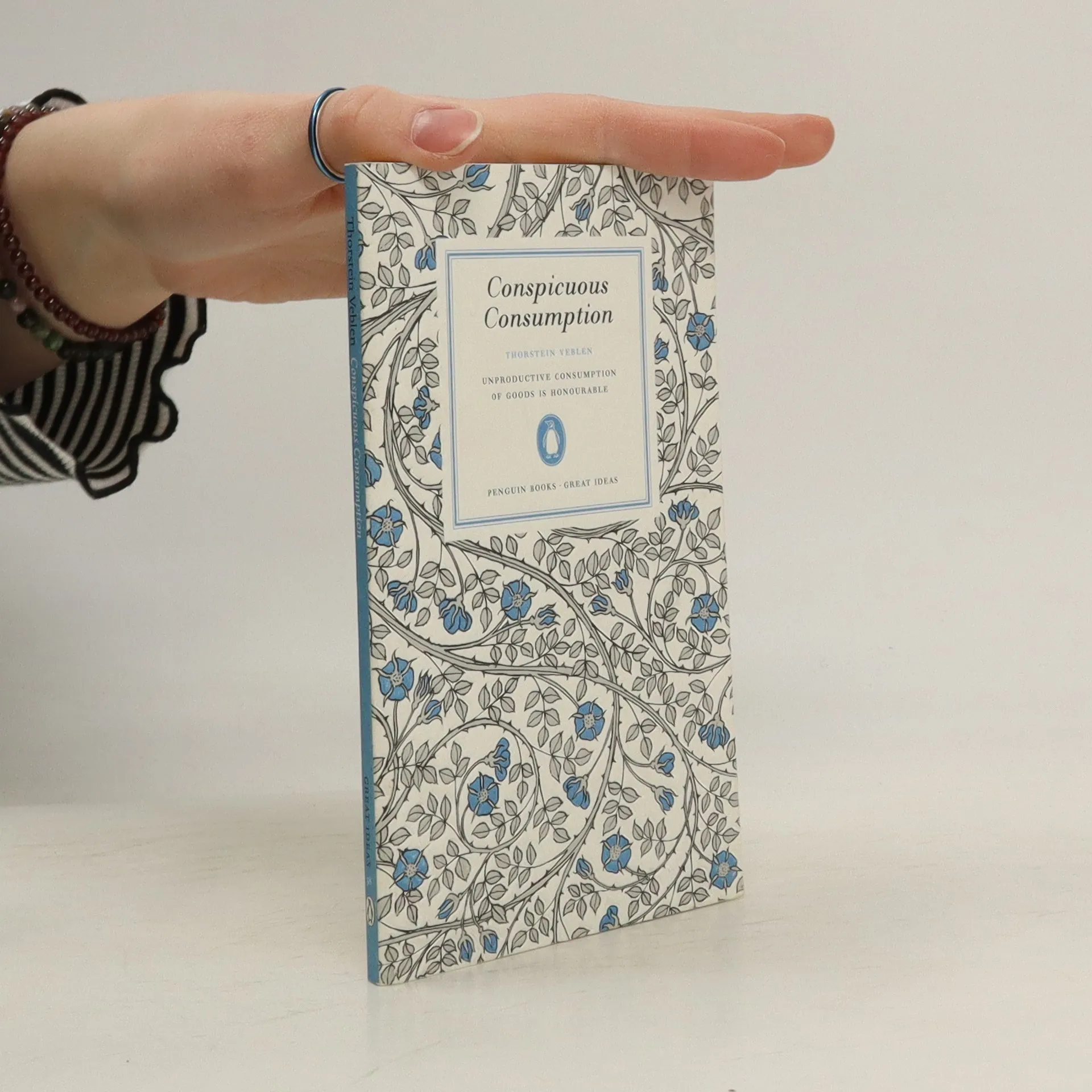
    • Conspicuous Consumption

      • 144 pages
      • 6 hours of reading
      3.4(62)Add rating

      Throughout history, some books have changed the world. They have transformed the way we see ourselves � and each other. They have inspired debate, dissent, war and revolution. They have enlightened, outraged, provoked and comforted. They have enriched lives � and destroyed them. Now Penguin brings you the works of the great thinkers, pioneers, radicals and visionaries whose ideas shook civilization and helped make us who we are. With its wry portrayal of a shallow, materialistic �leisure class� obsessed by clothes, cars, consumer goods and climbing the social ladder, this withering satire on modern capitalism is as pertinent today as when it was written over a century ago.

      Conspicuous Consumption
    • An Inquiry into the Nature of Peace

      and the Terms of Its Perpetuation

      • 230 pages
      • 9 hours of reading

      Focusing on the aftermath of World War I, this classic political science work explores the nature of peace and the conditions necessary for its lasting maintenance. It delves into the complexities of post-war relations and the frameworks that can sustain harmony among nations. Through a critical analysis, the book addresses the challenges and strategies for achieving enduring peace, making it a significant contribution to the discourse on international relations and conflict resolution.

      An Inquiry into the Nature of Peace
    • The book explores the logical framework of Marx's economic theories, emphasizing their systematic nature and coherence. It delves into the principles that underpin Marxist economics, highlighting the relevance and application of these theories in understanding contemporary economic issues. Through a detailed analysis, the author aims to illustrate how Marx's insights remain significant in today's economic discourse.

      The Socialist Economics of Karl Marx and His Followers
    • The Theory of the Leisure Class

      in large print

      • 400 pages
      • 14 hours of reading

      The book is a reproduction of a historical work, produced by Megali, a publishing house dedicated to creating large print editions. This initiative aims to enhance accessibility for readers with impaired vision, ensuring that important historical texts can be enjoyed by a wider audience.

      The Theory of the Leisure Class
    • The Theory of the Leisure Class is criticism of capitalism. Conspicuous consumption, along with "conspicuous leisure," is performed to demonstrate wealth or mark social status. The book is a treatise on economics and a detailed, social critique of conspicuous consumption, as a function of social class and of consumerism, derived from the social stratification of people and the division of labour, which are the social institutions of the feudal period (9th - 15th centuries) that have continued to the modern era. The book presents the evolutionary development of human institutions (social and economic) that shape society, such as how the citizens earn their livelihoods, wherein technology and the industrial arts are the creative forces of economic production. The sociology and economics applied by Veblen show the dynamic, intellectual influences of Charles Darwin, Karl Marx, Adam Smith, and Herbert Spencer; thus, his theories of socio-economics emphasize evolution and development as characteristics of human institutions. Thorstein Veblen (1857-1929) was an American economist and sociologist. He is well known as a witty critic of capitalism. Within the history of economic thought, Veblen is considered the leader of the institutional economics movement. Veblen's distinction between "institutions" and "technology" is still called the Veblenian dichotomy by contemporary economists.

      The Theory of the Leisure Class: An Economic Study of American Institutions and a Social Critique of Conspicuous Consumption: Ba
    • Die Theorie der privilegierten Klasse

      Die herrschende Klasse und ihr Luxusleben

      • 252 pages
      • 9 hours of reading

      Die Analyse der Dynamiken von Wohlstand und sozialem Status in kapitalistischen Gesellschaften steht im Mittelpunkt dieses wegweisenden Werks. Thorstein Veblen führt den Begriff des "sichtbaren Konsums" ein, um den Luxusverbrauch der oberen Klassen, der auf sozialem Prestige und nicht auf Notwendigkeit basiert, zu erläutern. Das Buch deckt die Mechanismen auf, die die privilegierten Klassen von der arbeitenden Bevölkerung abgrenzen, und bietet eine scharfe, kritische Perspektive auf die Funktionsweise des modernen Kapitalismus. Ein unverzichtbarer Klassiker der Sozialwissenschaften.

      Die Theorie der privilegierten Klasse