
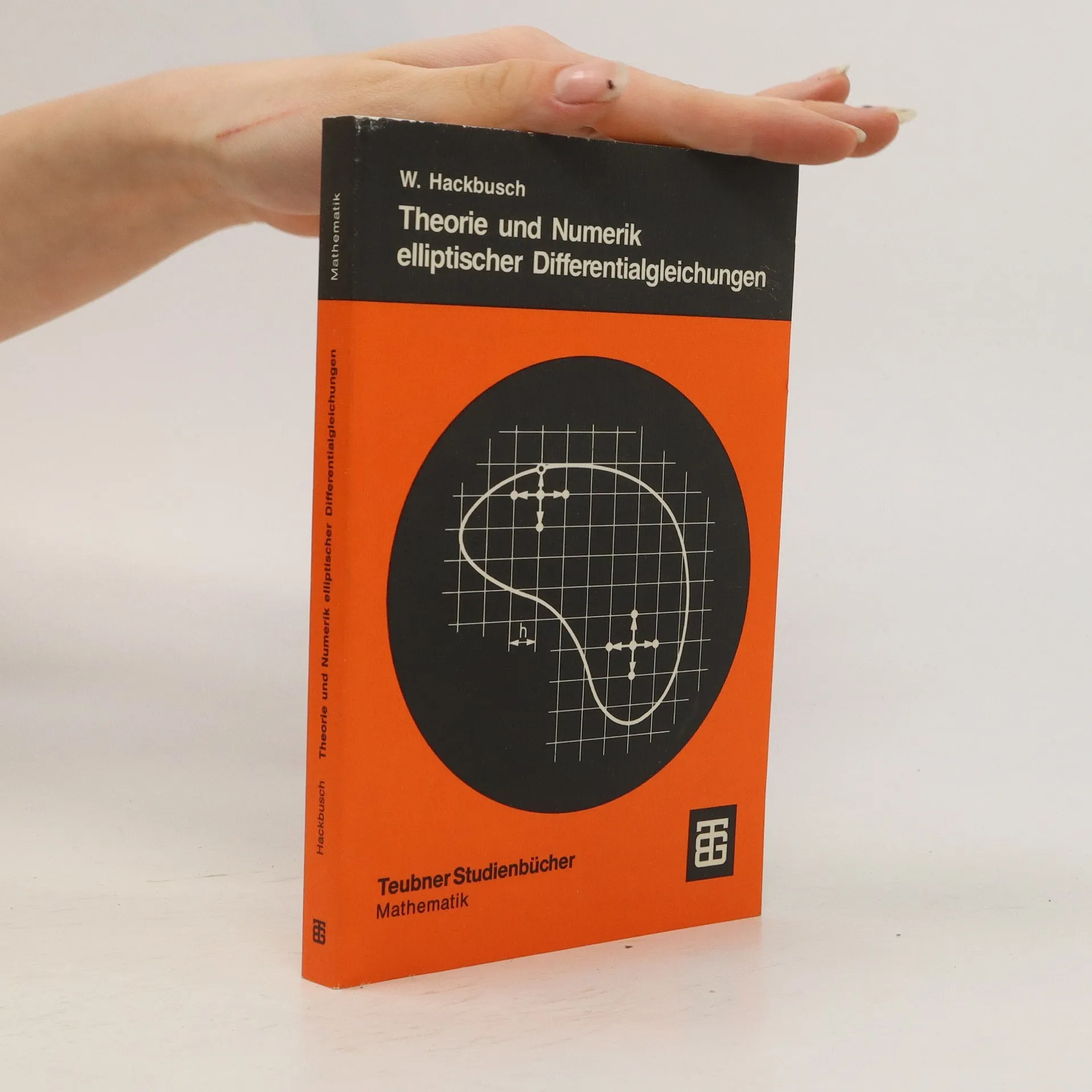

This book has developed from lectures that the author gave for mathematics students at the Ruhr-Universitat Bochum and the Christian-Albrechts-Uni versitat Kiel. This edition is the result of the translation and correction of the German edition entitled Theone und Numenk elliptischer Differential gleichungen. The present work is restricted to the theory of partial differential equa tions of elliptic type, which otherwise tends to be given a treatment which is either too superficial or too extensive. The following sketch shows what the problems are for elliptic differential equations. A: Theory of B: Discretisation: c: Numerical analysis elliptic Difference Methods, convergence, equations finite elements, etc. stability Elliptic Discrete boundary value equations f-------- ----- problems E: Theory of D: Equation solution: iteration Direct or with methods iteration methods The theory of elliptic differential equations (A) is concerned with ques tions of existence, uniqueness, and properties of solutions. The first problem of VI Foreword numerical treatment is the description of the discretisation procedures (B), which give finite-dimensional equations for approximations to the solu tions. The subsequent second part of the numerical treatment is numerical analysis (0) of the procedure in question. In particular it is necessary to find out if, and how fast, the approximation converges to the exact solution.
Wolfgang Hackbusch Books


Multi-Grid Methods and Applications
- 392 pages
- 14 hours of reading
Focusing on the efficiency of multi-grid methods for solving elliptic boundary value problems, this book provides an accessible introduction to multi-grid algorithms alongside a thorough convergence analysis. It includes special applications such as convection-diffusion equations and eigenvalue problems. A detailed presentation of the multi-grid method of the second kind is also featured, highlighting its significance in integral equations and various other issues. Both practical and theoretical readers will find valuable insights within its pages.
Tensor Spaces and Numerical Tensor Calculus
- 500 pages
- 18 hours of reading
Focusing on practical tensor methods, the book explores numerical operations applicable in various fields. It covers significant applications such as quantum chemistry, multivariate function approximation, and the solution of partial differential equations, providing readers with a comprehensive understanding of how to effectively utilize tensors in complex problem-solving scenarios.
Iterative Solution of Large Sparse Systems of Equations
- 536 pages
- 19 hours of reading
The second edition offers an in-depth exploration of both classical and modern methods of linear iteration, highlighting the often-overlooked algebraic structure. With the addition of four new chapters and updated references, it provides a comprehensive analysis that enhances understanding of the subject. This edition stands out by focusing on the theoretical underpinnings that are frequently neglected in other works, making it a valuable resource for readers seeking a deeper insight into linear iteration methods.
Hierarchical matrices: algorithms and analysis
- 536 pages
- 19 hours of reading
This self-contained monograph presents matrix algorithms and their analysis. The new technique enables not only the solution of linear systems but also the approximation of matrix functions, e. g., the matrix exponential. Other applications include the solution of matrix equations, e. g., the Lyapunov or Riccati equation. The required mathematical background can be found in the appendix. The numerical treatment of fully populated large-scale matrices is usually rather costly. However, the technique of hierarchical matrices makes it possible to store matrices and to perform matrix operations approximately with almost linear cost and a controllable degree of approximation error. For important classes of matrices, the computational cost increases only logarithmically with the approximation error. The operations provided include the matrix inversion and LU decomposition. Since large-scale linear algebra problems are standard in scientific computing, the subject of hierarchicalmatrices is of interest to scientists in computational mathematics, physics, chemistry and engineering.
The concept of stability in numerical mathematics
- 188 pages
- 7 hours of reading
In this book, the author compares the meaning of stability in different subfields of numerical mathematics. Concept of Stability in numerical mathematics opens by examining the stability of finite algorithms. A more precise definition of stability holds for quadrature and interpolation methods, which the following chapters focus on. The discussion then progresses to the numerical treatment of ordinary differential equations (ODEs). While one-step methods for ODEs are always stable, this is not the case for hyperbolic or parabolic differential equations, which are investigated next. The final chapters discuss stability for discretisations of elliptic differential equations and integral equations. In comparison among the subfields we discuss the practical importance of stability and the possible conflict between higher consistency order and stability.
Hierarchische Matrizen
Algorithmen und Analysis
Bei der Diskretisierung von Randwertaufgaben und Integralgleichungen entstehen große, eventuell auch voll besetzte Matrizen. In dem Band stellt der Autor eine neuartige Methode dar, die es erstmals erlaubt, solche Matrizen nicht nur effizient zu speichern, sondern auch alle Matrixoperationen einschließlich der Matrixinversion bzw. der Dreieckszerlegung approximativ durchzuführen. Anwendung findet diese Technik nicht nur bei der Lösung großer Gleichungssysteme, sondern auch bei Matrixgleichungen und der Berechnung von Matrixfunktionen.
InhaltsverzeichnisNotation.1 Partielle Differentialgleichungen und ihre Einteilung in Typen.2 Die Potentialgleichung.3 Die Poisson-Gleichung.4 Differenzenmethode für die Poisson-Gleichung.5 Allgemeine Randwertaufgaben.6 Exkurs über Funktionalanalysis.7 Variationsformulierung.8 Die Methode der finiten Elemente.9 Regularität der Lösung.10 Spezielle Differentialgleichungen.11 Eigenwertprobleme.12 Stokes-Gleichungen.
