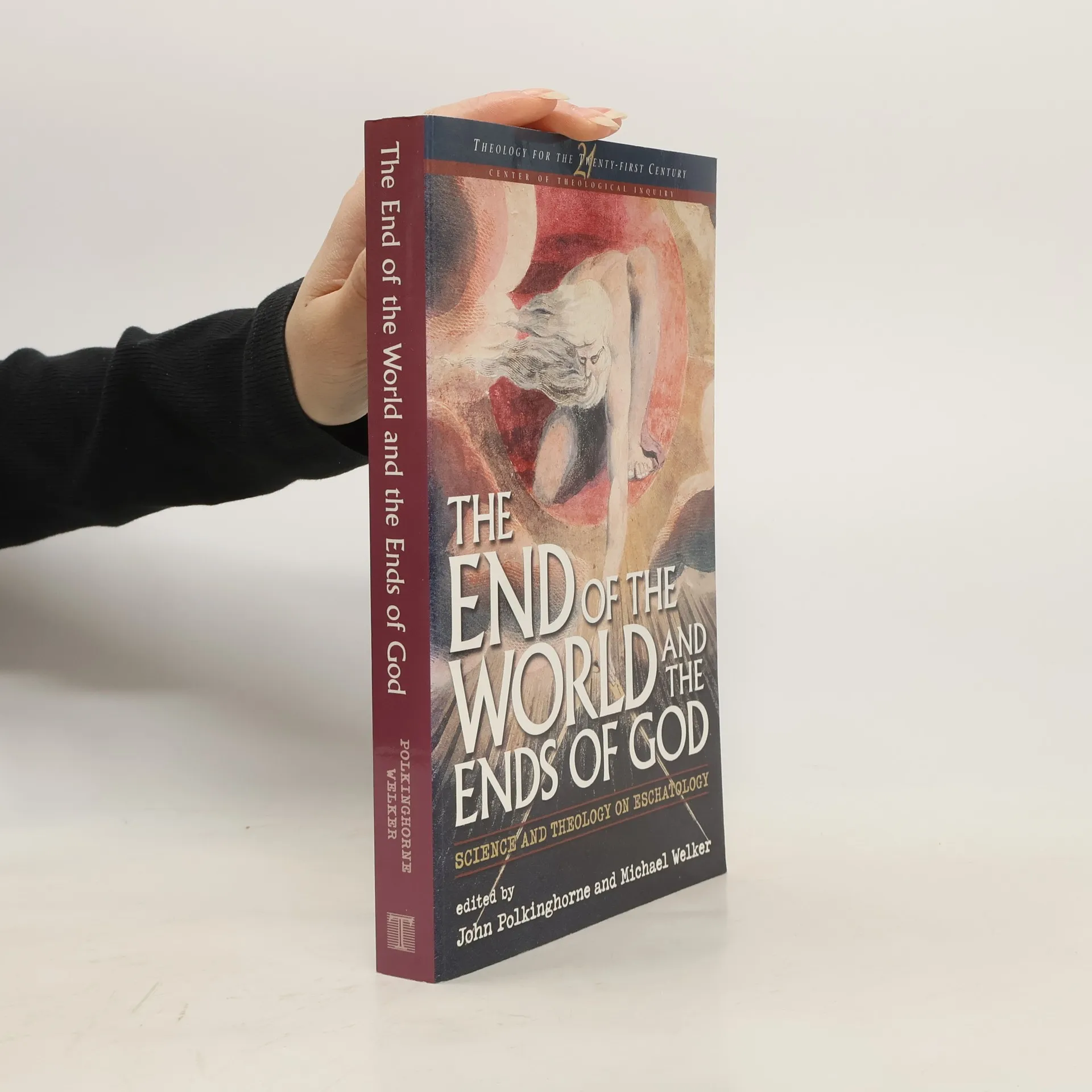
The end of the world and the ends of God
- 309 pages
- 11 hours of reading
In this volume, 16 scientists and theologians contend that eschatology provides a common concern for both theology and the sciences.


In this volume, 16 scientists and theologians contend that eschatology provides a common concern for both theology and the sciences.
Exploring the intersection of faith and reason, two authors with distinct backgrounds offer a dual perspective on theological questions. They emphasize truth and reliability over polemics and certainty, seeking to ground their discussions in concrete examples rather than abstract concepts. By addressing challenging questions and providing thoughtful reassurances, they engage with the complexities of belief. This second edition includes a new Preface and updated bibliographies, enhancing the original insights into their shared faith.
From the 2019/2020 Gifford Lectures at the University of Edinburgh In God's Image describes how centering our culture on the human and divine spirit can revitalize four universally acknowledged characteristics of a thriving human existence: justice, freedom, truth, and peace. Inspired not only by religious sources, but also by scientists, philosophers, economists, and legal and political theorists, Michael Welker develops the idea of a "multimodal" spirit that generates the possibility of living and acting in the image of God. Welker's new approach to natural theology explains why the human and the divine spirit cannot adequately be grasped in simple bipolar relations and why the human spirit should not be reduced to the rational mind. Addressing the question What is the calling of human beings? in the context of late modern pluralistic societies, he aims at explaining to believers and non-believers alike what it means to be persons created in the image of God, moved by a spirit of justice, freedom, truth, and peace.
This volume brings together leading theologians, biblical scholars, scientists, philosophers, ethicists, and others to explore the multidimensionality and depth of the human person. Moving away from dualistic (mind-body, spirit-flesh, naturalmental) anthropologies, the book's contributors examine human personhood in terms of a complex flesh-body-mind-heart-soul-conscience-reason-spirit spectrum. The Depth of the Human Person begins with a provocative essay on the question "Why is personhood conceptually difficult?" It then rises to the challenge of relating theological contributions on the subject to various scientific explorations. Finally, the book turns to contemporary theological-ethical challenges, discussing such subjects as human dignity, embodiment, gender stereotypes, and human personhood at the edges of life. Contributors: Maria Antonaccio Warren S. Brown Philip Clayton Volker Henning Drecoll Markus Hfner Origen V. Jathanna Malcolm Jeeves Isolde Karle Eiichi Katayanagi Andreas Kemmerling Stephan Kirste Bernd Oberdorfer John C. Polkinghorne Jeffrey P. Schloss Andreas Schle William Schweiker Gerd Theissen Gnter Thomas Frank Vogelsang Michael Welker
on Character Formation, Ethical Education, and the Communication of Values in Late Modern Pluralistic Societies
Pluralism has become the defining characteristic of many modern societies. Not only a plurality of individual and social claims and activities gain impacts on societal life. A creative pluralism of institutions and their norms profoundly shape our moral commitments and character - notably the family, the market, the media, and systems of law, religion, politics, research, education, health care, and defense. In the theoretical, empirical, and historical contributions to this volume, specialists on medicine, medical ethics, psychology, theology and health care discuss the many challenges that major transformations in their areas of expertise pose to the communication and orientation in late modern pluralistic societies. Contributors come from Germany, the USA and Australia.
This beautifully illustrated, compact volume traces the profile of 48 European cities in early Reformation times. It transports readers across Europe from Spain to Estonia, from Scotland to Romania, passing through many fascinating cities in the Reformation heartland of this continent. With finely drawn historical portraits and abundant pictorial material, the articles by different scholars also feature the most prominent Reformers who lived and worked in each city (including six dynamic women). Supplemented by an illustrated map of Europe, local websites and reading lists, Europa Reformata will serve as a guide for visitors and armchair travelers alike. By highlighting so many cities and pioneers of the Reformation, it makes a timely and unique contribution to the 500th anniversary of this groundbreaking movement. Der prächtige und doch handliche Band zeichnet die reformatorischen Profile von etwa vierzig europäischen Städten nach. Die Leser werden von Spanien über Zentraleuropa bis Estland und Finnland geführt, von Schottland und England bis nach Rumänien. Profilierte Texte und reiches Bildmaterial veranschaulichen das Wirken der berühmtesten Reformatoren – sowie der fünf Reformatorinnen – und stellen die Städte mit ihren Bauten und Zeugnissen aus der Reformationszeit vor Augen. Ergänzt durch eine bebilderte Europakarte und die Angabe von kirchlichen Adressen und Tourismusbüros, eignet sich der Band auch als Reiseführer auf den Spuren der Reformation in Europa. An diesem perfekten Geschenk zum 500. Reformationsjubiläum sollte niemand achtlos vorübergehen.
Die Untersuchung beleuchtet die Wechselwirkungen zwischen religiösen Denkweisen und rechtlichen Konzeptionen. Sie analysiert, wie religiöse Überzeugungen das Verständnis von Recht und Gerechtigkeit prägen und umgekehrt, wie rechtliche Rahmenbedingungen religiöse Praktiken beeinflussen können. Der Autor geht auf verschiedene historische und kulturelle Kontexte ein, um die komplexen Beziehungen zwischen Religion und Recht zu verdeutlichen und bietet einen interdisziplinären Ansatz zur Betrachtung dieser Thematik.
Eine Anthropologie des Geistes
Christologie