

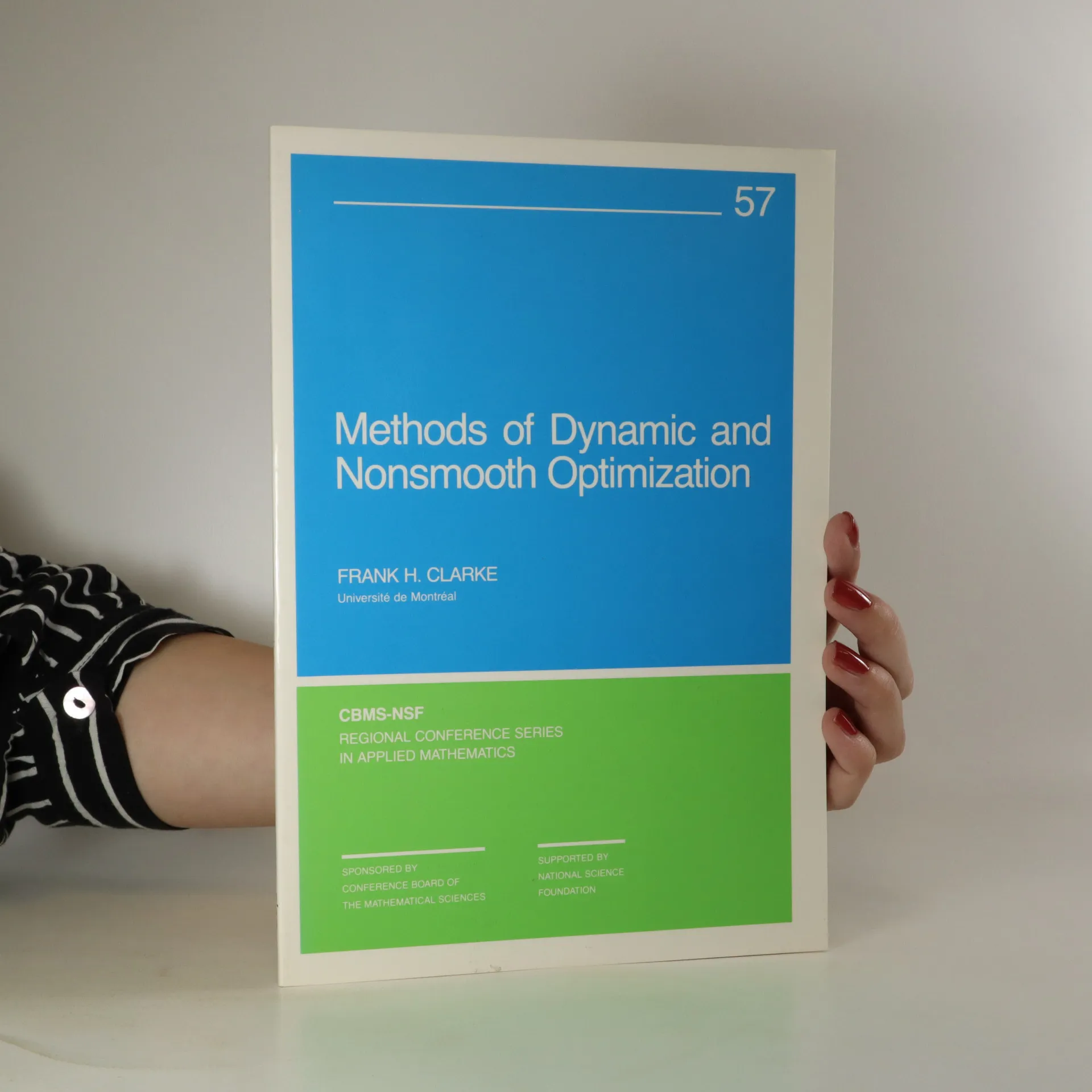
More about the book
Presents the elements of a unified approach to optimization based on "nonsmooth analysis," a term introduced in the 1970's by the author, who is a pioneer in the field. Based on a series of lectures given at a conference at Emory University in 1986, this volume presents its subjects in a self-contained and accessible manner. The topics treated here have been in an active state of development, and this work therefore incorporates more recent results than those presented in 1986. Focuses mainly on deterministic optimal control, the calculus of variations, and mathematical programming. In addition, it features a tutorial in nonsmooth analysis and geometry and demonstrates that the method of value function analysis via proximal normals is a powerful tool in the study of necessary conditions, sufficient conditions, controllability, and sensitivity analysis. The distinction between inductive and deductive methods, the use of Hamiltonians, the verification technique, and penalization are also emphasized.
Book purchase
Methods of dynamic and nonsmooth optimization, Frank H. Clarke
- Language

- Released
- 1989
Payment methods
No one has rated yet.
- Title
- Methods of dynamic and nonsmooth optimization
- Language
- English
- Authors
- Frank H. Clarke
- Released
- 1989
- Pages
- 95
- ISBN10
- 1611970148
- ISBN13
- 9781611970142
- Series
- Categories
- Tags
- Description
- Presents the elements of a unified approach to optimization based on "nonsmooth analysis," a term introduced in the 1970's by the author, who is a pioneer in the field. Based on a series of lectures given at a conference at Emory University in 1986, this volume presents its subjects in a self-contained and accessible manner. The topics treated here have been in an active state of development, and this work therefore incorporates more recent results than those presented in 1986. Focuses mainly on deterministic optimal control, the calculus of variations, and mathematical programming. In addition, it features a tutorial in nonsmooth analysis and geometry and demonstrates that the method of value function analysis via proximal normals is a powerful tool in the study of necessary conditions, sufficient conditions, controllability, and sensitivity analysis. The distinction between inductive and deductive methods, the use of Hamiltonians, the verification technique, and penalization are also emphasized.