

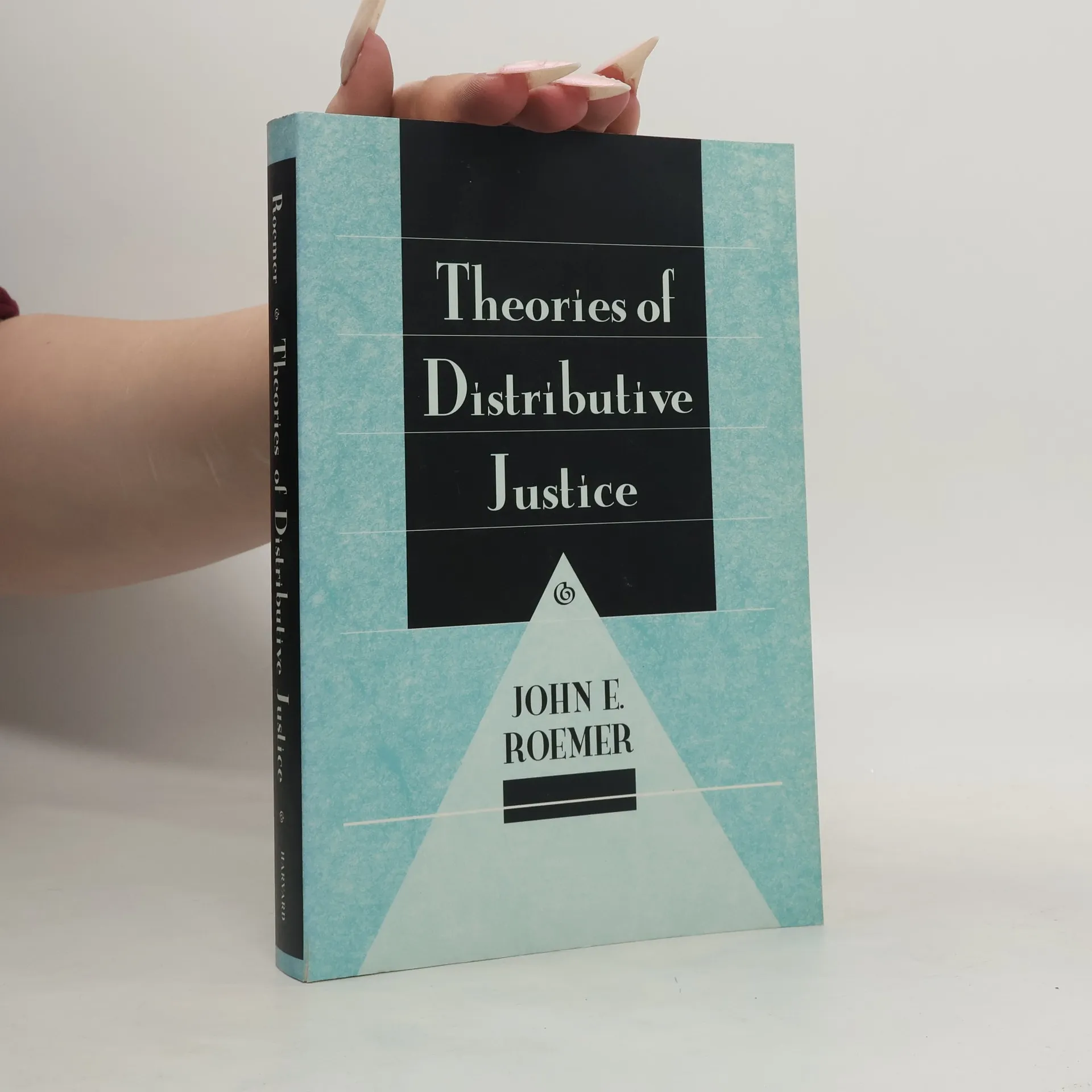


More about the book
John Roemer critiques economists' views on justice through a philosophical lens and vice versa, merging economic modeling with philosophical inquiry. His work encourages productive dialogue between philosophers and economists. Roemer enhances economists' understanding of fairness in resource allocation by extending social choice theory to aggregate individual preferences into social preferences. He challenges the standard applications of axiomatic bargaining theory, arguing they overlook crucial information about available resources and preference orderings. By incorporating these factors, he develops resource allocation mechanisms that align better with our intuitions about distributive justice. He also critiques utilitarianism and addresses the optimal population size in a resource-limited world. Roemer delves into key philosophical concepts in distributive justice—such as primary goods, functionings, capabilities, and various forms of responsibility—and illustrates how economic analysis can refine these ideas. He critiques and builds upon contemporary theories of justice from thinkers like Rawls, Sen, Nozick, and Dworkin, ultimately constructing a theory of equality of opportunity based on the insights of Arneson and G. A. Cohen. This work presents significant original findings and serves as a valuable graduate-level resource in both economics and philosophy.
Book purchase
Theories of Distributive Justice, John E Roemer
- Language

- Released
- 1996
- Binding
- (Paperback)
Payment methods
We’re missing your review here.
- Title
- Theories of Distributive Justice
- Language
- English
- Authors
- John E Roemer
- Publisher
- Harvard University Press
- Released
- 1996
- Format
- Paperback
- Pages
- 352
- ISBN10
- 0674879201
- ISBN13
- 9780674879201
- Series
- Tags
- Business
- Rating
- 3.95 out of 5
- Description
- John Roemer critiques economists' views on justice through a philosophical lens and vice versa, merging economic modeling with philosophical inquiry. His work encourages productive dialogue between philosophers and economists. Roemer enhances economists' understanding of fairness in resource allocation by extending social choice theory to aggregate individual preferences into social preferences. He challenges the standard applications of axiomatic bargaining theory, arguing they overlook crucial information about available resources and preference orderings. By incorporating these factors, he develops resource allocation mechanisms that align better with our intuitions about distributive justice. He also critiques utilitarianism and addresses the optimal population size in a resource-limited world. Roemer delves into key philosophical concepts in distributive justice—such as primary goods, functionings, capabilities, and various forms of responsibility—and illustrates how economic analysis can refine these ideas. He critiques and builds upon contemporary theories of justice from thinkers like Rawls, Sen, Nozick, and Dworkin, ultimately constructing a theory of equality of opportunity based on the insights of Arneson and G. A. Cohen. This work presents significant original findings and serves as a valuable graduate-level resource in both economics and philosophy.