

More about the book
Advances in physics, computers, and mathematics have made it possible to illustrate an astonishing array of potential behavior that can occur when nonlinear interactions are present. As Prigogine explains from a physicist's perspective, the fundamental role of instability and boundedrationality provide more precise understanding for evolution and changes. This volume considers these developments from various fields in the context of economic science. The work starts with a general non-mathematical discussion, introducing the major themes--nonlinearity, dynamical systems, andevolution in economic processes. The work continues with nonlinear analysis of macroeconomic growth and fluctuations. It describes analyses of economic adaptation, learning, and self-organization. The volume also scrutinizes a specific market--equities using nonlinear analysis, controlledexperiments, and statistical inference when nonlinearity plays an essential role in data generation. The volume closes with an historical reflection by Richard Goodwin and a roundtable discussion on basic issues and new challenges in nonlinear economic dynamics.
Book purchase
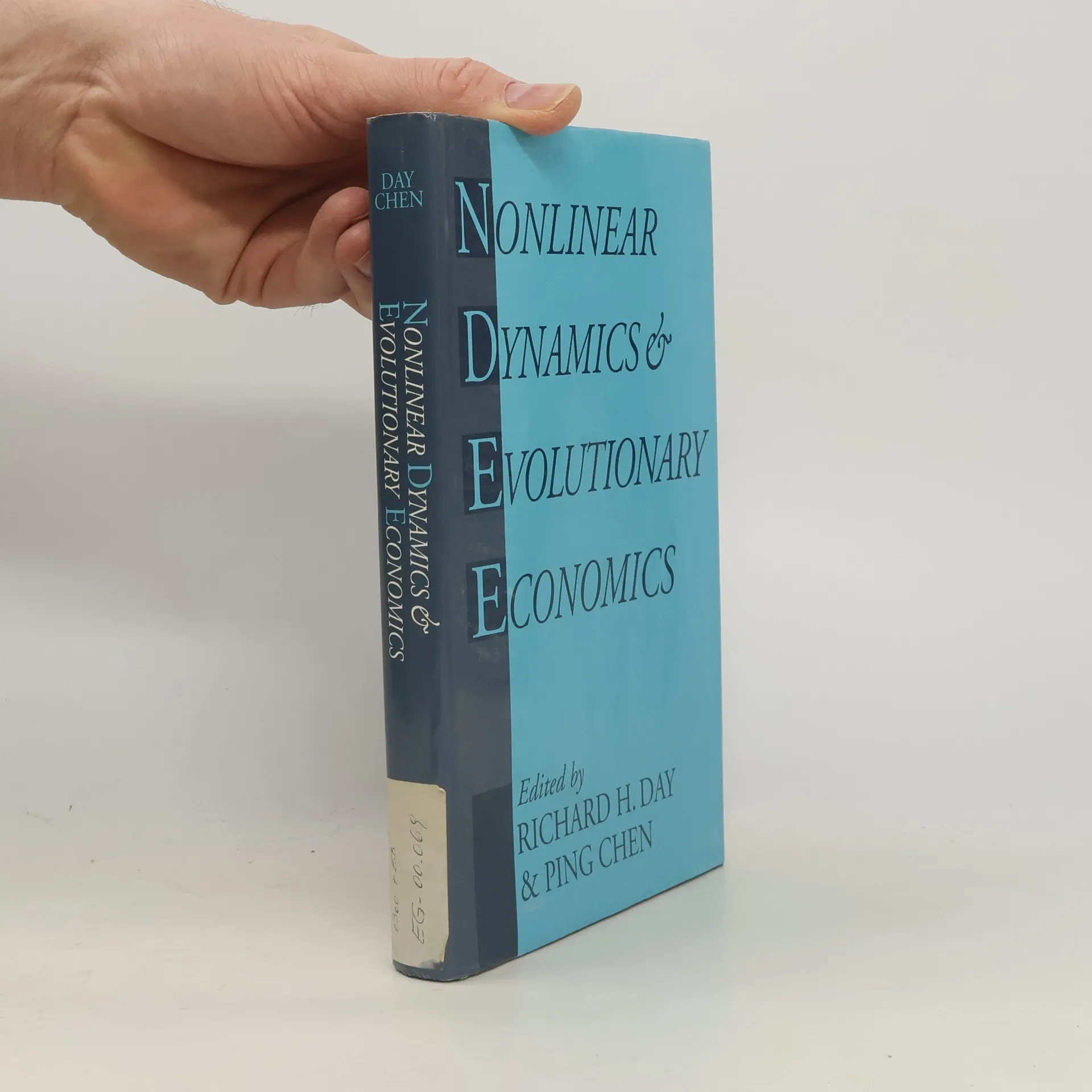
Nonlinear Dynamics and Evolutionary Economics, Richard Hollis Day, Ying-ping Chen
- Language

- Released
- 1993
- Binding
- (Hardcover)
Payment methods
No one has rated yet.
- Title
- Nonlinear Dynamics and Evolutionary Economics
- Language
- English
- Authors
- Richard Hollis Day, Ying-ping Chen
- Publisher
- Oxford University Press
- Released
- 1993
- Format
- Hardcover
- Pages
- 352
- ISBN10
- 0195078594
- ISBN13
- 9780195078596
- Series
- Description
- Advances in physics, computers, and mathematics have made it possible to illustrate an astonishing array of potential behavior that can occur when nonlinear interactions are present. As Prigogine explains from a physicist's perspective, the fundamental role of instability and boundedrationality provide more precise understanding for evolution and changes. This volume considers these developments from various fields in the context of economic science. The work starts with a general non-mathematical discussion, introducing the major themes--nonlinearity, dynamical systems, andevolution in economic processes. The work continues with nonlinear analysis of macroeconomic growth and fluctuations. It describes analyses of economic adaptation, learning, and self-organization. The volume also scrutinizes a specific market--equities using nonlinear analysis, controlledexperiments, and statistical inference when nonlinearity plays an essential role in data generation. The volume closes with an historical reflection by Richard Goodwin and a roundtable discussion on basic issues and new challenges in nonlinear economic dynamics.