




More about the book
Montesquieu's characteristic is not the strangeness of his subject, but his understanding of it. He only wanted to comprehend. We have a few glimpses that show this effort and pride. He delved into countless documents and texts, into the infinite heritage of the past, historical books, and documents, solely to grasp their logic and reason. He aimed to catch and unravel the thread tangled by centuries. He was unraveling. At first, he saw himself as lost in this small universe, like a ship adrift in a boundless sea. He wanted the shores of the sea to exist, to reach and dock at these shores. He was docking. No one had ventured into this adventure before him. One must believe that this man, who loved ships enough to think about the drawing of their hulls, the height of their masts, and their speeds, was akin to all fearless sailors, as he engaged in overseas journeys that traced the Carthaginians along the African coasts and the Spaniards to India (America). Seeing himself within the vastness of his subject, it is not in vain that he remembers these things: the last sentence of his book is a celebration of the approaching shore. It is true that he moved toward the unknown. But for this sailor, the unknown was also new land.
Book purchase
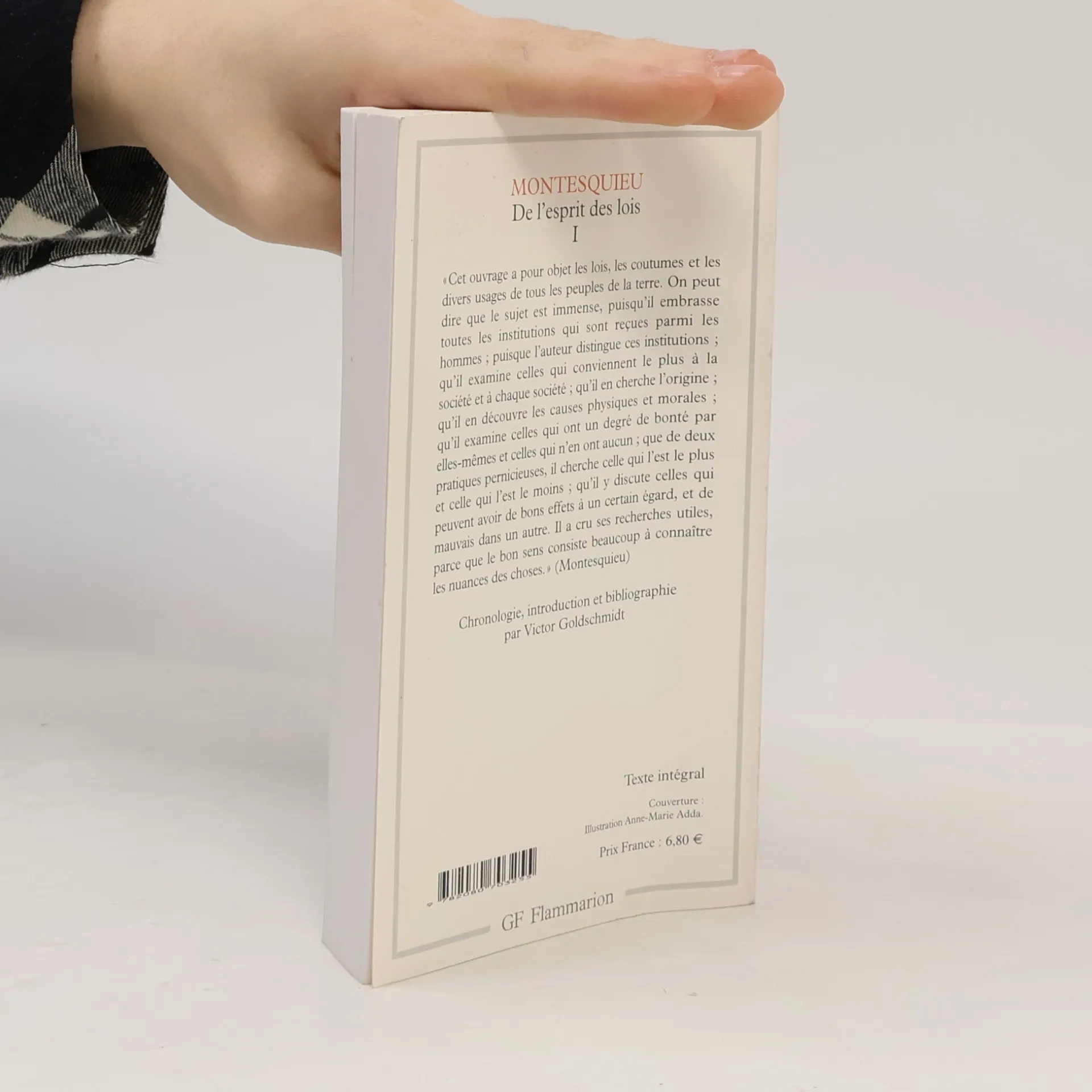
De l'esprit des lois 1, Charles de Secondat, Baron de Montesquieu
- Language

- Released
- 1980
- Binding
- (Paperback),
- Book condition
- Damaged
- Price
- €2.38
Payment methods
We’re missing your review here.
- Title
- De l'esprit des lois 1
- Language
- English
- Publisher
- Éditions Flammarion
- Released
- 1980
- Format
- Paperback
- Pages
- 486
- ISBN10
- 2080703250
- ISBN13
- 9782080703255
- Series
- Rating
- 3.9 out of 5
- Description
- Montesquieu's characteristic is not the strangeness of his subject, but his understanding of it. He only wanted to comprehend. We have a few glimpses that show this effort and pride. He delved into countless documents and texts, into the infinite heritage of the past, historical books, and documents, solely to grasp their logic and reason. He aimed to catch and unravel the thread tangled by centuries. He was unraveling. At first, he saw himself as lost in this small universe, like a ship adrift in a boundless sea. He wanted the shores of the sea to exist, to reach and dock at these shores. He was docking. No one had ventured into this adventure before him. One must believe that this man, who loved ships enough to think about the drawing of their hulls, the height of their masts, and their speeds, was akin to all fearless sailors, as he engaged in overseas journeys that traced the Carthaginians along the African coasts and the Spaniards to India (America). Seeing himself within the vastness of his subject, it is not in vain that he remembers these things: the last sentence of his book is a celebration of the approaching shore. It is true that he moved toward the unknown. But for this sailor, the unknown was also new land.